Community Corner
VIDEO: 'There's No Crying in Baseball,' and Pepper Davis Should Know
The Van Nuys resident says today's baseball players are pampered and never could have made it in her day.


Pepper Paire Davis, attached to an oxygen tank, sat in her purple wheelchair on Monday dressed in a white baseball uniform and a red cap filled with collector pins.
Her walking stick, decorated with an American flag decal, was by her side while she recounted the decade she spent as a shortstop and catcher on a women’s league baseball team during World War II that traveled to the small towns across America while the men were at war.
The crowd of about 30 members of the Chatsworth Community Coordinating
Council listened intently and broke out in laughter as Davis poked fun at today’s rich, pampered baseball players. It was tough for her team back in the 1940s as they traveled in buses without restrooms, music, air conditioning or reclining seats.
Find out what's happening in Northridge-Chatsworthfor free with the latest updates from Patch.
“The bus didn’t have a potty. If you had to go, you had to find tall corn fields,” said Davis, now 86 and living in Van Nuys. “The guys today couldn’t hack what we went through. They have a 2 1/2-hour plane ride and they tire. We loved it. We were playing baseball, making money, helping the war effort and keeping baseball alive.”
When major league baseball lost many of its players to the military in World War II, women played hardball in dresses instead of softball in long pants. Sliding into base was painful, often leaving sores that reopened time and again before they were finally able to heal.
Find out what's happening in Northridge-Chatsworthfor free with the latest updates from Patch.
Davis made $55 a week playing for the All-American Girls Professional Baseball League.
She said teams played a game every night and double-headers on Saturday and Sunday. She never had a day off in 10 years except when the team visited hospitals—where they played exhibition games—two or three times a year.
“That was routine. Major leagues today would never have made it,” she said. “In 4 1/2 months we played between 110 and 130 games. There’s no crying in baseball. You cried in your room at night after shutting off the lights and laying your head on the pillow.”
Davis said she even played with a broken finger one season.
Women’s baseball evolved over the years, and the women with it.
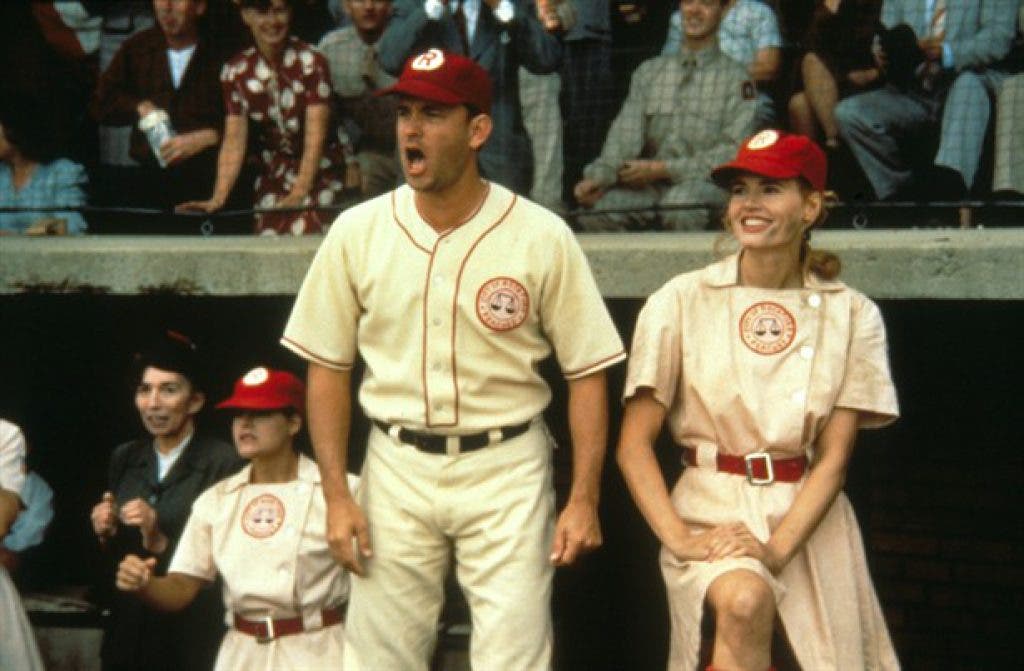
The women’s league story was told in the 1992 Hollywood movie A League of
Their Own, directed by Penny Marshall and starring Geena Davis, Tom Hanks,
Madonna, Rosie O’Donnell and Lori Petty.
Geena Davis (no relation) played Pepper, who became an author this fall writing her first book, Dirt in the Skirt.
Pepper Davis, who also spoke recently at the Chatsworth Historial Society, said the movie was 80 percent factual.
She said Marshall did an amazing job taking 10 years and boiling it down to one
year in a two-hour film. She also said some of the facts were blended together for the sake of the movie.
Davis was working as a waitress in the San Fernando Valley when the movie began production. She was hired as a consultant.
“It took 60 years to tell our story,” Davis said, adding that major league baseball was always jealous and didn’t want to admit that the women’s teams succeeded. During the 1940s, when towns were losing minor league baseball teams as the war broke out, women were called in to keep baseball alive. "We were first in their hearts and on their front pages in all the small towns we played in. We kept baseball alive for them.”
Davis began as a shortstop and then moved into a catcher position with the All-American Girls league. She was sassy back in the day, and got into innocent trouble with her teammates.
On Monday, she recalled the time she and the other players met a bunch of sailors during one of the team’s tours. The sailors invited her and her friends back to a submarine and were given a sail around the bay.
"We broke a million regulations that night,” Davis said.
The league, the only women's pro baseball league to ever exist, disbanded when the troops returned home from the war and as the female players left due to injuries, jobs and a return to their families and former lives.
Pepper Davis: The Early Years
Born Lavone Paire in West Los Angeles, Pepper was given her nickname by the boys who teased her because of her red hair. They’d call her "Red Pepper" and eventually only the Pepper part stuck, she said.
Pepper grew up during the depths of the Depression. Families were very poor, but because they didn’t realize what they were missing, they were perfectly happy, she said.
They made new soles for their shoes out of cardboard and shined the tops of them to make them look good. They also made their own toys and on occasion received a special toy at Christmas.
Her mother made dresses out of lima bean sacks.
She got into baseball when she was 8 or 9 years old. Her brother was 18 months older. As the story goes, when it was time to choose sides for a pickup game at a sandlot, her brother would only accept if the team agreed to take his sister on the team too.
Then the roles were reversed. Davis said she had a strong throwing arm and natural talent.
Davis was a graduate of University High School, where Marilyn Monroe was a classmate.
“People still call to buy my yearbook,” she said.
After graduating from high school, she got a job building airplanes at Lockheed in Culver City, and graduated from UCLA with a degree in English when a scout announced he was starting a major baseball league for women.
“We thought we died and went to heaven,” Davis said. “Off I went. I just turned 18.”
She later married and raised three children.
“Back then my hair was red and my eyes were blue, now my eyes are red and my hair is blue, Davis said, drawing laughter from the crowd. “The engine is still the same inside. The accessories went to pot.”
For the women in the league at that time, transferring to hardball from softball was easy. They evolved and learned on the job.
"The [field] was [set up] between a softball game and a [hardball] game. First the mound was moved back, then the bases … and pitching went from under arm to side arm to overhand,” Davis said.
After the women’s league gained fame and original players left for a variety of reasons, the newer players had difficulty transitioning.
The fans noticed the difference in the quality of play and decided to find other pastimes. And soon, the league was gone.
Visit pepperpairedavis.com for more information.