Community Corner
Unexpected Calif. Fire Hazard Spreads Across Golden State
The stunning fields of yellow blooms dotting the state's landscape are an invasive plant and a potential timebomb come the wildfire season.


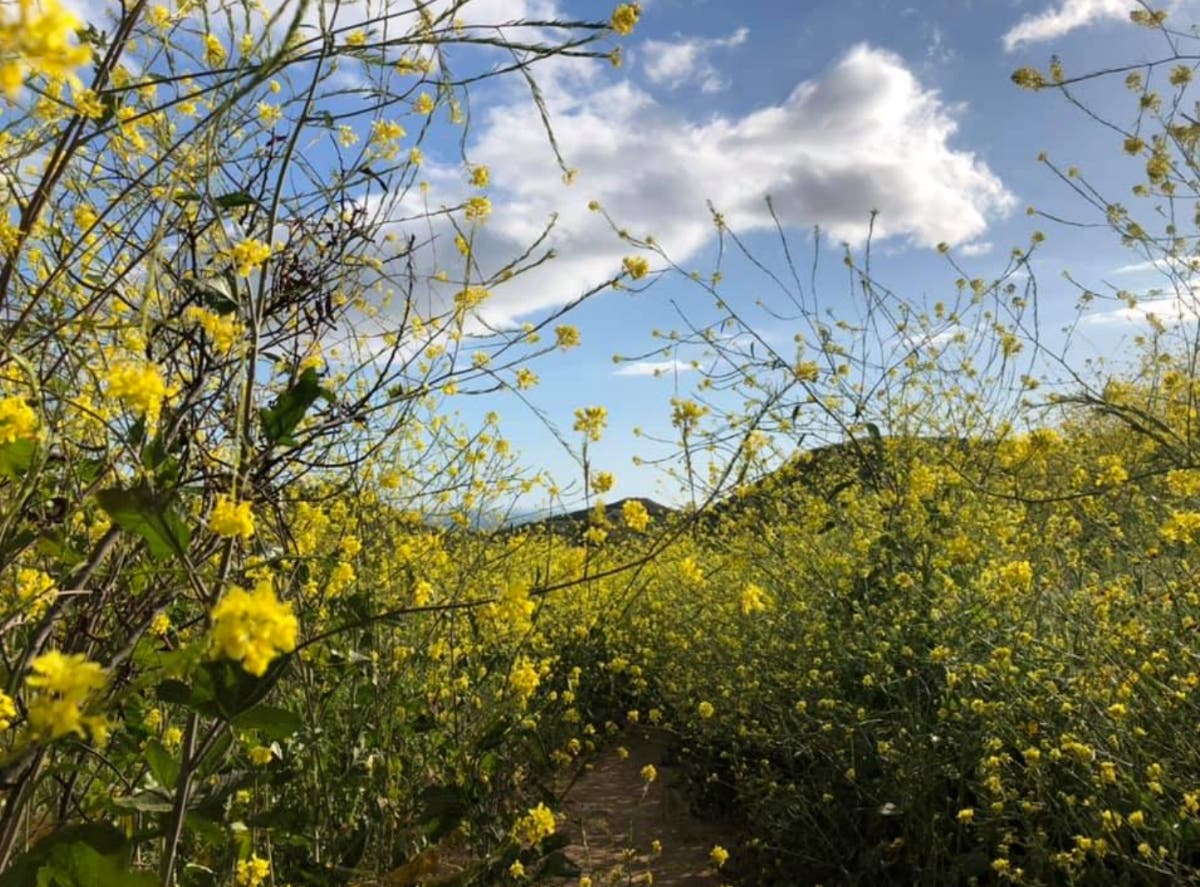
LOS ANGELES, CA — The Super Bloom that made for such an unforgettable spring is likely to make for an equally memorable fire season, biologists and fire officials warn. In fact, the striking flower that’s still blooming across miles of hillsides up and down California — Brassica nigra or invasive black mustard — is likely to pose serious problems when the wildfires return.
"As the saying goes, 'All that glitters is not gold,'” the National Park Service warned on its facebook page.
The bright yellow plant grows up to 10-feet-tall before drying out in the warm months, making what firefighters describe as a “fire ladder” carrying flames up to taller trees and structures. And right now, it’s everywhere. Mustard proliferated in Napa Valley after the 2017 firestorms, down the central coast and through the Santa Monica Mountains after last year’s Woolsey Fire. Miles of mustard yellow hillsides currently dazzle from south Orange County through San Diego.
Find out what's happening in Northridge-Chatsworthfor free with the latest updates from Patch.
Though it’s stunning today, it might as well be tinder come September.
"In a couple of months, the mustard will dry out, turn brown and become tinder for wildfire," Joseph Algiers, a restoration ecologist for the Santa Monica Mountains National Recreation Area, told NBC4. "Sadly, newly burned sites are more subject to invasion."
Find out what's happening in Northridge-Chatsworthfor free with the latest updates from Patch.
That’s a problem in the Santa Monica Mountains where the Woolsey Fire burned about 96,949 acres last year. The mustard plant’s seeds can lie dormant for decades, but a wildfire primes the landscape for the invasive mustard to bloom again. Last year’s catastrophic wildfires combined with the unusually wet winter to ensure a spectacular year for wildflower blooms and mustard, in particular. The seeds took root in the winter and quickly edged out native species. Today the mustard fields are among the most dominant blooms. As hundreds of thousands thronged to see the superbloom, biologists saw an invasive species flexing its muscles.
“It is something people tend to misunderstand,” Jutta Burger, the science program director for the California Invasive Plant Council told the Los Angeles Times. “They see a nice yellow field in the distance. On closer inspection, it is a mustard field.”
The plants will drop thousands of seeds, and will be among the first to bounce back after a fire, she explained.
“It is a vicious cycle,” Burger told the newspaper.
Algiers, the restoration ecologist, said the plant is already so widespread, it’s not likely it can be managed.
"It would probably be easier to get another man on the moon than to get rid of this invasive plant on a regional scale," Algiers told NBC4.
Still ecologists hope to make the best out of a bad situation, working in burn scar areas to replace scorched hillsides with native plants such as coastal sagebrush. The National Park Service officials are also seeking volunteers to help scale back the invasive plants.
"There are over 300 non-native species in the Santa Monica Mountains. A core group of them are considered the ‘evil 25’ and along with park staff and volunteers, there is an effort being made to combat the spread of these non-natives," according to the National Park Service.
Residents living near national parks, open spaces and wildfire burns scars, can also do their part by choosing native plants for their yards.
Get more local news delivered straight to your inbox. Sign up for free Patch newsletters and alerts.