Seasonal & Holidays
February’s Full Snow Moon Rises Over Oceanside On Wednesday
The Full Snow Moon will reach peak illumination just before midnight on Wednesday, with clear skies predicted over Oceanside.

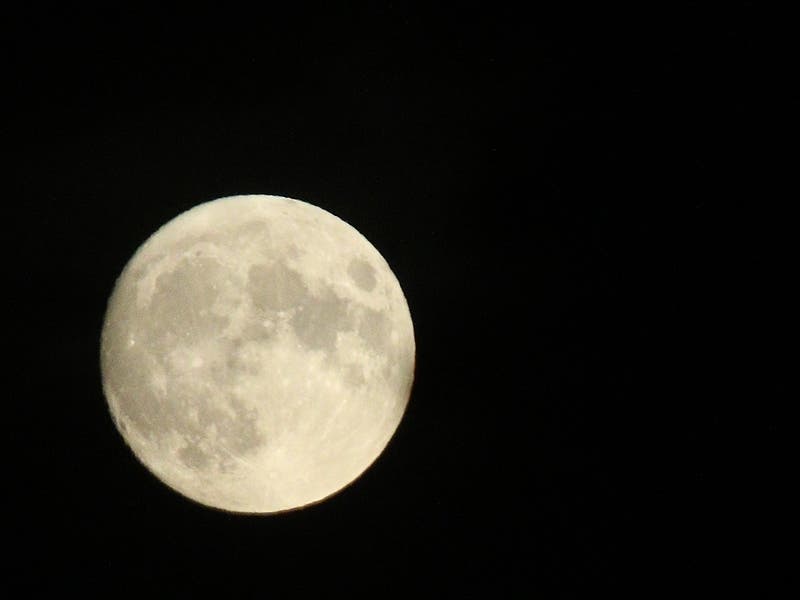
OCEANSIDE, CA — The National Weather Service predicts clear skies over Oceanside for Wednesday's Full Snow Moon.
According to the Old Farmer's Almanac, the February Full Snow Moon reaches peak illumination at 11:59 A.M. EST on Wednesday, February 16. For the best view of this Moon, look for it that night or the night before; it will drift above the horizon in the east around sunset and reach its highest point in the sky around midnight. See when the Moon will be visible in your area.
Why Is It Called the Snow Moon?
Find out what's happening in Oceanside-Camp Pendletonfor free with the latest updates from Patch.
The full Moon names used by The Old Farmer’s Almanac come from a number of places, including Native American, Colonial American, and European sources. Traditionally, each full Moon name was applied to the entire lunar month in which it occurred, not just to the full Moon itself.
The explanation behind February’s full Moon name is a fairly straightforward one: it’s known as the Snow Moon due to the typically heavy snowfall that occurs in February. On average, February is the United States’ snowiest month, according to data from the National Weather Service. In the 1760s, Captain Jonathan Carver, who had visited with the Naudowessie (Dakota), wrote that the name used for this period was the Snow Moon, “because more snow commonly falls during this month than any other in the winter.”
Find out what's happening in Oceanside-Camp Pendletonfor free with the latest updates from Patch.
Names for this month’s Moon have historically had a connection to animals. The Cree traditionally called this the Bald Eagle Moon or Eagle Moon. The Ojibwe Bear Moon and Tlingit Black Bear Moon refer to the time when bear cubs are born. The Dakota also call this the Raccoon Moon, certain Algonquin peoples named it the Groundhog Moon, and the Haida named it Goose Moon.
View a video from Old Farmer's Almanac about the February Full Snow Moon
Below, find a rundown of meteor showers, full moons and supermoons, and other celestial events to put on your 2022 calendar. This guide is curated from NASA, The Old Farmer's Almanac, the American Meteor Society and Sea and Sky.
2022 Meteor Shower Peak Dates
Unless otherwise noted, meteor showers are best viewed between midnight and dawn, as far away from city lights as possible. If you're planning 2022 meteor-watching excursions, check out dark sky locations.
Lyrids, April 22-23: Running April 16-23, the Lyrids meteor shower is an average shower, offering about 20 shooting stars an hour at the peak. The moon will still be bright, and that may wash out fainter meteors — but the Lyrids are known to produce bright dust trails that last for several seconds. The Lyrids are produced by dust particles left behind by the comet C/1861 G1 Thatcher.
Eta Aquarids, May 6-7: This above-average meteor shower runs from April 19-May 28. The best place to see it is in the Southern Hemisphere, where it produces about 60 meteors an hour, but it's a decent show in the Northern Hemisphere, too, and viewers in this part of the world can expect to see about half that many. Comet Haley is the parent of this meteor shower, which has been observed since ancient times.
Delta Aquarids, July 28-29: This shower runs from July 12-Aug. 2 and produces about 20 meteors an hour at the peak. A new moon means dark skies, so viewing conditions should be excellent for this shower, which is produced by debris left behind by the comets Marsden and Kracht.
Perseids, Aug. 12-13: Famous for producing a large number of fireballs, the Perseids meteor shower is regarded as one of the best of the year. The shower runs July 17-Aug. 24 and produces up to 60 shooting stars an hour at the peak. The shower, discovered in 1862, is produced by the comet 109/P Swift-Tuttle. A nearly full moon will cause viewing problems, but the Perseids are so bright that skywatchers should still get a good show.
Draconids, Oct. 7: This is the one meteor shower of the year that is best viewed in the early evening hours. A minor meteor shower that runs Oct. 6-10, it produces about 10 shooting stars an hour. The first-quarter moon will blot out all but the brightest meteors from this shower, created by comet 21P Giacobini-Zinner.
Orionids, Oct. 21-22: Comet Haley is the parent of this meteor shower, which produces about 20 shooting stars an hour at its peak. The shower runs from Oct. 2-Nov. 7. The thin, crescent moon will leave mostly dark skies during the peak.
Taurids, Nov. 4-5: What makes this long-running meteor shower unique is that it consists of two separate streams — the first created by grain dust left behind by Asteroid 2004/TG10, and the second by dust grains left behind by Comet 2P/Encke. It runs Sept. 7-Dec. 10. A nearly full moon at the peak will make viewing difficult.
Leonids, Nov. 17-18: The Leonids meteor shower runs Nov. 6-30 and puts on an average show of about 15 meteors an hour — except during cyclonic peaks that occur about every 33 years, when hundreds of meteors an hour can be seen. It happened last in 2001, putting us years away from a similar show from this shower created by dust grains left behind by comet 55P/Tempel-Tuttle, discovered in 1865.
Geminids, Dec. 13-14: Meteor experts say the Geminid meteor shower is hands-down the best in the heavens, producing 120 multicolored meteors at the peak. Produced by debris left behind by the asteroid 3200 Phaethon discovered in 1982, it runs from Dec. 7-17. Moonlight will wash out some of the faintest meteors, but the Geminids are so bright and prolific they should still offer a good show.
Ursids, Dec.21-22: This minor meteor shower runs Dec. 17-25 and offers about five or 10 an hour. It is produced by dust grains left behind by comet 8P/Tuttle, discovered in 1790. A nearly new moon will mean dark skies to view what could be a good shooting show, and the last one of 2022.
Equinoxes And Solstices
Spring equinox, March 20: Spring officially begins as the vernal equinox occurs at 11:33 a.m. EDT, when the sun shines directly on the equator and the hours of sunlight and nighttime are nearly equal throughout the world.
Summer solstice, June 20: Summer officially begins at 11:32 p.m. EDT. During the solstice, the Earth arrives at the point in its orbit that its North Pole is at its maximum tilt — about 23.5 degrees — resulting in the longest day — that is, hours of sunlight — and shortest night of the year.
Fall equinox, Sept. 23: The fall or autumnal equinox heralds the arrival of fall at 3:20 p.m. EDT, the moment the sun shines over the equator and the hours of daylight and nighttime are again nearly equal throughout the world.
Winter solstice, Dec. 21: Winter officially arrives at 4:48 p.m. EST, the moment the Earth's South Pole reaches its maximum tilt away from the sun. This is known as the "shortest day" and "longest night" of the year.
Total Lunar Eclipses
People living in North America will be able to see at least one total lunar eclipse in 2022, and some people will be able to see two, weather permitting.
Lunar eclipses occur only during full moons, and when the sun, Earth and moon align and allow the moon to pass into the Earth's shadow. In a total lunar eclipse, the entire moon falls within the darkest part of the Earth's shadow, or umbra, turning it a rusty or blood red. According to NASA, "the more dust or clouds in Earth's atmosphere during the eclipse, the redder the Moon appears."
The two total lunar eclipses in 2022 are:
- May 16: This eclipse will be visible throughout North America.
- Nov. 8: This eclipse will be visible in parts of western and central North America.
Full Moons And Supermoons
According to most definitions, 2022 will see three supermoons — times when the moon appears to be bigger and brighter than normal.
The term supermoon didn't come from astronomy. Rather, astrologer Richard Nolle coined the term in 1979, defining a supermoon as a new or full moon that occurs when it is at its closest approach to Earth in a given orbit.
"Interestingly, nobody paid much attention to Nolle's definition until March 19, 2011, when the full moon arrived at an exceptionally close perigee, coming within 126 miles (203 kilometers) of its closest possible approach to Earth," Joe Rao wrote for Space.com.
Until Nolle "branded" the supermoon, astronomers called the full moon that coincided with perigee as a "perigean full moon," and it passed without notice.
"Now," Rao continued, "it seems that every time a full moon coincides with perigee, it is referred to as a supermoon."
Early indigenous populations named the moons to track the seasons. Below are all the full moons of 2022, including supermoons, and the names Native Americans gave them:
- Jan. 17: full wolf moon
- Feb. 16: full snow moon
- March 18: full worm moon April pink moon
- May 16: full flower moon
- June 14 (supermoon): full strawberry moon
- July 13 (supermoon): full buck moon August sturgeon moon
- Sept. 10: full harvest moon (The harvest moon is always the full moon occurring closest to the fall equinox, which falls on Sept. 23. The harvest moon almost always falls in September, but every three years, it's in October. In that case, the September full moon is called the corn moon; the hunter's moon always follows the harvest moon. This is a departure from Native American tradition.)
- Oct. 9: full hunter's moon
- Nov 8: full beaver moon
- Dec. 8: full cold moon