Crime & Safety
Family Preparedness Open House teaches real-life emergency skills
The event featured eight preparedness stations, each focused on a specific emergency skill.

By Lou Ponsi
Whether learning how to use a fire extinguisher, perform basic first aid, safely turn off gas and electricity, or take other actions, the ReadyOC Family Preparedness Open House provided vital information families need before an earthquake, wildfire, power outage, or other emergency strikes.
Held May 9 at the Irvine Civic Center, the purpose of the open house was to give families hands‑on practice with skills they may have heard about but never actually tried, said Brian Lochrie, outreach manager for ReadyOC, Orange County’s preparedness resource.
Find out what's happening in Orange Countyfor free with the latest updates from Patch.
Residents often intend to prepare but don’t take action until it’s too late, Lochrie said.
“Some of these things may be common sense, some of them not, but they're important to know before the emergency happens,” Lochrie said. “There’ll be a fire and people say, ‘Well, I’ve got my fire extinguisher,’ but they have never used it before. Here you get an opportunity to be hands‑on, to understand how to use the equipment, to understand how to be prepared in advance of a disaster.”
Find out what's happening in Orange Countyfor free with the latest updates from Patch.
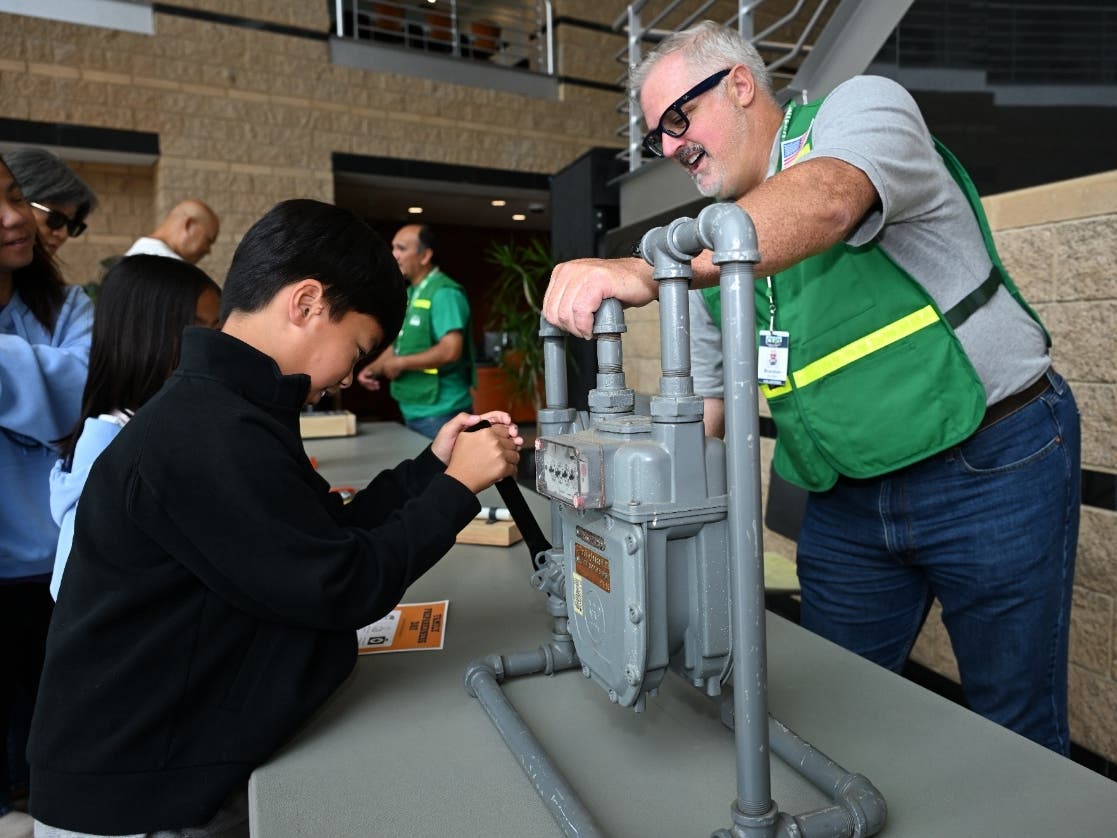
The event featured eight preparedness stations, each focused on a specific emergency skill. Attendees learned basic first aid, how to purify water for drinking during an emergency, how to build a 72‑hour emergency kit, and more. A water shutoff demonstration included a plumbing setup where people physically turned valves on and off.
“You can tell people what to do, but until they see it, physically touch it, move the water, they don’t really know,” Lochrie said.
ReadyOC is planning to hold family preparedness open houses in more cities, Lochrie said.
Austin Demski, a lead volunteer with Irvine’s Office of Emergency Management, manned a table with items that should be included in a 72‑hour emergency kit — nonperishable food items, water, warm clothing, a flashlight, and extra batteries, to name just a few. Demski said most people assume that in an emergency, they can call 911 and help will arrive within minutes.
“That’s not right,” Demski said. “In a real emergency, 911 doesn’t work the way people assume. If something goes wrong — or when something goes wrong — being prepared to handle the what‑if scenarios is really important.”
Large‑scale disasters such as earthquakes, wildfires, or infrastructure failures force first responders to prioritize the most severe, life‑threatening situations, he said. In those moments, individuals and families must be able to take care of themselves because the system simply cannot reach everyone at once.
“It’s foundational to taking an attitude of independence and self‑reliance,” Demski said.
Thomas Osbrink, a volunteer with CERT in Irvine, said communication planning is one of the most overlooked but essential parts of readiness.
Families should establish specific meet‑up locations in case they can’t return home, and they should decide these spots in advance to avoid confusion during a crisis.
Osbrink also urges residents to know where to get verified information. For example, official fire department and city social media channels provided vital information during the Portola fires.
Residents should also register with AlertOC, the county’s text‑based emergency notification system.
Osbrink praised ReadyOC for organizing the preparedness open house.
“The ReadyOC program is really awesome because the whole idea is being able to make the community more robust in the case of an emergency,” Osbrink said. “Anything you can do in advance means you don’t have to figure it out in the moment, in the stress and the hustle.”