Event Details
3… 2… 1… Ignition!
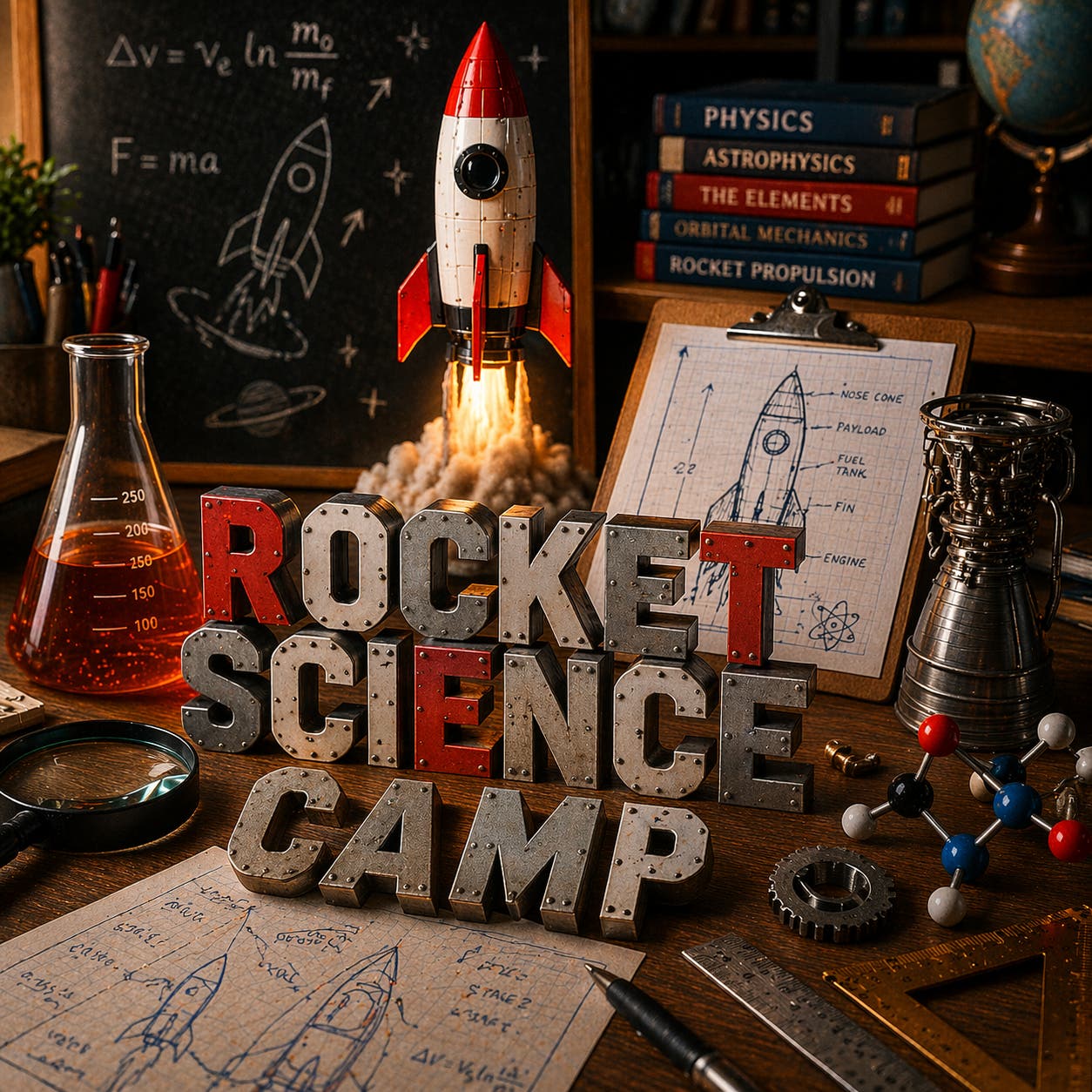
Become a literal rocket scientist for a week. We take campers on a journey from the digital drawing board to the high-flying reality of aerospace engineering. This camp blends high-tech flight simulation with hands-on, high-pressure launches to teach the physics of how we reach the stars.
From Simulation to Stratosphere
Our curriculum moves through three levels of propulsion, combining digital design with "live" launches:
- The Virtual Hangar (Simulation): Before building in the real world, campers use professional-grade simulators like Kerbal Space Program to master orbital mechanics. Learn how gravity, drag, and thrust affect flight paths—and what happens when things go "boom."
- Air & Pneumatic Power: Start with the basics of aerodynamics. Design custom fins and nose cones for high-pressure air rockets to see how stability affects your "Apogee" (the highest point of flight).
- Hydro-Propulsion (Water Rockets): Experiment with Newton’s Third Law. Using specialized launchers, campers will calculate the perfect water-to-air ratio to send high-volume water rockets hundreds of feet into the air.
- The Fire & Fuel Finale: The ultimate test. Under the supervision of our safety officers, campers will build and launch Solid-Fuel Chemical Rockets. From engine installation to parachute recovery, you’ll manage a full "Mission Control" countdown.
The Weekly Mission Log
- Day 1: Aerodynamics 101. Understanding center of mass vs. center of pressure.
- Day 2: The Digital Launchpad. Designing multi-stage rockets in the simulator.
- Day 3: Pressure & Force. Air and Water rocket trials.
- Day 4: Payload Engineering. Can you launch an "Egg-stronaut" and return it safely to Earth?
- Day 5: The Big Launch. Real solid-fuel rocket launches and flight data analysis.
Skills for the Final Frontier
This is a deep dive into serious STEM principles:
- Physics in Action: Mastering Thrust, Drag, Weight, and Lift.
- Calculated Risk: Learning rigorous safety protocols and "Checklist" culture.
- Data Analysis: Using altimeters to track how high the rockets went and why.
- Iterative Design: Analyzing "failed" launches to rebuild a better, stronger craft.