Community Corner
After 4 Calif. Drownings: Here Are The 'ABCs Of Water Safety'
Rip currents will trap thousands at local beaches this summer, and pool parties will end in 9-1-1 calls. Here are the ABCs of water safety.


LOS ANGELES, CA — Next week marks the official start of summer, and along with the long days and rising temperatures comes an increase in drownings. This week, lifeguards across the state are preparing for beach crowds even as a series of tragic headlines attest to the dangers that come with summer fun.
On Saturday, 31-year-old Los Gatos resident Florencio Rodriguez Pureco drowned while swimming Lake Del Valle in Alameda County. On Monday, 14-year-old Berekteab Yohannes drowned while swimming off the coast of San Francisco's Crissy Field Beach. On Tuesday, a beloved 23-year-old jockey Shawn Spikes Jr. drowned while boating in Lake Del Valle, the same lake where Pureco drowned three days earlier. Also on Tuesday, 34-year-old Tony Carnill Foster, Jr., likely drowned while boogie boarding at Stinson Beach in Marin County.
In Southern California, the beach lifestyle comes with a downside: fire departments and lifeguards consistently handle among the most drowning calls nationwide.
Find out what's happening in Pacific Palisadesfor free with the latest updates from Patch.
"These drownings are the hardest for the firefighters and first responders to go on because they are preventable tragedies that happen so quickly and to good people and good families," said Steve Concialdi, an Orange County Fire Authority captain and member of the Orange County Drowning Prevention Task Force.
Concialdi, who recently addressed the crowd at the inaugural Southern California Water Safety Summit has handled hundreds of drownings over 30 years as a firefighter-paramedic and public information officer. The calls never get easier, he said.
Find out what's happening in Pacific Palisadesfor free with the latest updates from Patch.
"I have dealt with hundreds and hundreds of drownings in Orange County, and every one of them are heartbreaking," he said. "Unfortunately, children too often drown without a sound, and when this happens, not only is it devastating for the family but it affects the whole community."
Drowning is the leading cause of injury death for toddlers. Among young children, drownings usually occur in pools.
"Kids are attracted to the water. The water is playtime to them, and they don't recognize the danger," said Concialdi.
Among teens and adults, drowning usually occur in oceans, rivers or lakes, especially when they swim alone and have no one to aid them if they get into trouble. Alcohol or riptides are often a factor in adult drowning accidents.
The ABCs Of Water Safety
These tragedies are preventable. Authorities recommend these safety precautions.
OCFA wants to stress the ABCs of Water Safety:
- A: A is for active supervision of kids anytime children are in, near, or around the water. Even when there is a large gathering, and there are lots of people inside the house or outside by the pool. Experts recommend designating someone to be a water watcher at any given time at a beach outing or swim party.
- B: B is for barriers. All pools and spas should have barriers to protect kids from getting into them. Pool fences and gates that latch and self-close are a must in every backyard around pools and spas.
- C: C is for classes. All kids should learn how to swim. Also, teenagers and adults should know how to do CPR.
Rip Currents
As for rip currents, there are steps beachgoers can take to protect themselves. Rip currents account for 80 percent of Orange County beach rescues. Each year thousands are carried away in the currents, and each year, swimmers die trying to make it back to shore.
"Another name for them is drowning machine," said Seal Beach Marine Safety Chief Joe Bailey previously told Patch. "Think of a rip current as a river in the ocean rushing out to sea. The water is murky and cloudy or brown and usually has a white cap."
Large rip currents can be as much as 50 yards wide and hundreds of yards long. The currents have a way of taking swimmers by surprise.
"I have seen some cases where everything looks perfect by the seawall by the pier, and, within a minute, six people have been sucked out to the end of the pier," said Bailey.
Not all rip currents are created equal. California beaches have countless rip currents with their own dangers and quirks.
In lifeguard lingo, rip currents fall into categories. There is the permanent rip caused by a structure such as a jetty, pier or storm drain. There are fixed rips, which always happen in the same spot even if they aren’t always pulling hard. Then there are flash rips. Finally, there is the traveling rip. They move up and down the beach depending on the wave action and size.
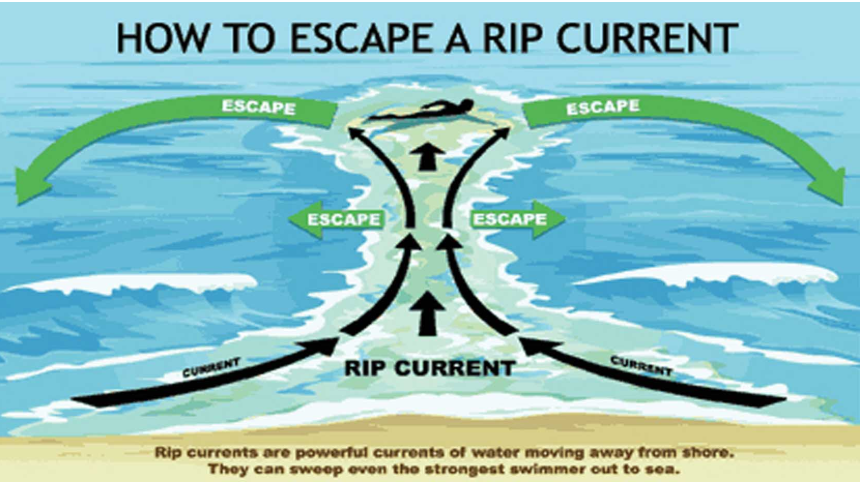
According to Los Angeles County Lifeguards, you can spot a rip current by a channel of churning, choppy water, a difference in water color, a line of foam moving seaward, and a break in the incoming wave pattern. If you find yourself caught in a rip current you should:
- Remain calm
- Tread water and float
- If you have a bodyboard or surfboard, stay on it
- Get the attention of a Lifeguard or a bystander who can inform a Lifeguard
- If you feel like you are able to self-rescue, swim parallel to shore first to get out of the rip current before swimming in to shore
- Do not try to swim against the current
![]()
Courtesy of the Los Angeles County Fire Department
Get more local news delivered straight to your inbox. Sign up for free Patch newsletters and alerts.