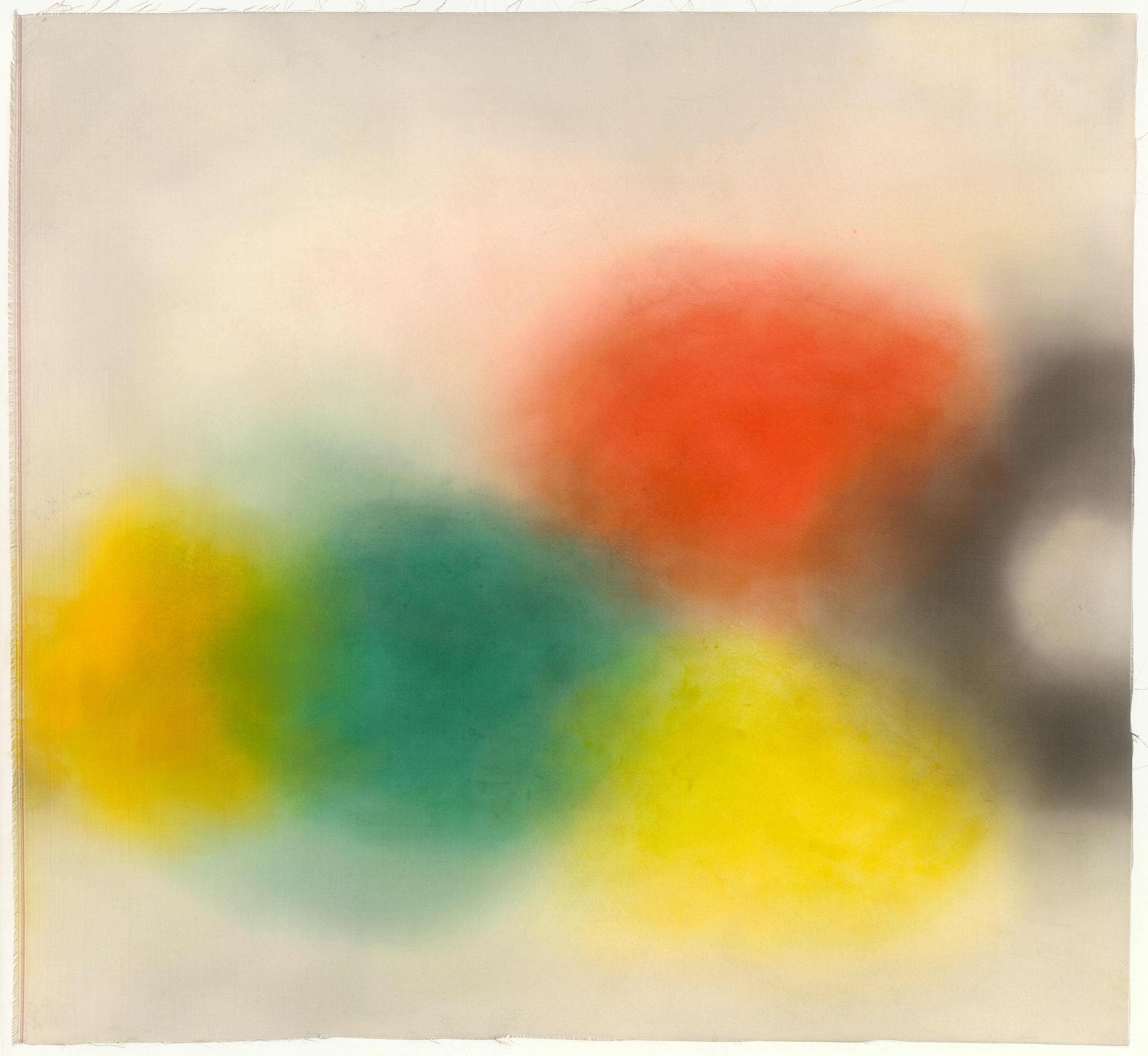
Qualia Contemporary Art is pleased to present Color and Ten Thousand Things, Chinese contemporary artist Xu Hongming’s third solo exhibition with the gallery. Continuing the artist’s decades-long interest in reinventing Chinese painting, Color and Ten Thousand Things presents new and recent abstract works that examine the spiritual, philosophical, and material elements that ground the traditional art form. Through atmospheric and brightly pigmented color field paintings on silk, Color and Ten Thousand Things explores space not as a mapped environment but as a field through which the viewer encounters a philosophical life force and the infinite. An opening reception will be held on July 25, 2026 from 4:30 pm - 6:30 pm and the exhibition will be on view through September 5, 2026. For more information, please visit www.qualiagallery.com
The title for this exhibition references a concept in Chinese philosophy called “wanwu” which translates to “ten thousand things,” an idea meant to express the multiplicity of existence. Echoing the artist's longstanding interest in color theory, cosmological thinking, and the concept of infinite space, the work in Color and Ten Thousand Things challenges the boundaries of painting. Without a fixed horizon or formal representation of line and shape, the forms in these colorfully diffuse works drift and float across the surface, suggesting a more serene encounter that encourages viewers to experience painting as sensation or perception rather than a framed image.
Xu Hongming’s practice has been informed by diverse sources including Northern Song landscape paintings, Dunhuang murals, Modernism, and the artist’s time spent in the Qin Mountains. Six Persimmons, a Southern Song Dynasty 13th-century ink painting by the monk Muqi Fachang, provides a source of inspiration for the artist who reinterprets its suspended forms, expansive negative space, and quiet compositional balance. Rejecting binary Eastern/Western categorization, Xu bridges Chinese aesthetic and philosophical traditions and contemporary abstraction in a distinct visual language. In recent years, the artist has deepened his exploration of color and its contextual push-pull, drawing from the color theory of Josef Albers. For the artist, color represents the essence of the world, existing in continual dialogue with one another, not as fixed values but a spectrum that shifts according to their proximity to other colors.
Xu’s process involves spraying water soluble pigments in layers onto silk, which accumulate in translucent layers. In the piece titled 2025.6.03, a brilliant red form appears buoyed by orbs of green, yellow, and gray, its diffuse edges dissolving into a luminous field of light. Elsewhere, pools of turquoise and blue seem to drift across the surface like currents of air or water. The resulting compositions possess a remarkable sense of luminosity, with color appearing to blend seamlessly into the surface rather than resting upon it. Forms emerge, recede, and transform, occupying a realm between atmosphere and matter, visibility and memory.
Through abstraction, material experimentation, and ongoing exploration of Chinese painting, the artist has developed a practice that is both contemporary and deeply rooted in centuries of art history and scholarship. As the artist has remarked, he is searching for "something that refuses to be defined." It is this embrace of uncertainty—of forms that hover between presence and disappearance—that gives the work its distinctive power. Neither landscape nor abstraction, neither image nor object, Xu Hongming's paintings offer spaces in which air, form, and consciousness collide.