Community Corner
France Meets California At Legendary Dominus Estate
Iron Chevsky visits the Dominus Estate to taste several vintages of the legendary Dominus Cabernet in Napa Valley.
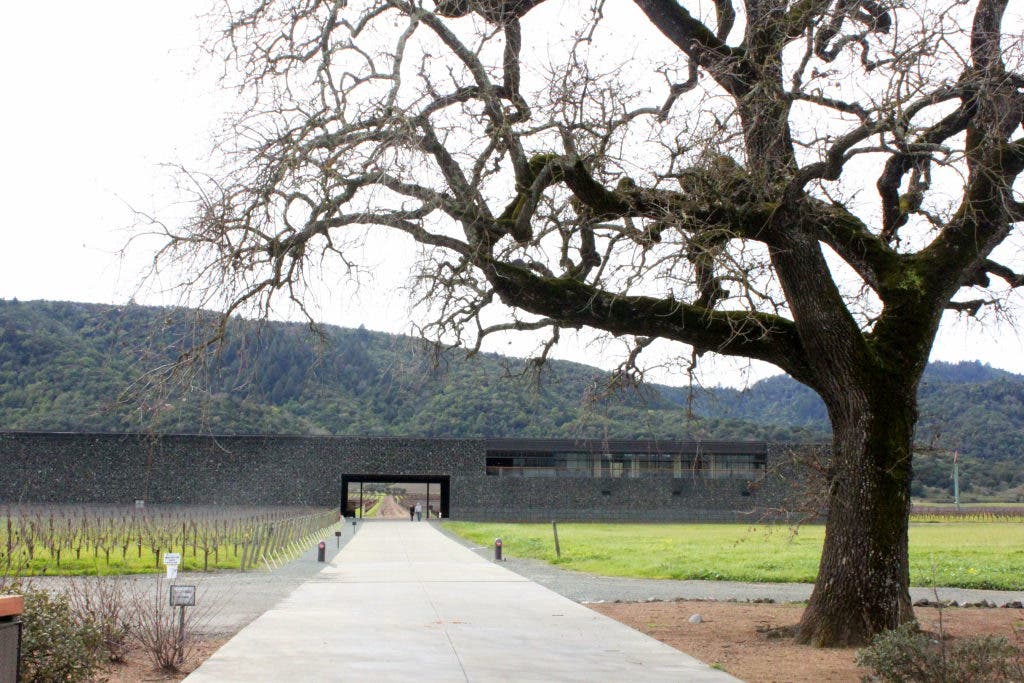


Dominus beckons on the other side of the highway from Yountville. "No tours, no tastings," says the sign by the front gate. Closed to the general public, its impregnable appearance, a unique winery structure made of large rocks, blends into the mountainous background of the Mayacamas.
With 7,000-8,000 cases a year of the main wine—a cabernet sauvignon-based Bordeaux-blend Dominus Estate—and 4,000-5,000 cases of the second wine, Napanook, and a reputation that commands respect throughout the world, Dominus is not worried about the general public.
Owner and founder Christian Moueix (pronounced "Moo-Ex") also happens to preside over an empire of right-bank Bordeaux chateaux in Pomerol and Saint-Emilion that include perhaps the most expensive and prestigious red wine in the world—Chateau Petrus, at $5,000 for a bottle of the 2005 vintage. Let's face it, the dude doesn't need more cash.
Find out what's happening in Palo Altofor free with the latest updates from Patch.
Patron of arts and other fine things, Moueix, now in his 60s, and his son, Edouard, seek perfection and beauty. At least, that's what Tod Mostero, director of viticulture and winemaking at Dominus since 2007, and Kassidy Harris, the new head of public relations and an ex-wine director from Thomas Keller's Bouchon Bistro (in Yountville), conveyed during my three-hour examination of the estate's vineyard and wines.
Dominus Estate was founded in 1982 on some of the most historic soils in Napa Valley. The Napanook vineyard once belonged to the Inglenook winery, which had made wine since the 19th century. But despite its famous lineage, Dominus had not gained acclaim until the 1990s. According to Tod, it took a number of years for a family that was expert at making merlot-based wines in Bordeaux to see results from cabernet-based vines in Napa Valley.
Find out what's happening in Palo Altofor free with the latest updates from Patch.
Tod pointed out that, perhaps only now, after nearly 30 years, they are starting to figure out how to make wine in Napa. It's a modest statement, considering the track record. Tod explained that the "figuring out" part comes in when dealing with whatever each vintage throws at you. Learning how to get the best out of the weather and vines each year takes a long time. Which is why it's hard to compare with places in the Old World where fine wine has been made for centuries.
What had attracted me to Dominus was its reputation for making balanced, Bordeaux-like expressions of Napa Valley. Tod talked about his focus on the vineyard, rather than the "post-production." He was sensitive to avoid being called a "wine-maker," because he loathes the notion that he "makes" wine. Whatever you call him, there is a common sentiment I've heard from many winemakers—that wine is made in the vineyard, not in the winery.
The Bordelais' approach is owning its vineyards (thus the term "estate vineyard") to control every possible aspect of the wine. Healthy but struggling vines are what a winemaker is after. Dominus will replant its vines after 25 years or so (the oldest at Dominus are from 1988). Remarkably, just after two years, new vines in Napanook can produce worthy wine. There is absolutely zero irrigation past a vine's infancy. The Dominus team believe that is the key to making fine wine in Napa—dry farming.
Only certain lots of land in Napa allow for dry farming, as soils of the right kind have to be deep enough to retain just enough moisture to support development of deep roots. As moisture has to come from somewhere, in the case of Napanook, there is an underground flow of water from the Mayacamas mountains down to the valley floor. The vineyard slopes gently toward Highway 29 at a 5-degree angle, something that is hard to see with the naked eye but is fundamental to the soil composition of the vineyard (deeper soils at the foot of the mountain, shallowing toward the highway). The western tip of the vineyard is more than 75 feet higher than the eastern end. I wondered if growing on the hillside would not result in better wine—certainly a popular concept. Tod explained that, in fact, they would have to irrigate a hillside vineyard, because moisture would not be retained at such a steep angle.
Past taking care of the vines, the biggest wine-making technique, if you will, is picking the right harvest date. Careful determination of the optimal level of ripeness (even one day off may noticeably degrade the final wine) is critical.
"Consider a perfectly ripe peach," says Tod, "It's complex, sweet and tart, flavorful, juicy and delicious. If unripe, it would be too green and one-dimensional. If too ripe, the nuances will be covered up by sugar, so as to become one-dimensional as well. We are looking for the perfect peach!"
The next key step is removing imperfections from grape clusters. "Complexity comes from harvest date. Purity comes from sorting," says Tod. This is one place where high technology is used, as an image analysis module is built into the sorting equipment to automatically filter out anything that doesn't look like a good grape berry. (I've seen the same equipment experimented with at Opus One.) Past that, modest oak treatment (40 percent new oak for Dominus; 20 percent for Napanook) for 16-18 months aims to allow the juice not the wood to shine through. The wines end up at around 14.1 percent alcohol.
In Bordeaux, usually maximum sunlight is desirable to ripen the grapes. Thus, thinning of the leaves to expose grapes is common practice there. Dominus, on the other hand, employs a unique trellising system that spreads apart four shoots from each vine, such that the canopy of leaves hangs over the grapes at a precise angle in order to reduce the amount of direct sun hitting the grape clusters.
Overall impressions
For the tasting, Tod lined up the 2007, 2006, 2005 and 1996 vintages of Dominus and 2007, 2006 and 2005 vintages of Napanook. All but the 1996 are still readily available in the market. The opportunity was much appreciated, given these wines retail for $100-$150 a bottle—still a relative bargain compared with many other top Napa cabs. I had requested that 1987, 1991 and 1994 be poured, as those are the most highly regarded prior vintages. Alas, I was out of luck. I think it would have been helpful to try those older bottles, given the steep maturity curve I observed going from 2005 to 1996. Perhaps next time.
I enjoyed the wines. Like a pretty woman in a Valentino red gown, they are easy to love, yet far from shallow. Dominus is more powerful and complex than Napanook, but both are good. Beautiful flavors and medium-weight textures, with a streak of inky chocolate running through all of them and a bit of spice, especially in Dominus. A hint of earthiness and herbaceousness benefits the overall flavor profile. The wines reminded me of Opus from the 1990s, but perhaps even more to my liking.
Tasting notes
Vintage differences were evident—a good thing in my book—with the 2007 (95 percent cab, 3 percent cab franc, 3 percent petit verdot) being beautifully open, pure and plain delicious; 2006 (91 percent cab, 6 percent cab franc, 3 percent petit verdot) tight, tannic, full of chocolate, blueberry and pencil lead, thicker and more intense than 2007, and structured for aging; and 2005 (92 percent cab, 5 percent cab franc, 3 percent petit verdot) drier and a touch more herbaceous, which I enjoyed.
The 1996 Dominus was an absolute beauty—all secondary flavors, incredibly complex and intellectual. Tod suggested that 15 years of age is the perfect spot to drink Dominus. Judging by the 1996, I agree. But in my opinion, it's not a wine for everyone. Those who enjoy the primary youthful fruit would probably not appreciate the 1996 as much as I did. The degree of difference that nine years (from 2005 to 1996) had made was striking.
Acidity is a significant topic for me, as it not only affects the overall balance of a wine but also its aging potential and its food-friendliness. Dominus wines were medium acidity, higher than many Napa wines I try, but less acidic than their Bordeaux counterparts—undoubtedly a manifestation of Napa climate. Having recently tasted cabs from Ridge Monte Bello, Dunn and Opus One from the 1980s and 1990s, with higher acidities, I felt that Dominus seemed to have matured faster, which could be a good or a bad thing, depending on one's outlook and purpose. After all, drinking beautifully at a 15-year mark is nothing to sneeze at. However, I think, had the wines had higher acidity, the 1996 would have been brighter and more youthful.
All said, my friend, Chris, and I did love it (in fact, he wanted to run out and buy a case!) —I'm just not sure I would age it for another 10 years.
"1996 Dominus Estate (82 percent cab, 10 percent cab franc, 4 percent petit verdot, 4 percent merlot)— nose: a blend of black fruits and baked/roasted sweet veggies and tobacco. On the palate: secondary flavors, puree of sweet roasted veggies (beets, squashes, etc.) and black cherries and berries. Wow! So much character! Minty, tobacco, savory, forest floor, faded leaves and flowers, medium-acid." —
None of the wines felt hot or alcoholic or jammy or over-the-top, despite the 14.1 percent alcohol on the label. The 2005 was my favorite Napanook and stood shoulder-to-shoulder with its bigger brother Dominus:
"2005 Napanook—a little herb on the nose; mint, cool herbs, more Bordeaux-like, dark berry tea, hint of roasted coffee."
Conclusion
All in all, rarely have I drunk more delicious California cabernets than Dominus. The young 2007 was particularly tasty, and the mature 1996—quite intellectual. If one were to imagine a child of two worlds —Bordeaux and Napa—Dominus might be it. To my palate, I still prefer old world acidity of top Bordeaux, as described in this story.
To the vast majority of wine lovers who appreciate the suave nature of New World wines without the tongue-cutting, saliva-inducing high acidity, but with the elegance and restraint of an Old-World gentleman, I think these wines are worth the price, but I would start drinking them five years from release, and definitely be checking on them at the 10-year mark.
Get more Iron Chevsky at ironchevsky.com