Neighbor News
Moldaw Residences Remembers Survivors and Those Lost During The Holocaust in Observance of Yom Hashoah
During Yom HaShoah , the residents and staff members of Moldaw Residences are reflecting on their own stories from the Holocaust.
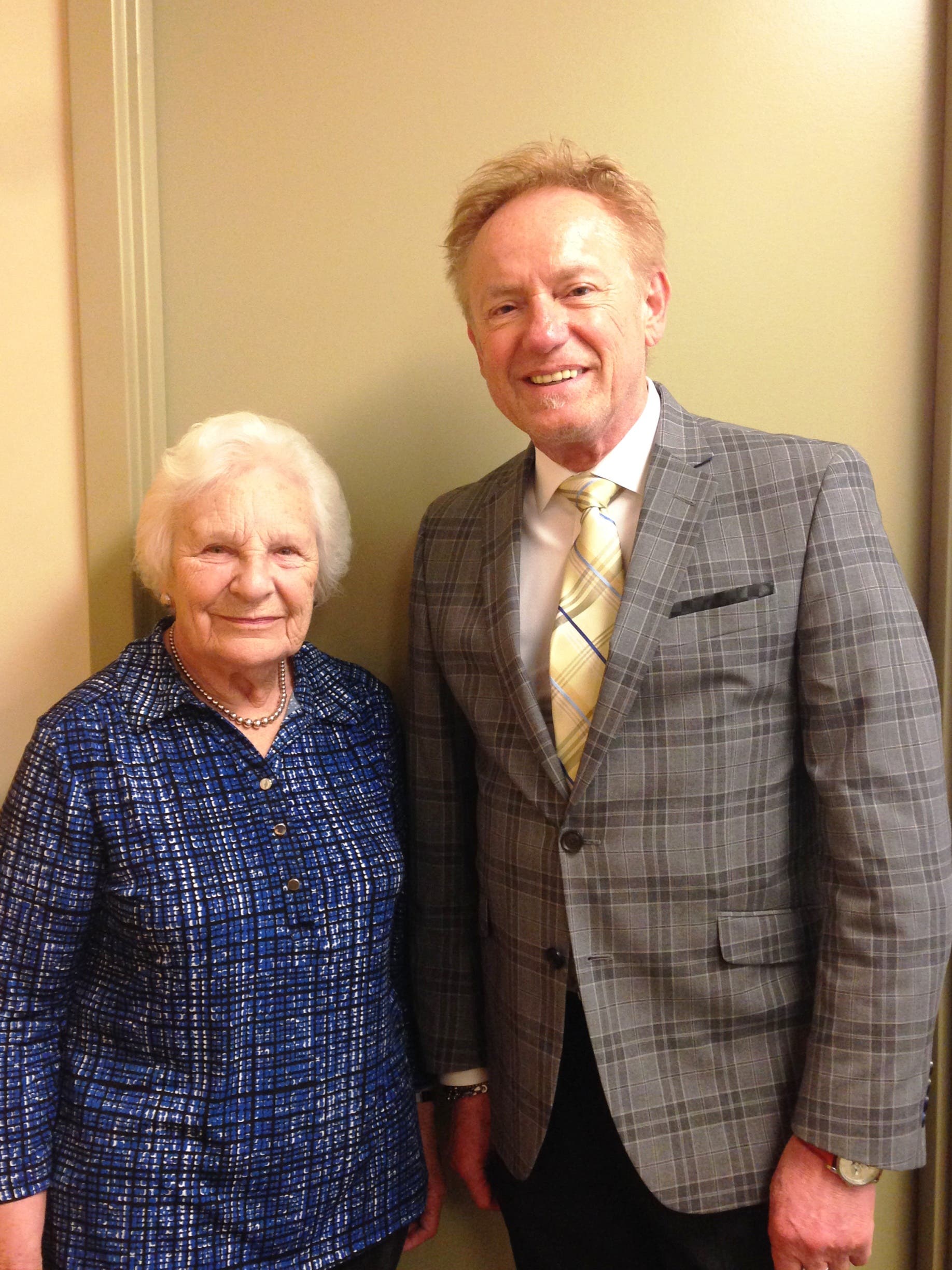
Today, the horrors and atrocities committed during the Holocaust are far removed from daily life. For Holocaust survivors and their loved ones, however, the passage of time cannot erase the memories of that period’s darkness. Because of this, it’s essential to make sure the events of the past are not forgotten, and never repeated. Holocaust Remembrance Day, or Yom HaShoah, is observed each year worldwide as a day of commemoration for the approximately 6 million Jews who perished as a result of the actions of Nazi Germany during World War II. As Yom HaShoah approaches, the residents and staff members of Moldaw Residences are reflecting on their own stories from the Holocaust and those of their loved ones. For Moldaw resident Helga Newman, her childhood memories of occupied Vienna are still as clear today as they were when she was nine years old.
“The war was not a time where you could be a child,” said Newman. “We grew up very fast with Hitler in power; unfortunately even small children were aware of what was happening around them. It was an unimaginable time. Even at a young age you had to grow up and accept that the world around you was changing every day—the writing was on the wall.”
Newman and her family were able to get out of Vienna after Kristallnacht, when Nazi SS officers came into her family’s home and took everything, and arrested her uncle. The family was split up, with Newman’s mother escaping to London first to work as a maid. Newman followed on the Kindertransport, with her aunt and uncle following later after her uncle was released from Dachau. Her father stayed behind in Vienna until he was forced to escape illegally to Yugoslavia and was then eventually captured in Italy. From this time until after the war they did not hear from him again, and they had accepted he was dead. Newman soon found herself a part of the Kindertransport, an organized rescue effort that placed Jewish children in British foster homes to protect them prior to the start of World War II. Newman found herself in multiple homes throughout her time in the Kindertransport; and even though she was cared for and welcomed, life wasn’t easy. While with her first family, Newman became ill with scarlet fever, after which the war began and she was evacuated to a small village where she was taken in by an older woman to stay at a nearby farm.
Find out what's happening in Palo Altofor free with the latest updates from Patch.
“It was in the middle of winter when I stayed at the farm,” said Newman. “I was terribly dirty and ended up with chilblains and infected sores from the dirt and the cold. I had to be taken to a hospital to be treated because I was so sick. I was absolutely thrilled to go, because, as kind as the woman was, I was tired of being dirty and cold, and the hospital was so warm.”
After her stay in the hospital, Newman was taken to the home of a newlywed couple, with whom she stayed only for a short time. She was then evacuated to visit her mother in London. However, her visit happened to coincide with the worst night of the Blitz, causing her to be evacuated again to stay with a Baptist family outside of London. Newman recalls that while the family was very kind and taught her many things, she didn’t enjoy Sundays because she spent her entire day in church when she wanted to play. Newman would be evacuated twice more, staying with a family for a year before being sent to her final foster family with whom she stayed until the end of the war. The Newman family settled in London after the war, and slowly eased into post-war life. It was in 1946 that the Newmans received a wonderful surprise when they were reunited with her father. But even in the midst of their joy, the effects of the war and the family’s experiences brought challenges.
Find out what's happening in Palo Altofor free with the latest updates from Patch.
“Just because the war ended didn’t mean the challenges did,” said Newman. “When my father came home, everything was very different for him. Can you imagine leaving behind a nine-year-old child and suddenly having a 16-year-old in her place? It was quite the adjustment for him, and we had to work through that as a family. It was difficult and we didn’t always get along. For the longest time, he thought I didn’t like him.”
It wasn’t until later in life that Newman truly looked back on her experiences, and that is when she became a part of the Kindertransport Association. The organization is a nonprofit that works to help children in need today, by donating to other organizations that support children in need. Newman is still an active member, and acts as secretary handling membership dues. She says that while it is still important for her to be involved, she has taken a step back. Now that there are fewer people from the survivor generation, more of the second generation is taking charge.
One such member of the second generation is the executive director of Moldaw Residences, Alexander Ben-Israel, whose parents were both survivors of the Holocaust. Ben-Israel’s father, Abraham, was born in Warsaw, Poland, in 1928 and was around 12 years old when his family was transferred to the Warsaw Ghetto. The family was then separated into different concentration camps. While Abraham was sent to Treblinka, the rest of the family — his grandparents, parents and two siblings — was sent to Auschwitz where they perished, leaving Abraham as the only surviving member of the family.
“My father told me once of a story of when he was in line for the showers,” said Ben-Israel. “He, like all of the other prisoners, knew that once you went into the showers you didn’t come out. He said he remembered seeing a bucket of water by a fence, so he simply got out of line and walked to it. When he was stopped by a guard who asked him what he was doing, he lied and said he had been told by another guard to take the bucket somewhere else, thus sparing himself from the gas chambers.”
Ben-Israel’s mother, Chana, was a young child at the time of the war, nine years younger than Ben-Israel’s father. After her father was killed, Chana survived with her mother and two siblings, who hid on a farm outside of Salzburg, Austria, until they were liberated in 1945. The couple met later in life when they were trying to travel to America. But after meeting and falling in love, they decided to make their home in Germany. The couple raised their children in a traditional Jewish home, only sharing their stories and experiences when the children asked — choosing to look ahead and enjoy their lives rather than looking back on the horrors of the past. Ben-Israel is thankful to have known his parent’s stories and learned from their experiences, knowing that it was their love that made him who he is today.
“I learned a great deal from my parents,” said Ben-Israel. “It is my traditional Jewish upbringing that makes it possible for me to relate to the residents here at Moldaw, and fully understand what is important to them and their families. As Yom HaShoah approaches, it is important to remember those we lost and those who survived; so many of our residents are either survivors themselves or know someone who was touched by the Holocaust. It’s a story that we all share in some way, and it’s vital that we continue to tell it.”
“I’m very thankful for the people who took me into their homes,” said Newman. “They provided me with shelter and the care I needed to survive. Their kindness helped people to remember even in the darkest of times that there was still good in the world. There was hope, and while I don’t remember exactly how I felt as a child, I know that, like anyone at the time, I wanted my home and my family. My family was lucky in the end, and I have been blessed with the ability to build my own life with my own family. My own husband and children are what mattered, and today that is what is most important to me.”
“It is paramount that we never forget what happened,” said Ben-Israel. “If we allow ourselves to forget or quit talking about what occurred, it could happen again. The world lost 6 million people, and it is our responsibility to make sure that we all do our part to ensure it never happens again.”