Politics & Government
Palo Alto, Like California, Shines As A Land Of Promise But Is Haunted By Its History
In "Palo Alto: A History of California, Capitalism, and the World," author Malcolm Harris tells tales of the city's founding.


In “Palo Alto: A History of California, Capitalism, and the World,” author Malcolm Harris tells tales of the city’s founding, highlighting how some grew rich through technology and science while others were left out of the growth and prosperity. His provocative premise explores California’s earliest sins and the haunting toll they have taken centuries later.
PALO ALTO, CA — Malcolm Harris grew up in the intellectual heart of Silicon Valley, where people are “educated, rich, healthy, innovative” and yet so haunted by the sins of history that the city of Palo Alto had the nation’s highest youth suicide rate for more than a decade.
This is the provocative premise of Harris’ new book, the 700-plus page “Palo Alto: A History of California, Capitalism, and the World.” Harris, 34, grew up in Palo Alto, but left his hometown more than a decade ago for college and an East Coast writing career.
Find out what's happening in Palo Altofor free with the latest updates from Patch.
In Palo Alto, the former Occupy Wall Street activist, punk enthusiast and self-described Marxist casts his sharp gaze back west, delivering a scalding historical critique of a city and a part of the world whose vast income and wealth disparities were not just laid bare but accelerated during the pandemic.
Harris’ approach in Palo Alto is similar to other contemporary histories recasting modernity through the lens of an American city. His ideology is clear from the first page, with an epigraph from Karl Marx describing the Golden State by writing, “nowhere else has the upheaval most shamelessly caused by capitalist centralization taken place with such speed.”
Find out what's happening in Palo Altofor free with the latest updates from Patch.
And Harris’ thesis is straightforward: Palo Alto’s fortunes rose on the backs of the downtrodden so that a select few could profit.
“What haunts (this city) are the kinds of large historical crimes that, once committed, can never truly be set right,” Harris writes.
Yet what’s perhaps novel, and ultimately valuable, about Palo Alto, is that 15 years after the financial crisis that inspired one of his generation’s most well-known rebellions, Harris rightly captures the ascendance of the new American capitalism in California. Far from the cavernous streets of lower Manhattan, tucked away in suburban office parks and draped in the language of endless innovation, Silicon Valley is long overdue for an unflinching look, even if Harris consistently detours outside the physical boundaries of the city of 66,000 that his book is ostensibly about.
This is a region, after all, where last year just eight households held more wealth than the bottom 50% (nearly half a million households), according to the Silicon Valley Index, an annual report by the Silicon Valley Institute for Regional Studies.
Initially conceived as a memoir, Palo Alto retains little of the author’s personal experience and instead takes the reader from the gold rush era through the age of the personal computer and into the tech booms that Silicon Valley is known for today.
“I write about myself like a bad bowler anyway,” Harris concedes in his introduction, “always headed straight for the gutters of historical context rather than for the pins of personal revelation.”
“What haunts (this city) are the kinds of large historical crimes that, once committed, can never truly be set right.”
malcolm harris, author of “Palo Alto: A History of California, Capitalism, and the World”
Palo Alto is Harris’ third book. In his first, “Kids These Days: The Making of Millennials,” Harris presents a robust rejection of the stereotypes surrounding his generation. His second book, a series of critical essays on everything from student debt to wages to fascism, carries an unprintable title inspired by an Occupy Wall Street protest sign.
An activist and a voracious researcher from an early age, Harris was arrested on his high school campus for handing out leaflets telling his fellow students they didn’t have to take a standardized test. When he was 18, Harris dedicated himself to reading 100 pages a day, “a programmatic form of study” that he calls “a defining choice of my life.” At the University of Maryland, Harris studied government and politics and English literature.
In Harris’ analysis, California was birthed in inequality, a land stolen from its Indigenous peoples and Mexico, a land that provided Anglo American settlers with a blank slate, of sorts, to run a variety of racist, capitalist projects. He called on Stanford University to return the land to the Muwekma Ohlone tribe.
“California is capitalist from the beginning,” Harris said during an interview in San Francisco, in the midst of the first leg of his promotional tour. The state provided such rapid growth that it almost immediately created unusual amounts of wealth.
The book details the eugenics movement at Stanford, the pseudoscience that adapted Charles Darwin’s survival-of-the fittest explanation of human evolution and extended it to justify racial segregation, racial purity efforts and forced sterilizations. It was promulgated by David Starr Jordan, the university’s founding president.

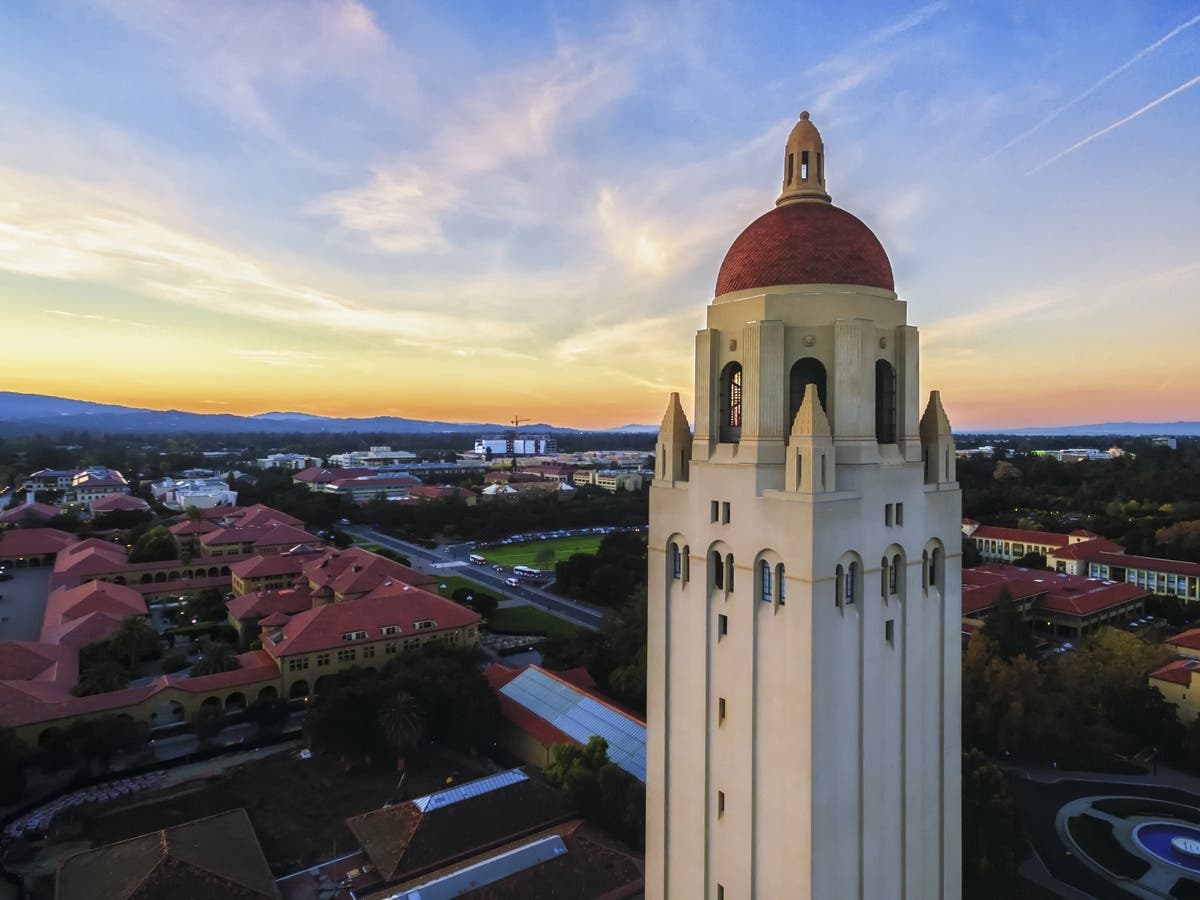
Stanford University’s Hoover Institute, Reaganism and the ballot measure system are all subject to critique in Harris’ book, as is Silicon Valley’s role in the postwar proliferation of nuclear weapons.
For all its attention to history, Palo Alto spends little time addressing California’s efforts to counteract some of the inequalities Harris identifies. In recent years, the state has launched one of the most prominent reparations task forces in the nation, awarded more than $25 million in grant funding to seven guaranteed income pilot projects reaching 12,000 people and extended the social safety net to undocumented immigrants.
Harris’ book has sparked a debate about how broadly one should interpret the city’s influence in the world. The Washington Post in one review praised Palo Alto as “a vital” history, similar to Mike Davis’ treatment of Los Angeles in his classic “City of Quartz.” Meanwhile, San Francisco historian Gary Kamiya criticized Harris in the New York Times for trying to pin too many problems on one California city, and took umbrage with the book’s unapologetically Marxist framework.
For his part, Harris said he originally wanted to title the book “the Palo Alto System,” named after a horse breeding process originally developed by Leland Stanford that serves as the book’s central metaphor. Stanford, the former governor who founded Stanford University, looked to develop a better trotting horse through breeding.The plan ultimately resulted in some of the fastest horses in the country.
Stanford University plays a central role in the book, and is very much at the heart of Harris’ personal story. His father was an undergraduate at UC Santa Cruz and employed at Stanford when he met Harris’ mother, then a research assistant there.
Born in Santa Cruz, Harris and his’ family moved to Palo Alto when he was a child and he attended high school as the city grappled with a spate of student suicides. Harris opens his book with these deaths, citing them as an example of the city being “haunted,” noting that many of the suicides were committed by stepping in front of a commuter train that was “the same locomotive line on which Leland Stanford built the town.”
Having thoroughly avoided writing the “suburban California survival memoir” he so promises to eschew, Harris concludes that the suicides are a response to the Palo Alto System he identifies. “Even the winners can’t stop the train, even when their own kids are in the way,” he writes.
By returning to the suicides, Harris rightly identifies the undeniable reality that his hometown has demons to reckon with. Yet hundreds of pages later, only the most dogmatically aligned reader would agree Harris has given a satisfying explanation for these particular tragedies. His conclusion threatens to exploit these sorrows, leaving the reader with a provocation, and yearning for some real hope.