Arts & Entertainment
Printmakers Make an Impression
More than 40 artists in a wide-ranging exhibition at the Palos Verdes Art Center give new looks to old printmaking techniques.
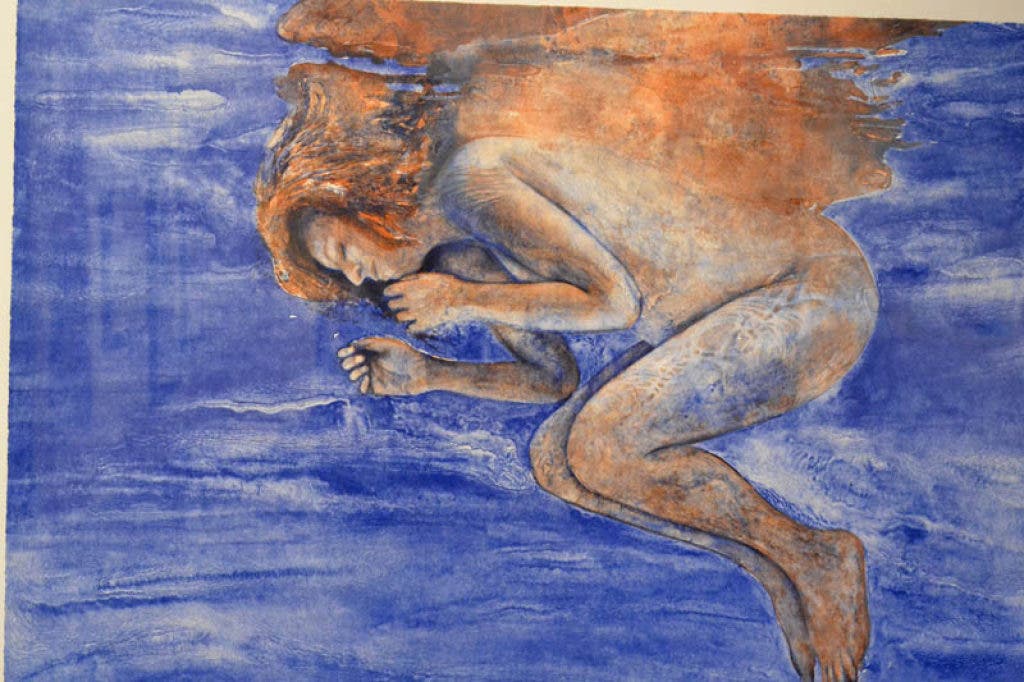


The Southern California Printmaking Exhibition at the Palos Verdes Art Center is big and wide-ranging. More than 100 works by 41 artists—etchings, lithographs, woodcuts, linocuts and more—cover every bit of exhibition space with prints ranging from postage stamp-size to 6-by-10 feet.
In centuries past, printmaking was a technology employed to make art more affordable by mass-producing either a drawing or a black-and-white copy of a painting by a well-known artist.
These days, with cameras in everyone’s hands, we are awash in a sea of images that are multiplying in cyberspace, and traditional hands-on printmaking is a dying art.
Find out what's happening in Palos Verdesfor free with the latest updates from Patch.
Rather than cranking out multiples, many of the artists in this show use printing processes or combinations of printing techniques, painting and collage to produce unique works.
If they produce singular work, why print rather than paint? Because they like the look of a particular printing technique.
Find out what's happening in Palos Verdesfor free with the latest updates from Patch.
The show is an education in the how and why of printmaking. Wall labels explain how mezzotints, chine collé and other techniques are done. The works show the distinctive graphic quality that attracted an artist to a particular technique for a given piece.
For example, woodcuts tend to have a bold, rough look made by quick gouging and crosshatching of the block. This relatively simple technique has been used in folk art in many cultures.
It is well-suited to Dirk Hagover’s poster-like portrait of Cesar Chavez as well as his larger-than-life portrait of German painter and printmaker Käthe Kollwitz, which echoes the Expressionist power of her work.
The woodblock also imparts strength to the largest work in the show, the 10-foot Ecce Homo, by Patrick Merrill, the late master printer to whom the show is dedicated.
Mezzotints, on the other hand, allow a subtle range of tones. Virginia Wyper, a longtime teacher of printmaking at PVAC, produces mezzotints of such delicacy they look as if they are about to float off the page. Her Scrambled or Over Easy? gives us smooth glass eggs in a rough cardboard carton on a wooden shelf with every texture and reflection spot-on.
Art Wegner is another master of the mezzotint whose work looks quite different. It has the rich range of tones of classic black-and-white photography and some works play on photography with the look of double exposures. McMansions, though, has the playful geometry of a board game with the viewer as a giant controlling the pieces.
Requiem, at 30 inches by 42 inches very large for such a labor-intensive work, looks like a rocky cliffside from a distance, but up close it becomes clear some of the rocks are tiny human figures.
Not all the prints are on paper. Marie-Laure Ilie not only prints on cloth, she forms the cloth into sculptures.
In Super Ego, headless and handless statues of Greek goddesses are transfer printed onto a 7-foot length of organza, which is draped over a rod so the transparent bolt of cloth stands before the viewer like an imposing figure.
Through the cooperation of the Jack Rutberg Fine Arts gallery in Los Angeles, curator Scott Canty was fortunate to obtain the works of two artists for this show: Ruth Weisberg, former dean of the USC School of Fine Arts, and renowned Abstract Expressionist Hans Burkhardt (1904-94).
Weisberg is known for her figures, and they are gracefully expressed in her monoprint Dream Alone and lithograph Waterbourne. Burkhardt’s My Lai exploits the strong graphic potential of linoleum cuts.
Linda Lyke brings sensuous juiciness and powerful contrast to disasters in the monoprint-watercolor combinations Griffith Park Fire #4 and Macondo Blowout. Those two small works on the stairs between the upper and lower galleries were my favorites in a strong, diverse show.