Politics & Government
City Council Introduces Johnson Drive Economic Development Zone Financing Options
The Pleasanton City Council met to discuss how to finance transportation improvements on Johnson Drive

PLEASONTON, CA - From the Pleasanton City Council: The City Council held a special meeting tonight to discuss financing options for transportation improvements related to the Johnson Drive Economic Development Zone (EDZ). The impetus for the EDZ came in 2013 when the Clorox Company outgrew their Johnson Drive site and relocated to a larger Pleasanton location, which prompted a conversation about whether the City might realize new tax revenues by rezoning 40 acres of vacant and underutilized land to reflect a changing economy. The EDZ was initially proposed as a way to spur investment in this area and create a thriving commercial corridor.
“The City entered into this conversation a few years ago to explore the creation of an economic
development zone to encourage new commercial activity and revitalize the Johnson Drive corridor.
Most everyone likely realizes the issue was contested at the ballot, and the community voted in
support of us continuing the conversation, which we are glad to have the opportunity to do tonight,”
said Pleasanton City Manager, Nelson Fialho.
The initial EDZ concept was endorsed by the Council in 2014. As prospective tenants (Costco and
some hotels) became interested, building size was contested at the ballot box, but in November 2016, 63 percent of voters indicated their desire to not restrict building size, potentially allowing a Costco or another club retail tenant to locate within the EDZ.
Find out what's happening in Pleasantonfor free with the latest updates from Patch.
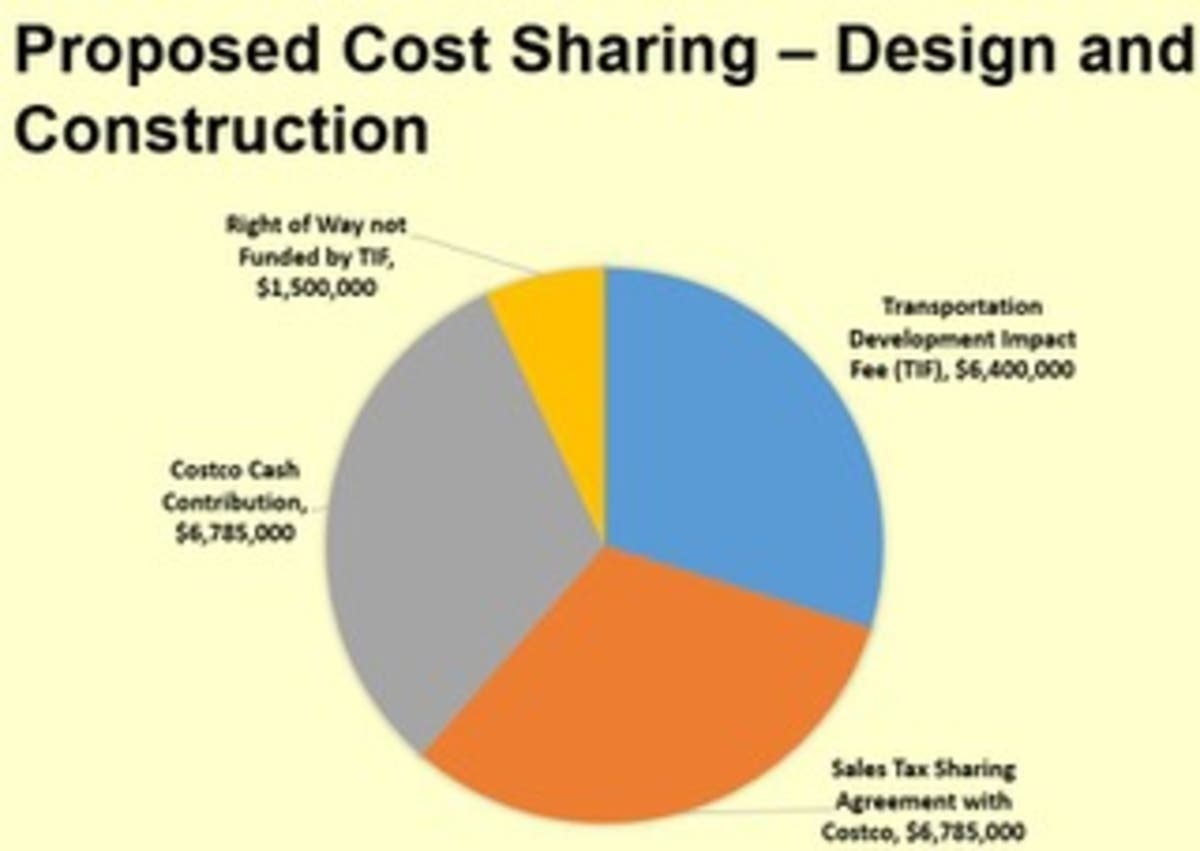
The transportation related improvements are estimated to cost $21.5 million. Funding sources –
including a combination of Transportation Impact Fees generated from development in the City and
a cash contribution from Costco – have been identified for all but $6.8 million of the total cost. The
City Council considered three financing options, all of which share the common objective of
making sure private developers pay their fair share of development costs. A key difference between
the options is that Option 1 (the sales tax sharing agreement) ensures there is no risk to the General
Fund.
There are five significant transportation improvements that would be needed to maintain acceptable
levels of service for the area if the EDZ is formally adopted: adding two new traffic signals;
widening parts of Stoneridge and Johnson drives, and constructing an additional onramp on
northbound I-680 at Stoneridge Drive. The three financing options for those needed transportation
improvements include: a sales tax sharing agreement, a City inter-fund loan, or a bank loan or bond
issuance.
Find out what's happening in Pleasantonfor free with the latest updates from Patch.
Option 1—Sales Tax Sharing Agreement with Costco
Costco advances the City $6,785,000; the City pays it back through a 60/40 percent split sales tax
sharing agreement with 1.5 percent interest (roughly $1.4 million) over a period not to exceed 25
years. The City receives 60 percent of the sales tax; Costco gets the other 40 percent as repayment.
Over 25 years, the City is expected to receive a total of $84.2 million in net new tax revenues. Of
that amount, under the sales tax sharing option, the City would receive $76.4 million or 91 percent
of those new revenues and Costco would receive $7.8 million or 9 percent of those new revenues.
Advantages include: no reduction of funds available for other City projects and obligations; no
General Fund exposure. One disadvantage would be that the City typically accrues all sales tax,
while under this scenario the City would repay Costco 40 percent of all sales tax generated over 25
years.
Option 2—City Inter-Fund Loan
The City advances itself $6,785,000 from an as yet to be determined fund to be repaid with an
interest rate of 1.0 to 1.5 percent. This option would eliminate any City financial obligation to
Costco, but would also reduce funding previously set aside for other City projects or obligations.
Option 3—Issuing Bonds or Securing a Bank Loan
This financing option is anticipated to cost approximately $10 million, including principal, interest,
and issuance costs over 25 years. A traditional loan or bond issuance would also eliminate any City
financial obligation to Costco, but the interest rates would be higher than Options 1 and 2.
A fourth scenario, also discussed, would have the City do nothing and not try to incentivize
businesses in the EDZ area. This scenario would eliminate any City financial obligation to fund
transportation improvements but would also eliminate the potential for significant new revenues
within the EDZ.
“The City conducted extensive outreach prior to and leading up to this evening because we knew
that while economic incentives, such as sales tax sharing agreements are tools used in other
communities, the concept was new to Pleasanton, and we needed to be providing our community
with the rationale for why the City was considering this,” Fialho concluded.
After deliberating all the financing options and without taking any action, as intended, Council
adjourned the meeting with a follow-up meeting scheduled for September 18, 2017.
For questions related to financing options, call Finance Director, Tina Olson, at 925-931-5402 or
email tolson@cityofpleasantonca.gov. For questions related to project development and planning,
call Community Development Director, Gerry Beaudin, at 925-931-5614 or email
gbeaudin@cityofpleasantonca.gov. For more information, including timeline, impact and feasibility
studies, previous agenda reports and FAQs, please visit the City’s website at
cityofpleasantonca.gov/JDEDZ. Follow us on Twitter @pleasantonca and Facebook
www.facebook.com/CityofPleasanton.
Image via Pleasanton City Council