Community Corner
Velma Johnston — 'Wild Horse Annie'
As Women's History Month closes, we remember a woman credited with saving America's wild horses.
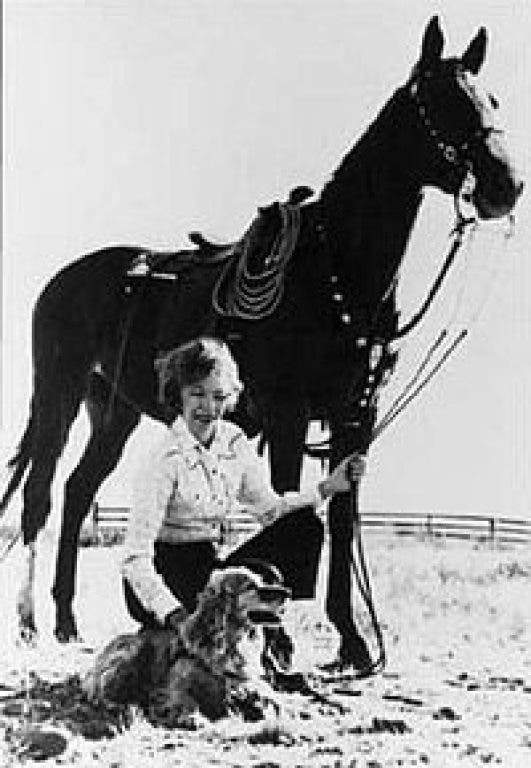


Velma Johnston had much to do with wild horses and legislation to protect and preserve the herds. She has been one of my American heroes because of her involvement with wild horses, even more so since since my Mustang Cricket came into my life several years ago.
Johnston was born in 1912 and lived in Nevada where her family owned a ranch. She contracted polio when she was 11 years old but that didn’t slow her down. She did well in school and worked during her adult life, remaining in Nevada. Johnston was later known as “Wild Horse Annie” because she spent almost 30 years working to protect wild horses in America.
From 1950 until 1977, Johnston worked to preserve the wild horse and burro herds in the West and their habitat. She passed away in 1977 but her legend and legacy live on.
Modern horses are believed to have originated in North America approximately six million years ago, according to a sign I saw during my recent visit to the San Diego Zoo. But they were wiped out and became extinct on this continent. Horses were reintroduced in the late 1400s when the Spanish and other European explorers visited and horses escaped the pens that held them. The horses then formed new herds and made the American West their new home. From those herds came what we call Mustangs today.
These wild horses were not protected in any way at that time, and large numbers were being rounded up and slaughtered due to the demand for horse meat for pet food. Ranchers wanted them eradicated because they were competition for the cattle. By the early 1950s, the demand for horse meat grew. One day, on her way to work, Johnston saw a truck full of horses, with blood dripping from its sides, and she decided to follow to find out what was going on.
Find out what's happening in Ramonafor free with the latest updates from Patch.
She observed first-hand the cruelty of the wild horse slaughter process. She resolved to do something about what she had seen and began to fight for protection of the horses. In 1960 Johnston and Helen and John Reilly co-founded the International Society for the Protection of Mustangs and Burros.
Johnston learned that the herds lived primarily on public lands, so she lobbied Congress for a law protecting the animals. Her advocacy and involvement were not popular in the ranching community where she lived, but she eventually succeeded. The ranchers and her other opponents began to call her “Wild Horse Annie” as a derogatory nickname, but Johnston adopted the name and used it throughout her crusade as a positive marketing image. How clever was she to make that twist on the name intended to be a slur?
According to the Society:
Find out what's happening in Ramonafor free with the latest updates from Patch.
- In 1952 Johnston organized a ban on using aircraft to capture horses in Storey County where she resided.
- In 1955, there was another ban, similar to the one in Storey County, which restricted aircraft from capturing wild horses except on public lands.
- In 1959 a law was enacted that prohibited the use of motorized vehicles to capture wild horses and burros, and prohibited the poisoning of water holes (PL86-234). This law is known as the “Wild Horse Annie Law.”
- In 1971 federal legislation was passed that protected wild horses and burros from capture, branding, harassment or death on public lands. It was called the Wild Free-Roaming Horse and Burro Act (PL92-195). In 2006 amendments were made to this act)
“Wild Horse Annie” brought much needed attention in our country that our public lands are not just for the vested interest groups, like ranchers grazing cattle, but that the lands belong to all the people of the United States. From her early efforts, she spawned other legislation that resulted in furthering the protection of public lands, such as the National Environmental Protection Act.
Johnston continued to fight for the wild horses of the West until her death in 1977. To this day, her efforts are supported by groups and organizations such as "Wild Love" and "Saving America's Mustangs" or "Coyote Canyon Caballos d’Anza", just to name a few.
The International Society for the Protection of Mustangs and Burros and other groups have succeeded in establishing Adopt-A-Horse/Burro programs which have placed large numbers of horses in homes after they had to be removed from their herds. The Society has also convinced many states and the federal government to establish protected ranges for these herds. They work constantly to continue the work Johnston started in 1950.
Velma “Wild Horse Annie” Johnston was one woman in history who made a difference through her hard work and diligence. This video, while partly an advertisement for a recent book written about this incredible woman (and worth the read), will give you a view into the past and what Johnston faced during her fight for the American Wild Horses.
There are many incredible women in history and March is the month to celebrate, remember and share their stories.