Politics & Government
Residents Talk Lawsuits, Equality at DeMaio Trash Collection Town Hall
The city plans to end trash collection for 102 HOAs at the end of the fiscal year in June, which some feel is unfair. Others say since they have to pay, these HOAs should, too.


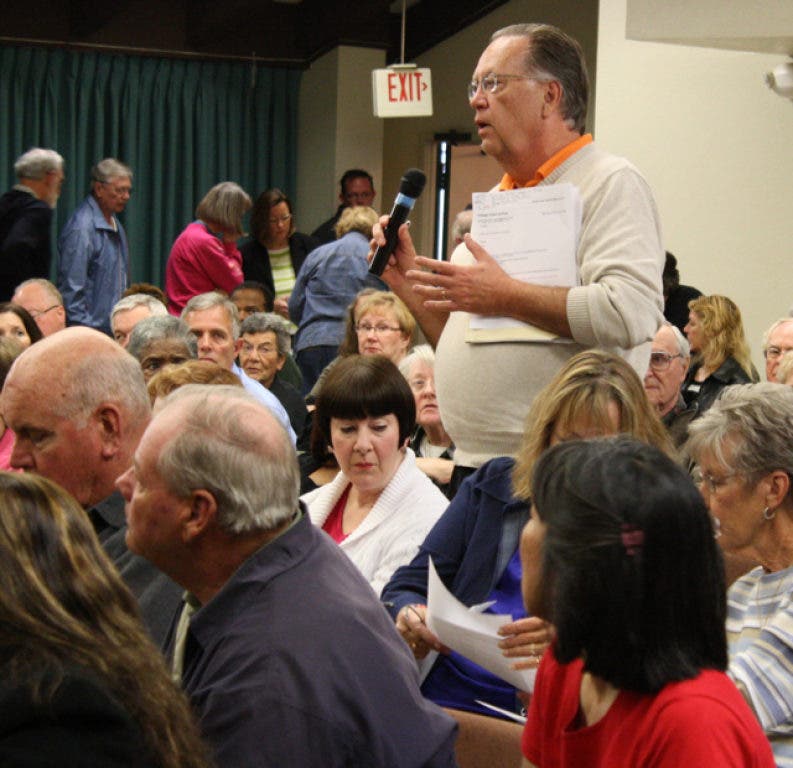

If any private-street residents have to pay extra for trash collection, all private-street residents should have to. And if the city wants to end the "free" trash pickup for HOAs, well, a lawsuit might be on the way.
These thoughts and more emerged during a Wednesday night town hall about Mayor Jerry Sanders' plan to end city trash collection on private streets—including many in Rancho Bernardo—in a little less than three months.
"I will not accept this without a fight," said San Diego City Councilman Carl DeMaio, who hosted the town hall at the Oaks North Community Center in Rancho Bernardo. The City Council may have the chance to challenge the mayor's plan the week of April 26, he said.
Find out what's happening in Rancho Bernardo-4s Ranchfor free with the latest updates from Patch.
[A list of affected HOAs in District 5, which includes RB, is attached to this story.]
DeMaio has been a vocal opponent of the mayor's plan, saying it goes against what residents voted for in 1986 when they approved a measure that lets residents on some private streets have the city collect their trash as long as they agree not to hold the city responsible for damage that may occur.
Find out what's happening in Rancho Bernardo-4s Ranchfor free with the latest updates from Patch.
Now the city wants to end those agreements to save money, which would require those residents to pay private haulers to come get their trash and recyclables. Currently, residents on public streets and those on private streets under "hold harmless agreements" pay no additional cost for trash collection.
More than 14,000 homes in 102 Home Owners Associations (HOAs) will be affected by the change.
"No one else says, 'Please come run over our sprinklers and we won't sue you,' "one woman said Wednesday night in protest of the plan to terminate the hold harmless agreements.
DeMaio said even residents who won't be directly affected by the change should pay attention, as this move could lay the groundwork for San Diego to end tax-funded trash collection for all residents. Trash collection is a basic service that residents should receive through their tax dollars, he said.
"This is a city government where [residents] pay more and get less," DeMaio said, adding he doesn't buy the claims that the change is needed to save money.
Putting trash collection services up for managed competition would likely save more money than cutting off service to certain residents, especially when no layoffs are planned along with the service reduction, he said.
The potential litigation over the cut also could cost the city, reducing any savings, he said.
Many residents at the town hall argued that it's not fair for them to lose their trash collection, forcing them to pay twice for the service: once through their taxes; and again through private haulers.
But city officials, and some at the town hall, have countered that it's not fair for these private-street residents to receive the trash collection at no additional cost when other HOAs have to pay.
The 1986 measure stipulated that any new private developments after that date could not receive hold harmless agreements and would have to arrange for their own trash collection. Nine out of 10 residential developments with private streets in San Diego pay for their own trash collection now, according to the mayor's office. About 60 percent of the city's occupied residential units receive trash service at no additional cost.
The 102 HOAs slated to lose their "free" trash service represent only 10 percent of all developments with private streets; the 14,200 residences that would have to begin paying comprise a little less than 3 percent of all occupied residential units.
The city has estimated that cutting service to these residents would save $675,000 for trash collection and $15,000 for recycling, and increase General Fund franchise fee revenue by $190,000 for a potential net benefit of $880,000. It could cost an estimated $400,000 to retrieve the city's trash bins from the areas no longer served, which would cut into the first year's gain, according to a city report. The city could also sell the bins to the private haulers.
The end of the town hall focused on what HOAs can do if their trash collection is cut. Harvey Levine of Bernardo Heights was designated a point-person to help attendees collaborate.
More questions from the town hall, with paraphrased responses from DeMaio's staff:
- Can some homeowners choose not to have their trash collected at all?
Some in the audience said the city's municipal code requires homeowners to have their trash collected, but DeMaio's staff said this would be a question for the City Attorney.
- Can the private streets be returned to the city to make them public?
It would take a legal agreement between the city, where the city buys the streets, and that is unlikely to happen.
- Can trash collection costs be a ballot issue again?
It would take a vote of five city council members, or the typical route of gathering public signatures to get the trash collection issue on the ballot.
- What happens when HOAs have some public streets and some private streets?
The city will collect the trash from the public streets but will not do so for the private streets, even though they are in the same development.
- Is the city mandated to still pick up greenery, even if it no longer picks up trash and recyclables?
No.
Get more local news delivered straight to your inbox. Sign up for free Patch newsletters and alerts.