Crime & Safety
Redlands Connection to Watergate 40th Anniversary: Haldeman Went to U of R
H. R. 'Bob' Haldeman, White House chief of staff for President Richard Nixon and a key figure in the scandal that forced Nixon to resign, attended the University of Redlands from 1944-45 as an apprentice seaman in the U.S. Navy.


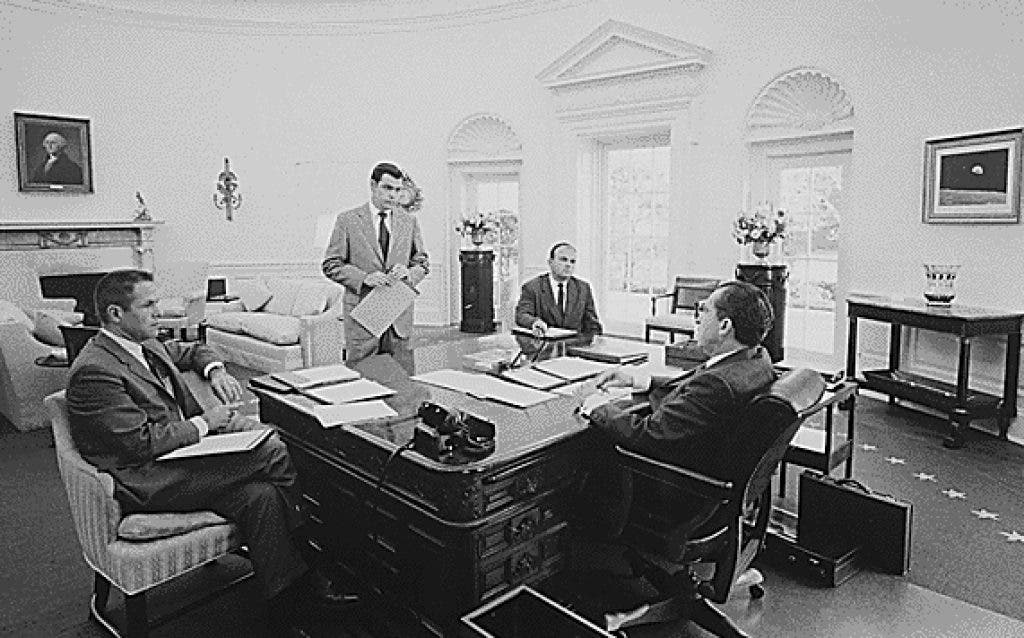

The Watergate break-in of June 17, 1972 that ultimately led to the resignation of President Richard M. Nixon was 40 years ago this Sunday, and the Washington Post is in the midst of a multi-feature retrospective.
Anchoring a Post web page devoted to "Watergate at 40" is a June 8 report by reporters Carl Bernstein and Bob Woodward, billed as their first shared byline since 1976 and headlined "Nixon was far worse than we thought."
A Redlands connection to Watergate is that H.R. "Bob" Haldeman, Nixon's chief of staff and a key figure in the scandal that began unfolding 40 years ago, attended the University of Redlands from 1944-45 as an apprentice seaman in the U.S. Navy.
Find out what's happening in Redlands-Loma Lindafor free with the latest updates from Patch.
On June 18 and June 25, 1991, Haldeman gave tape-recorded interviews with Dale E. Treleven of the University of California Los Angeles Oral History Program, and he spoke about his memories of Redlands. The interviews are also part of the California State Archives.
Haldeman told Treleven he was born in his grandparents' apartment in the mid-Wilshire area of Los Angeles on Oct. 27, 1926. His parents built a house in Beverly Hills and moved there shortly after he was born. When he was around 10 years old, he and his family moved to Toluca Lake in the San Fernando Valley. He attended North Hollywood High for a time, then transferred to the military Harvard School on Coldwater Canyon Avenue, where he finished secondary education in 1944.
Find out what's happening in Redlands-Loma Lindafor free with the latest updates from Patch.
Haldeman's remarks - about his time before going to Redlands and his recollections of Redlands itself - are quoted here verbatim from the June 1991 interviews.
HALDEMAN: Okay. I graduated from high school at Harvard in 1944, and graduation was June 10 or something like that, and on July 1 I reported for active duty in the navy. And that active duty assignment was at the University of Redlands.
TRELEVEN: Okay, now I have for your undergraduate education you had gone to USC.
HALDEMAN: I did, but that's later.
TRELEVEN: That's later.
HALDEMAN: Yeah.
TRELEVEN: So I've got these turned around.
HALDEMAN: They're reversed.
TRELEVEN: Okay, so . . .
HALDEMAN: I started at the University of Redlands in July of 1944 as a freshman enrolled as a regular freshman in the university curriculum and as an apprentice seaman in the navy V-12 unit at the University of Redlands.
TRELEVEN: Okay.
HALDEMAN: We were housed in a university dormitory, and there were four big dormitories that the navy had taken over, three of them for V-12 people and one of them for marine V-12 people. They were marine privates instead of navy apprentice seamen.
TRELEVEN: Right.
HALDEMAN: But going through basically the same program that we went through. And . . .
TRELEVEN: So you're going from Episcopalianism to Presbyterianism.
HALDEMAN: Episcopalian to Presbyterian and from an army ROTC to the navy V-12. I made a jump, yeah. University of Redlands was a weird place for a navy unit, because there was not only no smoking, no swearing, or anything like that permitted on the campus, there was no dancing permitted on the campus.
TRELEVEN: Oh my gosh.
HALDEMAN: The university commons, which was the student facility center on the university, had been taken over by the navy and operated by the navy as our . . . . That was our mess hall. All the navy units ate in there. We formed regular platoon formation in front of our dormitory for breakfast, lunch, and dinner, and then marched.
TRELEVEN: Marched over.
HALDEMAN: Over to the mess hall and then marched into the mess hall. The coeds on campus, I think they must have eaten somewhere else. I don't think they ate in the mess hall at all. We did though . . . . Because it was a navy base, it was no longer a campus. It was determined that we could have dancing there, so we did have some dances there from time to time. But. . .
TRELEVEN: But no other sins.
HALDEMAN: No other sins. Well, there were a few, but they weren't admitted. [Laughter] But that was a very intensive program. I took eighteen units of regular courses plus six units of navy courses, so I was running a twenty-four-unit program. And at that time Redlands was on the semester system and had normally two semesters a year, the fall semester and the spring semester. In the accelerated activity during the war they added a summer semester, so there were three four-month semesters in the academic year, and they went around the clock, the program went around the clock. I worked my tail off academically, physically, and militarily through that time. I did extremely well. I got top grades.
TRELEVEN: Even in engineering?
HALDEMAN: Even in engineering. I did very well.
TRELEVEN: You didn't like it, but you really worked.
HALDEMAN: I hated it. Even in engineering drawing, which was really awful for me, because I have no manual talent for artistic expression at all. It was very difficult, but it was a required course. We had the navy. . . . That was one of the navy courses we had to take, engineering drawing, heat power, advanced physics, calculus, vector analysis, differential equations, all the higher mathematics stuff. We were doing all that sort of thing in the navy-required stuff. And then I was taking a normal liberal arts college curriculum. You asked about teachers. I only remember there one outstanding teacher, and that was a guy named Fred Mayer, who was a philosophy professor. That was my first exposure to philosophy, and I was absolutely fascinated. It was a very . . . . It was that typical, you know, college freshman, exciting, opening of the world type course. I really, really got a lot of interest out of that. All the males on the campus, virtually - there were a few 4-F's that were there - but virtually all the males on the campus were navy V-12 people, navy-marine V-12 people. Then there were a lot of girls on the campus, and the normal classes we attended with the girls were regular college classes like the philosophy class. Then the navy classes were separate. We also had to take naval science and tactics or whatever it was. They were the navigation courses in navigation, and we had to learn the Morse code and all that kind of stuff that the navy required us to do. Then we had inspections every day and military drill every day and about three hours I think of physical training. We had morning calisthenics every morning for half an hour. Then we had an afternoon physical training program, obstacle courses and all the stuff that the services used to lay on. So it was a pretty intense period. I was there for four semesters, which would be the summer of '44 and then fall, winter, and summer . . . . Fall, spring, and summer of '44 to '45. The war ended in the summer of '45, and at that point the navy had this vast army of potential officer material scattered into not just the University of Redlands but all the colleges in the country practically, I guess between the navy and the army. They were breeding their officer training units and they tried to figure out what to do with us and finally concluded that they would not discharge us from the navy, they would transfer us to the naval ROTC. But there were no naval ROTC units at Redlands. There were only four ROTC units in California: 'SC, UCLA, Stanford, and Cal [University of California, Berkeley]. So all of us in the Redlands unit were given the opportunity to select a college that we would like to go to when we were transferred to the ROTC unit, which would be in the fall of '45. And at the Redlands unit everybody who selected 'SC was sent to UCLA. Everybody who selected UCLA was sent to 'SC. Everybody who selected Cal was sent to Stanford, and everybody who selected Stanford was sent to Cal without exception.
TRELEVEN: You're serious!
HALDEMAN: I am absolutely serious.
TRELEVEN: Why?
HALDEMAN: Well, I think probably because there was a yeoman enlisted man somewhere processing all these requests and applications and everything who said, "Screw these, you know, smart-ass officer candidates." There's probably, you know, a chief yeoman's mate who had been in the navy for - I don't know this, this is my suspicion - that had been in the navy for thirty years, was fed up with us, you know, these "ninety-day wonder" types, so he said, "One thing I can do is I can at least make sure they don't get to the college they wanted to go to." So that's how I got to 'SC. I had selected UCLA.
TRELEVEN: So you selected UCLA.
HALDEMAN: And got sent to USC. We were then just transferred, still on active duty in the navy, to the naval ROTC unit, which was an active duty unit at that time. All ROTC units were. All college ROTC units were active duty units. So you were in the naval reserve, but it was the active duty reserve. So I then spent the fall . . . . 'SC was also on the semester system at that time, so I spent the fall and spring semesters at 'SC in the navy unit there still on active duty. I lived in von KleinSmid Hall, but it was a navy dormitory, and it was operated the same as the V-12 dormitory. We'd form formation and march to chow and march back and had navy inspections and all that. There I discovered . . . . And the war was over, so the heat was off, and we didn't know what was going to become of us, but they wouldn't let us out of the navy at that point yet. So I had by then started to learn something about how to survive life in the navy, and I found that at 'SC if you were a member of the 'SC band, the Trojan band, you didn't have to stand Saturday morning either calisthenics or inspection. Saturday morning inspection was god-awful at 'SC, very strict, white glove-type inspection, really overdone type of thing. So I joined the band. I had played in the navy band at Redlands. I played the accordion, because also at Redlands you could get out of some form of calisthenics. There's something you got out of if you were in the band at Redlands. And so I got in the band, and I couldn't play anything except the accordion, and so they had never heard of an accordion in a marching band, but they put one in, because they figured the more bodies, the better the band would look. So I marched along trying to play by ear "Semper Fidelis" or whatever it was on the accordion. So when I got to 'SC I knew they wouldn't put an accordion in the band, but that was a good way of getting out of some stuff, so I volunteered for the band. They said, "What do you play?" And the only thing I could think of was cymbals that I figured I could handle all right or bass drum. And I didn't want to lug a bass drum around, so I volunteered for cymbals, and I was put into the 'SC band as a cymbal player. So I got to get out of navy uniform. We went to class in navy uniform. We stayed. . . . Because we were on active duty.
TRELEVEN: I was going to ask that.
HALDEMAN: We'd wear the uniform all the time at Redlands and all the time at 'SC.
TRELEVEN: All the time.
HALDEMAN: The ROTC uniform was the midshipman-type uniform rather than the . . . . At Redlands we wore the bell-bottom trousers and the . . .
TRELEVEN: White hats.
HALDEMAN: White hats. At 'SC we wore a black tie, coat and tie, and the blue jacket, or when we had fatigues, khaki fatigues, tie and no jacket. But the khaki, black tie and khaki pants, and black shoes.
TRELEVEN: Becoming a gentleman.
HALDEMAN: Yeah. So-called. So I went into the band there, and that got me out of whatever it was I was trying to get out of. And as a result I am able to tell my children that I played in the Rose Bowl for 'SC in 1946, which is literally true. I played the cymbals in the Trojan band, but 'SC did go to the Rose Bowl that year.
TRELEVEN: I'll be darned.
+++
Haldeman later attended UCLA and joined the advertising firm of J. Walter Thompson. He worked for Nixon as an advance man on Nixon's 1956 and 1960 campaigns, and he managed Nixon's 1962 run for Governor of California. When Nixon was elected President in 1968, he named Haldeman his chief of staff.
In the Nixon White House, Haldeman was a strict gatekeeper of the Oval Office and called himself "the president's son-of-a-bitch," according to the Washington Post.
"From the start, Haldeman played a leading role in the Watergate cover-up," the Post reported. "On June 23, 1972, six days after the botched break-in, Haldeman spoke with Nixon about using the CIA to divert the FBI's investigation of the burglars. When the White House released a recording of his June 23, 1972, conversation two years later, it was dubbed 'the smoking gun' tape because it showed conclusively that Nixon had orchestrated the cover-up all along. Haldeman was forced to resign, along with John D. Ehrlichman, on April 30, 1973. He was convicted of conspiracy and obstruction of justice the following year."
Haldeman spent 18 months in prison for his role in Watergate, according to the Post.
He died of cancer at his home in Santa Barbara, Calif., on Nov. 12, 1993, six months before publication of "The Haldeman Diaries," recounting his White House experience. He was 67.
For more information about the Haldeman oral history and to read a copy of the transcript, visit www.sos.ca.gov/archives/oral-history/pdf/haldeman-1.pdf and www.sos.ca.gov/archives/oral-history/pdf/haldeman-2.pdf.
Get more local news delivered straight to your inbox. Sign up for free Patch newsletters and alerts.