Home & Garden
Let's Give Some LUV to the Electric Cars Tooling Around Redondo
Neighborhood Electric Vehicles will cut pollution, greenhouse gas emissions and traffic congestion on our busiest streets if given the chance.



I've got to admit I came to this column about short-range, slow-speed Neighborhood Electric Vehicles (NEVs) with a negative bias.
I'm a strong proponent of full speed electric vehicles and I've been growing increasingly excited about the new plug-in Nissan Leaf and Chevy Volt coming to market later this year.
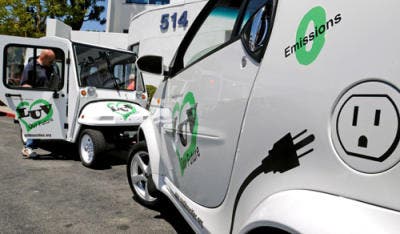
So I just couldn't get too worked up about the South Bay Cities Council of Government's "LUV" (Local Use Vehicle) test program of neighborhood electric vehicles that are restricted to a 25 mile per hour top speed, could only be driven on streets with a maximum 35 mph speed limit, and came with no air bags or other advanced safety features.
Find out what's happening in Redondo Beachfor free with the latest updates from Patch.
When the first cars in the LUV program were introduced at last year's Riviera Village Summer Festival, I was one of the volunteers showing the cars off to the public, answering questions about them and signing up potential test drivers. I even took an orientation class to learn about the cars and the program. Honestly, upon seeing the first cars I couldn't help but think that anyone driving one would feel like they were sitting inside a piñata waiting to feel a shattering blow from a speeding Ford Excursion or a Hummer.
But that was before I learned there has already been a LUV verses Hummer accident where no one was hurt and the LUV car lived on. And that was before I had a conversation with Jacki Bacharach, the executive director of the South Bay cities council of governments and David Margarian, the environmental analyst supervising the program and crunching the data.
Find out what's happening in Redondo Beachfor free with the latest updates from Patch.
The half dozen LUV cars are all equipped with GPS tracking that compiles their route mapping info. That data is combined with trip logs that each driver keeps to track their destinations. When I saw Jackie and David give an update on the test's initial findings at the Council of Government's Green Task Force last week, David shared some cool animated maps (see my video) created using the data accumulated so far.
I was surprised to hear Jacki tell the group that she had gone back and forth in her own mind about the need for these LUVs in light of the new electric cars coming to market. "See?" I said to myself, "I'm not the only doubter." Jacki went on to talk about the value of what they were learning from the test, not just for South Bay planners, but for major plug-in car manufacturers and the charging station industry. Her agency wants to both encourage the manufacture of these battery driven cars and to help provide specific data to help bring them to the market.
Jacki later told me she was "feeling a lot better about the fact that what we're testing is really an important thing to test for the future of how people are going to travel." She said that the folks at Southern California Edison working on electric cars and chargers are convinced that short-range/slow speed vehicles do have a place on the road and that households will be using a variety of different kinds of cars depending on the kind of trip they're taking.
After just three months of testing, they're already learning some first lessons, one of which is to add "Neighborhood Vehicle 25 MPH" stickers to the back of each LUV so that impatient drivers behind them know what to expect. Another interesting finding is that different neighborhoods are showing different tolerances for the LUV cars.
"For example," David told me, "Right around the Riviera Village people seem to be very tolerant and happy to give these vehicles some space. But once you get onto the Peninsula, people feel like they're in unfriendly territory when they're driving their LUV." Having driven and bicycled on these same roads for the past 17 years I could relate.
I was real happy to hear that another thing they've learned is that there's a natural synergy between electric Local Use Vehicles and bicycles, which Jacki also considers local use vehicles that face many of the same challenges. Both also deliver pollution-free transportation and can help relieve traffic congestion on our most heavily traveled streets.
The manufacturers claim a range of 30-40 miles for the LUV cars, but real road use by the test drivers is showing a 20-22 miles "comfort range" with the average trip being a three mile radius drive. The argument in favor of these slow-speed, short-range vehicles is that you don't need a bigger, faster, more expensive vehicle to make those trips to Trader Joes, the Post Office, Starbucks, the bank, etc.
I am now buying that argument, especially when a LUV could replace a family's second or third car gas-powered car and maybe serve as their entry to emission-free plug-in transportation.
"And that's what makes this so exciting to me," said Jacki. "We are sort of at the head of all this. The market will play out in front of us, but we're testing a lot of different ways people use their vehicles, when they use them, the decisions they make when they walk out the door and those are all going to be helpful in the future no matter which way the market goes."
I agree, and I wound up doing such a 180 on my viewpoint so that I am now applying to be a volunteer test driver. If accepted, I intend to offer regular video reports of my adventures. Stay tuned.