Health & Fitness
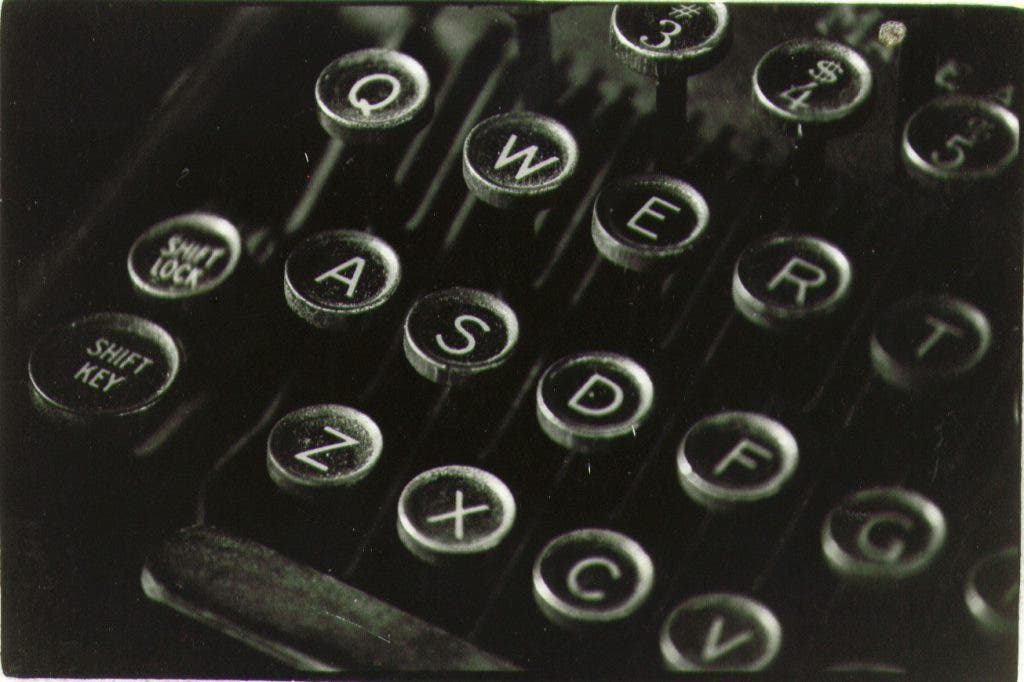
Blog: QWERTY -- Age Old Ingenuity In a New Age World
It was designed to slow us down, yet we can't let it go, despite our fast paced technology.
I recently read an article from Beloit College stating that today’s incoming college freshmen have never known a world without computers or the Internet.
When I was a college freshman, my experience with technology was limited to a typewriter, cassette tape recorder, and a record player.
Back then, career choices were also limited. Girls were basically given two options: work in an office or get married and raise a family.
Find out what's happening in Rosevillefor free with the latest updates from Patch.
I took the first option and chose high school clerical classes which focused on typing, shorthand and operating a switchboard.
That’s where I was first met "Qwerty".
Find out what's happening in Rosevillefor free with the latest updates from Patch.
Q-W-E-R-T-Y are the first six keys on the upper left row of a typewriter. Today, computer keyboards still use the same layout, invented in 1872 by Christopher Latham Sholes.
Popular belief claims that the keys were placed in this order to prevent them from jamming when words were typed too quickly. Although we no longer use machines with keys that jam, we still use the Qwerty-style keyboard.
Memorizing Qwerty, along with the rest of the keys on the typewriter was necessary in order to touch type. Typing without looking at the keys was easy; correcting typing errors was a nightmare.
Unlike today’s computers, we didn’t have a delete or backspace key which magically made errors disappear. We had to pull the carriage back to the typo, use white correction tape to conceal it, and then retype the correct letter over it. This was a lengthy, time-consuming process, which trained us early to make as few mistakes as possible.
One day in class, our teacher issued a challenge to see who could type the fastest, with the fewest amount of errors, during a three-minute timed test.
Judging the competition, I thought I had a chance at the prize.
I practiced by typing, "The quick brown fox jumps over the lazy dog,” over and over for weeks on end. That particular drill insured that every letter on the keyboard was used, which helped me build speed, accuracy and agility.
Unfortunately, all my practicing was in vain. Just before the day of the test, I broke my right index finger.
Determined, I took the test anyway, splint and all.
I didn’t win the prize, but I did win the teacher’s admiration, and aced the class.
Ironically, I never got a job in an office. I ended up choosing option two instead, and never regretted it.
Despite all the technological advances, Shole’s keyboard arrangement has withstood the test of time.
No matter what the newest electronic gadget is, chances are, 100 years from now, college freshman will still never know a world without a Qwerty keyboard.