Crime & Safety
CSI Roseville: Not Like the TV Show
Forensics investigator offers rare sneak peek into the profession at the Roseville Police Department.
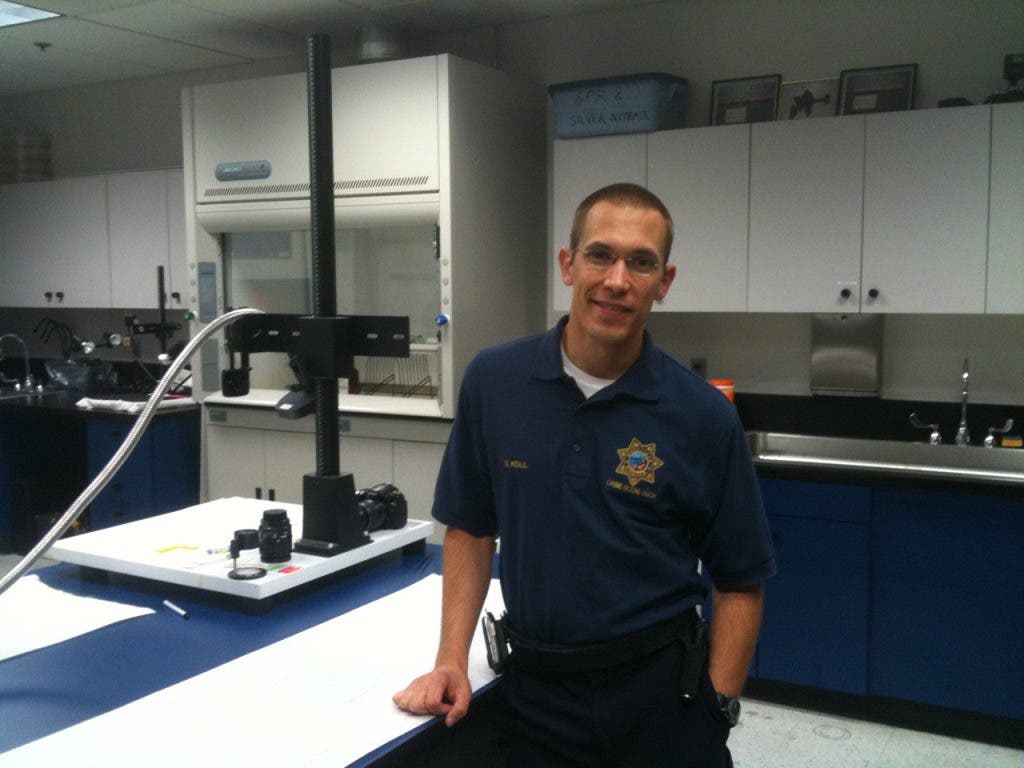
In a secluded wing of the ’s fortress-like headquarters, Scott Koll is explaining why his work as a crime scene investigator is nothing like a certain procedural drama.
“We help solve crimes, but one - we don’t look like Hollywood; two - we don’t drive Hollywood vehicles; and three - we don’t have stunt doubles,” the affable forensic investigator said in distancing his profession from the popular CSI franchise on CBS.
More pressingly, the state-of-the-art crime lab Koll offered a rare tour of on a recent afternoon does not crack increasingly elaborate cases in 44 minutes using an overwhelming onslaught of dazzling forensic equipment, despite what a growing number of people might think.
Find out what's happening in Rosevillefor free with the latest updates from Patch.
On this particular day, Koll is eyeballing elongated fingerprint samples taken from the scene of a bank robbery for potential points of comparison. It’s painstaking work, requiring Koll to go back and forth from one imperfect sample to the next, using nothing but a magnifying glass and his increasingly strained vision to search for that elusive match.
“Science is about facts. It doesn’t give you what you hope for,” Koll explained, before joking, “So basically I’m a huge disappointment to people is what I’m saying.”
Find out what's happening in Rosevillefor free with the latest updates from Patch.
That’s because the evidence Koll and his fellow CSIs collect sometimes force detectives to rework their theories about a particular crime.
“The fun part of our job is we’re that unbiased scientific side,” Koll said. “We’re not trying to actually put the pieces together. We’re just showing what evidence is there.”
And they’re doing it with an assortment of high-tech lab equipment that look surprisingly like household appliances: something resembling a refrigerator is where hot glue prints are made of evidentiary items; a contraption similar to a clothes dryer is where evidence is, well, dried so that DNA samples and other biological materials can be safely preserved.
A recent coup for the city’s CSI unit is the new-found ability to differentiate blood evidence from other types of biological evidence.
“We can actually test with some certainty … whether what we collect is blood or seminal fluid,” Koll said.
That may be a far Hollywood cry from determining bullet trajectories using lasers and pin-holed crash test dummies, but it’s what passes for revolutionary in the real world. No other crime lab in Northern California has this capability, Koll believes.
Be that as it may, dramas like CSI Crime Scene Investigation and Law & Order: Special Victims Unit, as well as ever-speedier revolutions in technology, are making armchair experts of us all.
The “CSI effect,” as Koll and others call it, has become something of a double-edged sword to real-life crime scene investigators, heightening both an interest and appreciation for the profession, but also jacking the public’s expectations to unrealistic levels in some instances.
“Juries no longer accept my word,” Koll said.
Koll said he generally spends an extra 20 minutes on the witness stand simply explaining the basics of his job, so juries know not to expect a computer-generated three-dimensional image of a suspect’s face using nothing but a fingernail and eyelash.
But television’s influence on jury pools is also an anecdotal concern whose existence hasn’t yet been scientifically proven, despite claims that the jury in the Casey Anthony trial succumbed to the CSI effect.
A study published in the March 2008 National Institute of Justice Journal surveyed more than 1,000 Michigan jurors prior to their participation in trial processes on their television watching habits and expectations for scientific evidence.
According to the survey, prospective jurors who watched CSI generally had higher expectations of forensic evidence being introduced in court cases than non-CSI viewers, but weren’t any more likely to acquit defendants in the absence of such evidence.
While those results may give CSI a break, the same can’t be said for the impact an evolving technological landscape has had on us.
The swift advent of smartphone technology, global imaging systems, social networking tracking features and fingerprint recognition software at gyms may be increasing the public’s expectations of the judicial system. That’s a reality study author and felony trial judge Donald E. Shelton says the system must try to meet, either by getting the evidence jurors expect or better explaining when that evidence isn’t relevant.
“Even though our study did not reveal a so-called ‘CSI effect’ at play in courtrooms, my fellow researchers and I believe that a broader ‘tech effect’ exists that influences juror expectations and demands,” Shelton wrote.
A 2009 study published in the Stanford Law Review came to similar conclusions.
“In an earlier analysis of federal trial data, we found no change in acquittal rates correlated with the advent of CSI,” wrote co-authors Simon A. Cole and Rachel Dioso-Villa, law professors at the University of California, Irvine. “Although this finding does not itself disprove the CSI effect, it does suggest that the media claims that there is such an effect were premature.”
The study by Cole and Dioso-Villa analyzed acquittals in criminal cases.
Representatives from the Placer County District Attorney’s Office didn’t respond to requests for comment.