Schools
UPDATE: District Responds to D.A.'s Brown Act Allegations
The Orange County District Attorney's office sent a letter to the Capistrano Unified School District board and officials saying it could prosecute them for multiple violations of open meetings law.
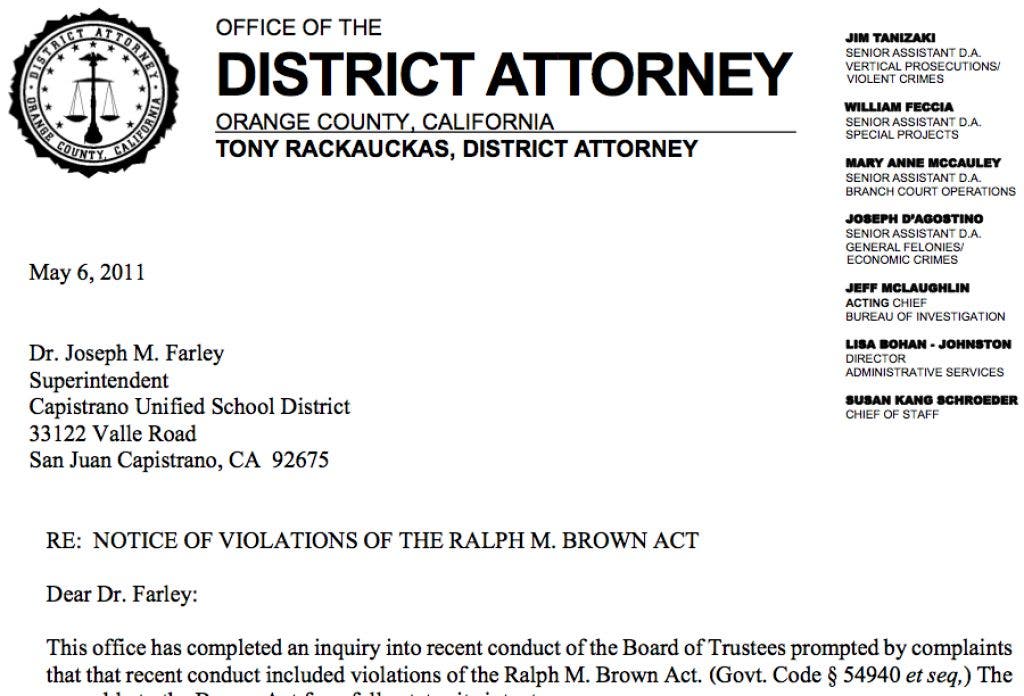

Updated at 4 p.m. May 6 to include responses from district spokesman Marcus Walton, as well as attorneys representing two trustees and a San Juan Capistrano resident who has brought a suit against the district.
The Capistrano Unified School District Board of Trustees violated the state's open meetings laws when it opted to, the Orange County District Attorney's office said in a letter Friday to Superintendent Joseph Farley.
The letter states that if the district takes corrective action, the D.A. won't pursue charges, but, "reserves the right to institute formal enforcement proceedings."
Find out what's happening in San Clementefor free with the latest updates from Patch.
The letter found that the Board of Trustees violated the Ralph M. Brown Act—which requires most business be conducted in open-session meetings—on at least three occasions. While altogether, the allegations do not arise to the level of criminal intent, given the district’s past problems with Brown Act violations, the board’s actions “constitute a pattern of conduct” that could be actionable.
“Counsel has not had an opportunity to review the District Attorney’s letter," district spokesman Marcus Walton said in an e-mail. "However, under its new leadership, the District’s practice has been to aggressively cure and correct any possible violations.”
Find out what's happening in San Clementefor free with the latest updates from Patch.
The first two violations are alleged to have occurred during a closed session meeting Dec. 13. The only item on the agenda that evening was a performance evaluation of Superintendent Farley. However, according to Senior Deputy District Attorney Ray Armstrong and Senior Assistant District Attorney William Feccia, the board discussed restoring two instructional furlough days the teachers agreed to take in their contract the board approved after the April 2010 strike.
Although an agenda item in the Jan. 11 board packet said the board approved the restorations at its Dec. 13 meeting, Farley and Walton have repeatedly said that report was in error.
The prosecutors, however, believe the board violated the Brown Act on Dec. 13 by discussing something not on the agenda and then failing to report out any action taken.
“The discussion of restoring furlough days to a collective bargaining unit cannot be reasonably construed to fall” under the topics permissible in an employee evaluation, the letter states.
“The restoration of previously ordered furlough days certainly 'affected' the employment status of the public employees involved. But the decision to do so was not subsequently reported in the public meeting in which the closes[sic] session had been held. This constituted an additional violation of the Brown Act,” Armstrong and Feccia wrote.
The board violated the Brown Act several times again at its Jan. 26 closed-session meeting, in which the board voted to partially restore teacher salaries. On an agenda revised two days before the meeting was a conference with labor negotiators, including the teachers union, Capistrano Unified Education Association.
The original agenda did not include a conference with negotiators. In documents obtained by Patch, a “time-sensitive labor negotiation matter” was added. Walton declined to identify what that item was.
“The [b]oard took action to restore teachers’ salaries in the closed session yet did not report that action taken in the open meeting wherein the closed session occurred,” wrote Armstrong and Feccia. “More egregiously, however, the [b]oard not only failed to report this action, but published minutes of the meeting which incorrectly stated that 'no action' had been taken on that agenda item. The conduct of the [b]oard at this meeting in not properly noticing the topic deprived the public of an opportunity to comment on the proposed action before or at the time the action was taken as required by” state law.
The third set of violations took place at a special meeting on March 16, ironically held to “cure and correct” any possible Brown Act violations alleged by San Juan Capistrano resident Jim Reardon, who has since based on similar accusations to the district attorney’s office’s.
Toward the end of the evening, trustee John Alpay made a motion that the board breech its contract with the teachers union. Although he would not describe the motion as sarcastic, he was clearly alarmed when President Jack Brick seconded the motion. Alpay asked for a quick recess, and the board adjourned without a vote.
Then the board members—without Ellen Addonizio and Sue Palazzo who had recused themselves from participating at the meeting at the advice of their lawyer – huddled together. When the meeting reconvened, Brick withdrew his second.
“That this violation was done in the presence of the [b]oard’s legal counsel, and that no attempt was apparently made to prevent it, renders it even more troubling,” the D.A.’s letter states.
In 2007, the district attorney’s office wrote a 60-page report about the then-school board, alleging similar violations, including discussing anything under the sun under the guise of a superintendent evaluation.
That letter to the district concluded with the assurance that, “Henceforth the Capistrano Unified School Board will diligently guard against Brown Act violations.”
Now that similar charges have emerged, “It is troubling that the District Attorney has now received evidence of additional Brown Act violations whose pattern emulates the unlawful practices of a past [b]oard,” the recent letter concludes.
Earlier this week, the , calling Reardon’s lawsuit—which contains similar accusations of Brown Act violations —“frivolous.”
Wayne Tate, the Laguna Hills lawyer who represents Reardon, reacted to the news about the D.A.’s letter by saying, “In reality, [Farley’s] assertions that Mr. Reardon’s accusations were frivolous were in themselves frivolous.”
Craig Alexander, the lawyer who advised trustees Addonizio and Palazzo to not participate in the March 16 vote to reaffirm the restorations said the D.A.’s letter “justifies and ratifies the decision of my clients to retain a lawyer.”
He added his clients only seek “openness, honesty and transparency.” He will continue to represent Addonizio and Palazzo as Reardon’s lawsuit moves forward.