Community Corner
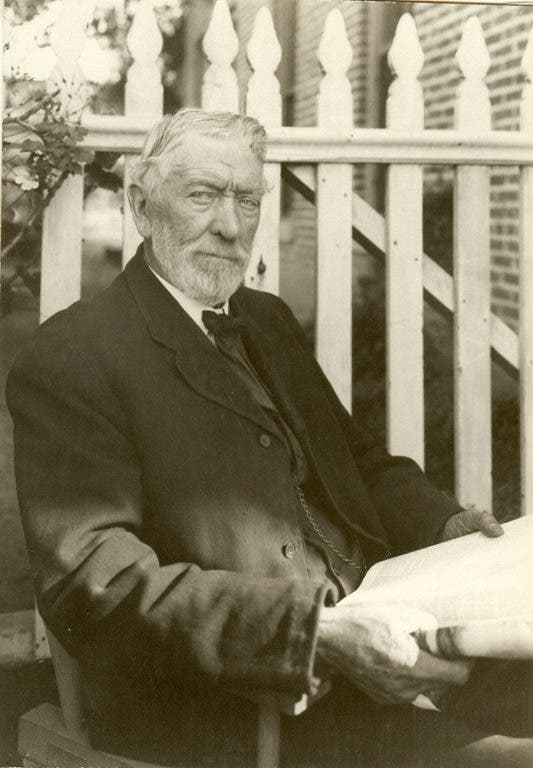
Capistrano’s Judge Egan: A Man of Many Talents
One of our town's most memorable residents was proclaimed the unofficial 'King of Capistrano' and remembered for, among other things, bringing the railroad and hosting magnificent galas.
San Juan Capistrano has always had its share of lively characters. We’ve already talked about a few of them: , who became one of Southern California’s largest landowners and even moved into the San Juan Capistrano Mission, and , the original owner of Rancho Niguel, who was known by all as El Rico, “The Rich One.”
Probably the biggest character of all, though, was Richard Egan, also known as “the Judge," or even “the King of Capistrano.”
Egan was an Irishman who came to San Juan Capistrano in 1868.
Find out what's happening in San Juan Capistranofor free with the latest updates from Patch.
This was still the era of the ranchos. No railroad had come through Capistrano, nor were tourists flocking to see the remains of the Great Stone Church or the beautiful Mission gardens planted by Father O’Sullivan. Instead, there was just a small village community surrounded by enormous farms and grazing cattle.
Egan moved onto a plot of land near Trabuco Creek growing barley, and quickly made a name for himself. In fact, Mary Ellen Tryon notes that throughout Egan's 55 years in San Juan Capistrano, his occupational pursuits included “farmer, telegrapher, notary, surveyor, agent for nearby landowners, keeper of rainfall records, dispenser of charity to the needy, and Justice of the Peace.” This last item is noteworthy because it is said that Egan charmed the community so much that voters elected him to the post in 1870, and for the next 20 years continued to do so without even putting his name on the ballot. From that point onward, Egan was known as “the Judge.”
Find out what's happening in San Juan Capistranofor free with the latest updates from Patch.
But it wasn’t just Egan's charisma that made him so popular. The Judge was also a part of San Juan’s high society, famous for the lavish balls and dinners he hosted at Harmony Hall, the two-story brick home he built for himself on Camino Capistrano in 1883. Pamela Hallan-Gibson points out that the Judge’s good friend, the famous opera singer Madame Helena Modjeska, dubbed him “king” and that Egan, in turn, began “knighting” all of his friends.
Indeed, it’s easy to see what made the Judge such a big personality around town. Still, Egan’s lasting impact on Capistrano was more than extravagant parties and a large ego.
He dramatically shaped the course of the town during the late 19th century by playing a key role in bringing the Santa Fe Railroad through San Juan Capistrano in 1887. Additionally, because of his surveying experience, Judge Egan served on the Los Angeles County Board of Supervisors from 1880 to 1884 (Orange County did not exist until 1889). Therefore, when Orange County did break away from Los Angeles, he was important in settling boundary disputes between the two counties. Lastly, when the Landmarks Club began its project to rebuild and restore Mission San Juan Capistrano in 1895, Egan helped spearhead the effort locally and did much of the physical restoration himself.
Clearly then, the title “King of Capistrano” comes off sounding a bit more fitting for Judge Egan. His stamp is unmistakably felt throughout the town. But kings, by their nature, are inherently controversial, and the Judge was no exception.
Pamela Gibson remarks that Egan got “mixed reviews” from others in the community, and that he used his position as a surveyor to advance his own interests: “It is said that he had a ‘rubber [surveyor’s] chain for the rich’ and an ‘iron chain for the poor’ when called upon to make a boundary decision.”
Whatever the case might be, there is no denying that Judge Egan was one of San Juan Capistrano’s most intriguing personalities. I would like to end with one final tale, probably the most famous about him. Although its validity is uncertain, it has become one of San Juan Capistrano’s notable legends.
The story, as it appears in Pamela Hallan-Gibson’s Ghosts and Legends of San Juan Capistrano, begins in 1870, shortly after Egan arrived in San Juan. Another Irish family, the Sheehans, had also just moved into town, and their daughter Mollie would be deemed the “acknowledged belle of Capistrano.” Egan and Mollie quickly became good friends and he would often escort her to town fiestas to acquaint her with the community.
The year 1870 was also when the telegraph came to San Juan Capistrano, and Egan became the town’s first operator. Thus, he was on hand to record and deliver an incoming message from a Montana man asking Mollie’s hand in marriage. The broken-hearted Egan reportedly found Mollie in the Mission and waited for her answer. Possibly, Mollie was waiting for Egan to intervene, but when he said nothing, she “looked up, sighed, and instructed him to wire back her consent.” Soon after, Mollie moved away.
Sadly, the Judge remained single until his death in 1923. But it is said that once a year, until his own death, he would tend the graves of Mollie’s dead relatives, a sign of his still broken heart.
Further Reading: Pamela Hallan-Gibson’s Two Hundred Years in San Juan Capistrano and Ghosts and Legends of San Juan Capistrano, as well as Mary Ellen Tryon’s A Guide to Historic San Juan Capistrano