Schools
Common Sense Approach to Funding CA Public Education:
Abolish the California Lottery - Increase Per Pupil Funding by $34 and Save Taxpayers Millions in Employee Pensions and Benefits Costs
The Lottery was created for the sole purpose of providing “supplemental” revenue to public education without the imposition of additional or increased taxes. “Supplemental” revenue that was to be used for “instructional materials and supplies”, and the “enrichment” or “expansion” of existing programs and levels of service.
It was never meant to fund general fund expenses such as increased compensation for current employees.
Government Code Section 8880 - 8880.14(i)(j)(k)
Find out what's happening in San Juan Capistranofor free with the latest updates from Patch.
8880.1. Purpose and Intent
The People of the State of California declare that the purpose of this Act is support for preservation of the rights, liberties and welfare of the people by providing additional monies to benefit education without the imposition of additional or increased taxes.
Find out what's happening in San Juan Capistranofor free with the latest updates from Patch.
The People of the State of California further declare that it is their intent that the net revenues of the California State Lottery shall not be used as substitute funds but rather shall supplement the total amount of money allocated for public education in California.
(i) No Budget Act or other statutory provision shall direct that payments for public education made pursuant to this chapter be used for purposes and programs (including workload adjustments and maintenance of the level of service) authorized by Chapters 498, 565, and 1302 of the Statutes of 1983, Chapter 97 or 258 of the Statutes of 1984, or Chapter 1 of the Statutes of the 1983-84 Second Extraordinary Session.
(j) School districts and other agencies receiving funds distributed pursuant to this chapter may at their option utilize funds allocated by this chapter to provide additional funds for those purposes and programs prescribed by subdivision (i) for the purpose of enrichment or expansion.
(k) As a condition of receiving any moneys pursuant to subdivision (a) or (b), each school district and county superintendent of schools shall establish a separate account for the receipt and expenditure of those moneys, which account shall be clearly identified as a lottery education account.
Created to “benefit students”, Lottery Funds were earmarked for textbooks, instructional supplies, enrichment opportunities and program expansion. However, like all revenues streams created to “benefit students” (Prop 30 revenues as one example), 80% of revenues are currently being used to maintain existing levels of service and to expand employee compensation. Lottery revenues are not, as required by law, being used for instructional materials and supplies, to expand programs, or for enrichment above and beyond a minimum curriculum. The truth is that Lottery funds have replaced State education funding rather than supplemented State educational funding.
This year the State Lottery revenues are expected to bring in a record high $6 billion in revenues with $1.4 billion in revenues going to public education (23% of total revenues down from 39.2% in 1984 when the Lottery was first created).
Does the State of California really need a $6 billion dollar per year government bureaucracy with over 300 employees housed in a $58 million dollar building to provide the public education system with an additional $34 per student in supplemental funding?
THE LOTTERY: A COSTLY, UNSUSTAINABLE BUREAUCRACY THAT FAILS TO MEET IT’S STATED PURPOSE
This year (2015-16) Lottery funds are projected to hit a record high $6 billion in revenues and provide $1.4 billion for public education. However, due to a 2010 amendment to the law, Lottery revenues have doubled, but the percentage of revenue paid to schools has declined from 39.2% in 1984 to 23% in 2015-16. Despite record high revenues, public education has not seen much increase in supplemental funding from the State Lottery. The Lottery has grown into a huge adult jobs program, housed in a new $58 million dollar facility, with over 300 employees. Today, 77% of Lottery funds are going to administration and prizes, with a record low 23% to benefit public education as promised.
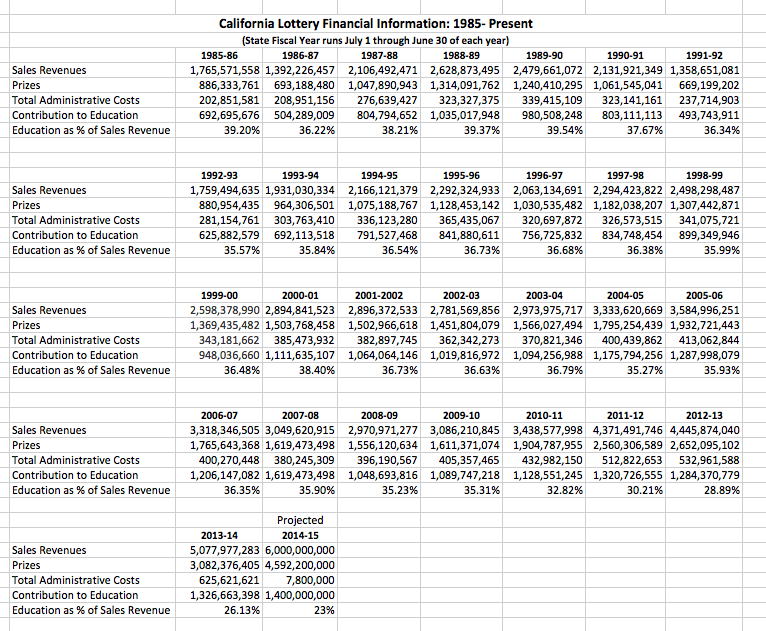
California Lottery Financial Information from 1985- 1999 was provided by the Lottery in response to a Public Records Request.
Lottery Reports for the years 1999 to the present can be found at the following link:
http://www.calottery.com/sitecore/content/ARCHIVE/media/reports/reports-to-public
HISTORY OF THE LOTTERY:
1984
In 1984, Proposition 37 aka The California State Lottery Act of 1984 amended Article IV Section 19 of the California Constitution to authorize the establishment of a statewide lottery. The sole purpose of the Lottery Act was to provide supplemental monies to benefit public education (specifically to provide guaranteed funds for textbooks and supplies) without the imposition of additional or increased taxes.
In 1984 the Lottery was administered by a five-person Commission appointed by the Governor and confirmed by the State Senate.
The Lottery Act required that revenues be spent as follows:
- 34% Public Education (28% to K-12 + 6% to Colleges and Universities)
- 50% to Prize winners
- 16% to administrative costs
2000
In 2000, Prop 20 aka Lottery Funds for Text Books was passed by the Legislature as AB 1453 and changed the way Lottery Funds were allocated.
Under Prop 20, K-14 schools received a larger percentage of lottery funds based on the wording of the Proposition which required that 50% of the Statewide growth in the lottery fund will first be distributed to K-14 schools to be earmarked for instructional materials. Then remaining funds would be distributed equally based on ADA. That meant that higher education and other state operated schools would no longer receive a share of the first 50% of growth funds. The result: Prop 20 gave K-14 schools a much larger slice of the Lottery pie.
See: May 10, 2000 letter from the California Department of Education
2003
Despite the California Department of Education’s recommendation that Lottery Funds (one-time money) be used for books and supplies, a 2003 State study concluded that 80% of Lottery Funds for public education were in fact going to employee salaries, pensions and benefits; and not to textbooks, materials and supplies.
* School Districts all over the State still continue to use 80% of their Lottery revenue for general fund purposes which is really against the law according to the actual language of Government Code Section 8880 - 8880.14(i)(j)(k) referenced above allocating the remaining 20% for the Lottery’s stated purpose.
2010 When BIG GOVERNMENT took the Lottery away from the kids.
In 2010, AB 142 California State Lottery amended the Lottery Act to allow the Lottery flexibility to pay out more money in prizes, and reduce the administrative cost limit to 13% of total revenues. Along with that flexibility, the new law required the Lottery to meet minimum levels of contribution to public education.
The act repealed the the requirement that at least 34% of revenues go to go to public education, and required the following:
A. Not less than 87 percent (an increase of three percent from current law) of the amount of the total revenues shall be returned to the public:
(1) Not less than 50 percent of the total revenues shall be returned to the public in the form of prizes, as determined by the Commission.
(2) The percentage of the total revenues to be allocated for public education shall be established by the Commission at a level designed to maximize the total net revenues for public education.
B. No more than 13 percent (a decrease of three percent from current law) of the total revenues shall be allocated for the payment of expenses of the Lottery.
The amendment required that revenues be spent as follows :
- % to Public Education to be established by the Commission
- 50% or more to Prize winners
- No more than 13% to administrative costs
AB 142 Repealed the requirement that a fixed 50 percent of the total annual revenues shall to be returned to the public in prizes.
AB 142 Repealed the requirement that at least 34 percent of the total annual revenues are to be allocated to the benefit of public education.
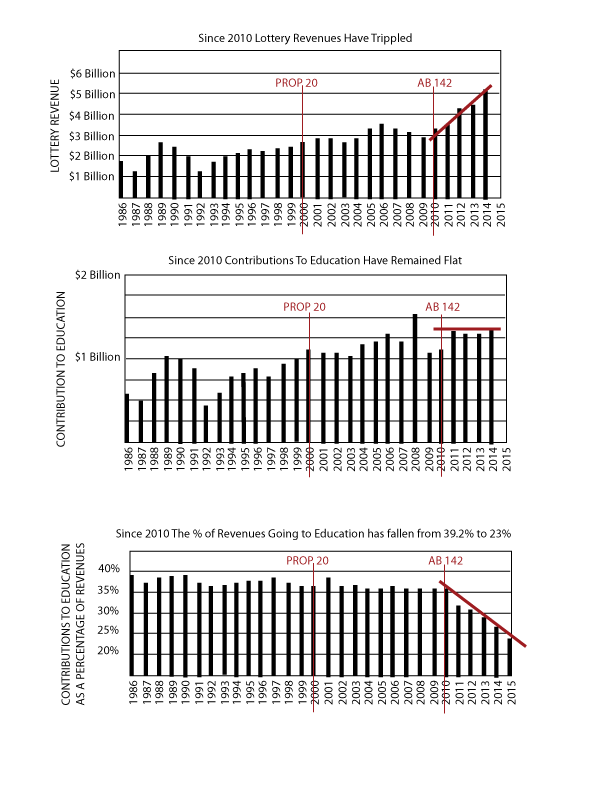
The result of AB 142 was to increase prize money to grow lottery revenues, but contributions to education as a percentage of revenues has consistently declined since the passage of AB, 142, providing little growth in the amount of lottery revenue going to public education. The percentage of Lottery Funding going to Public Education has declined from 39.2% at its inception to a projected 23% today and it will continue to decline.
2011
The Lottery moved into a new $58 million dollar headquarters. That building was constructed in 90 days to meet the requirements of the ballot measure that activated the lottery in 1985.
2015
The Lottery has become a giant bureaucracy with hundreds of employees. While Revenues have doubled since 2010, the percentage of revenues going towards prizes has increased while the percentage of revenues going towards education has declined 39.2% down to 23%. The result- revenues to schools since the passage of AB 142 has remained flat. With growing enrollment the result is a substantial decline in per pupil benefit.
How CUSD Spends it’s Lottery Revenues
The Capistrano Unified School District received $8,717,387 in total Lottery Revenues in 2014-15
Lottery Funds are Object Code #8560 in the CUSD Budget
2014-15 Estimated Actuals
- Unrestricted $6,760,599 (78% Salaries-pensions-benefits)
- Restricted $1,956,788 (22% Instructional Materials)
- Total $8,717,387
2015-16 Budget (a decline of 3% from previous year)
- Unrestricted $6,679,168
- Restricted $1,701,286
- Total $8,380,454
In CUSD only 22% of Lottery Revenue goes to the Lottery’s intended purpose (Instructional Materials and Supplies) $34 per student.
This story is to long for the Patch - continue to see:
Salaries-pensions and benefits of the 302 CA State Lottery Employees and supporting documentation.
http://disclosurecusd.blogspot.com/2016/02/where-did-all-lottery-money-go-as-usual.html