Community Corner
Integrated Pest Management: Bugs with Benefits
There are certain insects you should welcome into your garden, ladybugs included.


As early as I can remember, I've been questioning the application of chemical fertilizers and pesticides on lawns and gardens. Working in the yard alongside my mom, I'd ask her how the sprays and pellets she freely sprayed about the house worked exactly. She'd explain that they were chemicals that could kill weeds, snails and other unwanted bugs. "How do they know what we want to die and what we don't want to die?" She'd look down at the area she had just sprayed and pause.
As I got older, things only got worse for mom. On my trips home from college, now armed with knowledge of organic and inorganic chemistry, I’d harass her and my father about their habit.
To my mom: "That all ends up in our oceans, you know. When I come back home this summer and hit the beach, I’ll probably be swimming in it. Thanks, ma."
Find out what's happening in San Juan Capistranofor free with the latest updates from Patch.
To my dad: "Let me get this straight. You feed it chemical fertilizers so it will grow tall and thick…and then you get out there and complain about how you have to mow it down every week?"
Now that I have a lawn of my own, I enjoy not chemically fertilizing it (that’s what compost heaps are for) and not using pesticides. Instead, I welcome a wide variety of plants into the yard—this degree of biodiversity ensures one disease or pest won't wipe out our greenery—and I select native plants to ensure they have what it takes to withstand the local climate and, yes, potential barrage of native insects. Biodiversity and native plant selection are two tactics behind integrative pest management (also known as IPM), which the Environmental Protection Agency defines as "an effective and environmentally sensitive approach to pest management that relies on a combination of common sense practices."
Find out what's happening in San Juan Capistranofor free with the latest updates from Patch.
I will concede to this article's readers—and Mom and Dad, too—that integrated pest management takes time and effort. A well thought-out IPM plan begins with plan selection and continual evolves with crop or plant rotation and the release of beneficial insects. One truly can't do it all on their own. To get rid of a recent aphid infestation, for example, I had to recruit 1,501 friends.
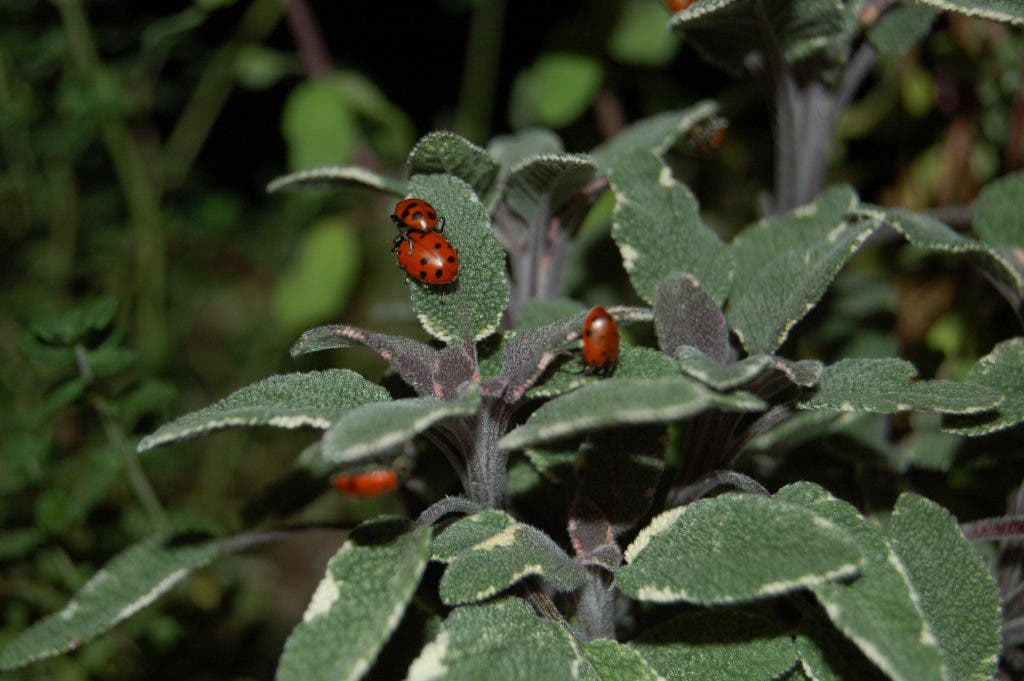
Releasing beneficials is a really fun, really easy way to get garden insect issues under control. It's the perfect opportunity to get children in on the fun as well; an extra set of little hands is quite helpful when over a thousand bugs need to be wrangled. Last week, I recruited my husband (friend number 1) and 1,500 ladybugs (friends 2-1501) to manage the situation. Our carefully planted basil, dill and tomato plants were covered with aphids that were literally sucking the life out of the plants. Using an IPM technique, we countered the infestation not by applying a chemical killer, but by introducing a natural predator.
In its 3-6 week lifespan, a ladybug can eat 5,000 aphids! They’ll also make a meal out of whitefly, mealybug, scales, mites and tomato worms. They're so effective that most nurseries carry them year-round. I got my army for a cool $7.99.
How is a beneficial release done? It's best to release beneficials at night. They aren’t as active in cooler weather, which means they’ll be less likely to fly away. Place them any and everywhere—on spinach, lettuce, cilantro, sage, citrus, etc.
Quick tip: keep the carrier carton in the fridge for a few hours prior to the release, again this is to slow the ladybugs down so they don’t have enough energy to leave the yard straight away. After all, it’s not actually the ladybugs themselves that eat all of the aphids, whitefly and scale. It’s their offspring. This means you want to do what you can to encourage the bugs to put down roots. I’ve read here and there that placing small capfuls of water near plants can encourage families to stay, as they do need a drink of water now and then.
Aside from all of the benefits to our garden, releasing ladybugs into the night with a loved one is really a joy in and of itself. It's a fun adventure and an opportunity for a lesson in gardening and/or the circle of life. There are several other beneficial insects that you can introduce into your yard: praying mantis, trichogamma wasps and decollate snails, for example—none quite as romantic sounding as the ladies, but just as effective! Here are a few beneficials and who they’ll gobble up for you:
Green lacewings: scale, mealy bugs, aphids, army worms, cutworms, fruitworms, spider mites
Praying mantis: scale, aphids, black fly larvae, mosquito
Beneficial nematodes: grubs, ants, beetles, cutworms, weevils
Trichogamma wasps: army worms, cutworms, fruitworms