March 3, 2017
PRESS RELEASE CUSDWatch
Virtual Charter School Drains Millions From CUSD
Find out what's happening in San Juan Capistranofor free with the latest updates from Patch.
Find out what's happening in San Juan Capistranofor free with the latest updates from Patch.
In the spring of 2001, Sylvan Ventures started a separate business unit to create a turnkey virtual school program based on a commitment to the highest educational standards, with full accountability. The company began operations of its first schools in two states in the fall of 2002. In September of 2004, Connections Academy was sold to an investor group led by Apollo Management, L.P. The company now supports tuition-free public schools under management contracts from charter schools or school districts in Arizona, California, Colorado, Florida, Georgia, Idaho, Indiana, Iowa, Kansas, Louisiana, Maine, Massachusetts, Michigan, Minnesota, Nevada, New Mexico, North Carolina, Ohio, Oklahoma, Oregon, Pennsylvania, South Carolina, Texas, Utah, Wisconsin and Wyoming. In the spring of 2009, Connections Academy opened a private school, International Connections Academy (iNaCa), that is available everywhere.
Connections Education was established in early 2011 to meet the growing demand for quality K–12 online learning. and the growth of Connections Academy. Connections Education consists of two education-focused divisions including Connections Academy and Connections Learning that serves educational institutions and other organizations, both in the U.S. and internationally, with online learning solutions.
In the fall of 2011, Pearson, the world’s leading learning company, acquired Connections Education, establishing a leading position in the fast-growing virtual school segment and the opportunity to apply Connections Education’s skills and technologies in new segments and geographic markets.
The company's website says it provides "free" services since it does not charge students. However, Connections Academy contracts with Public School Districts and charter schools to provide online classes for K- Adult students.
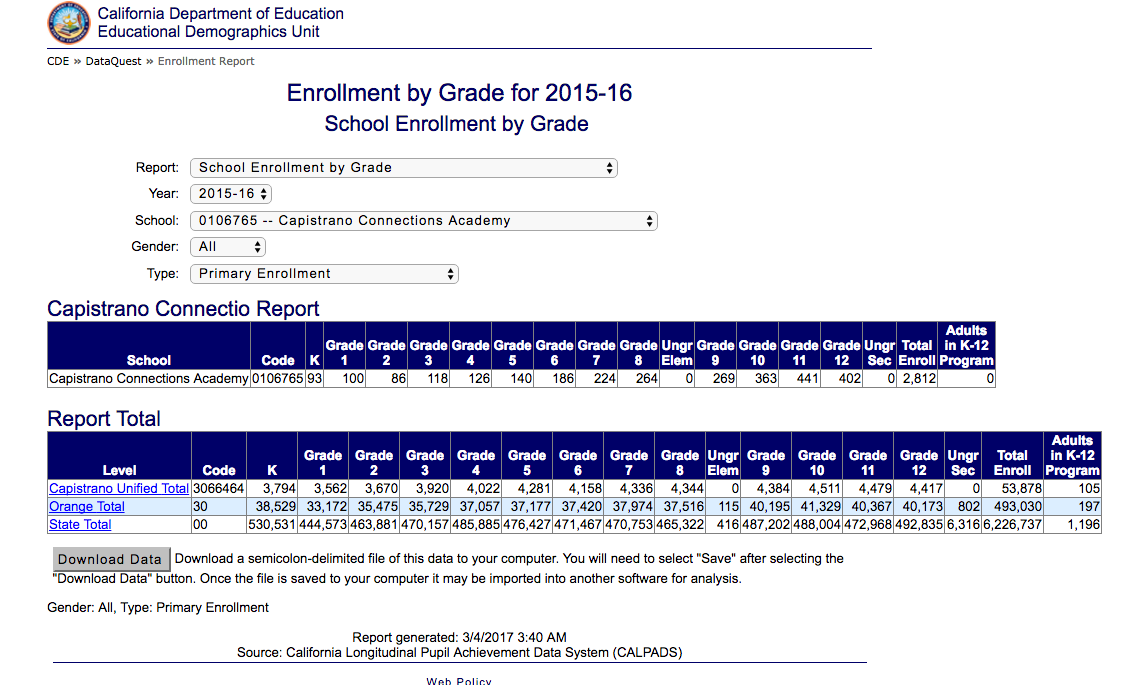
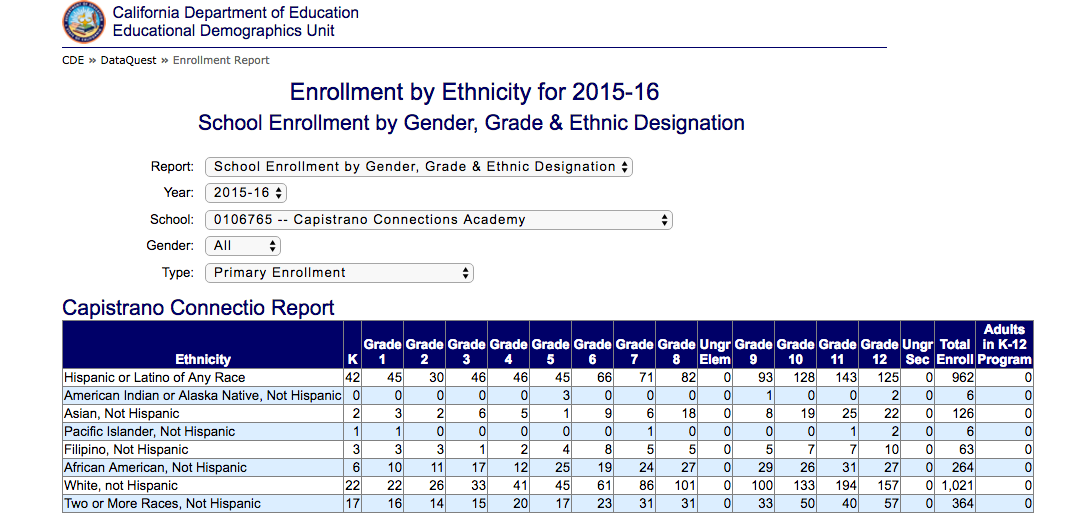
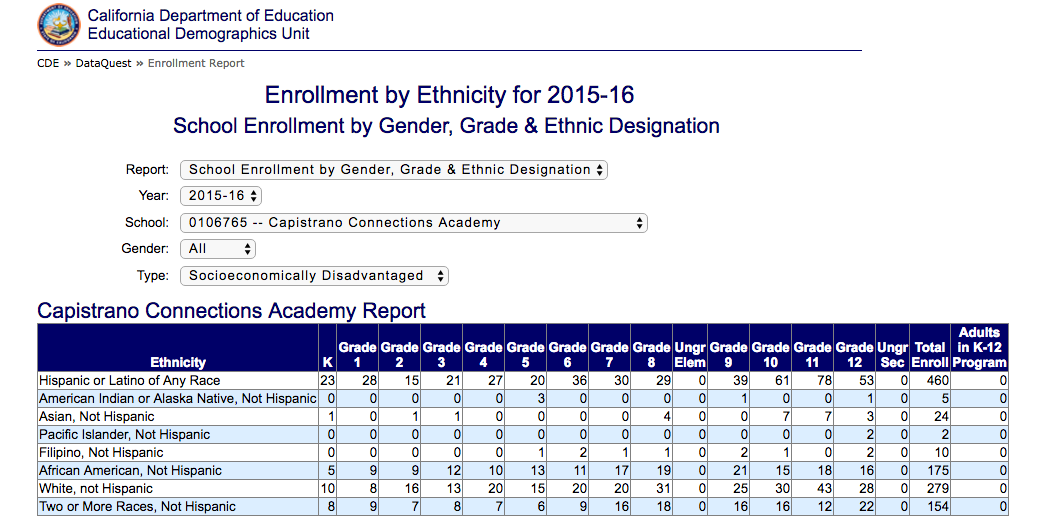
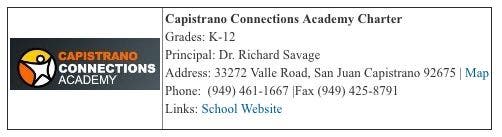
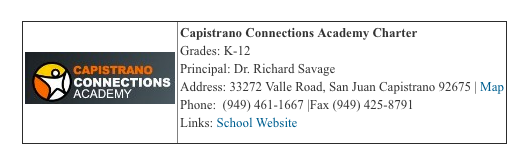
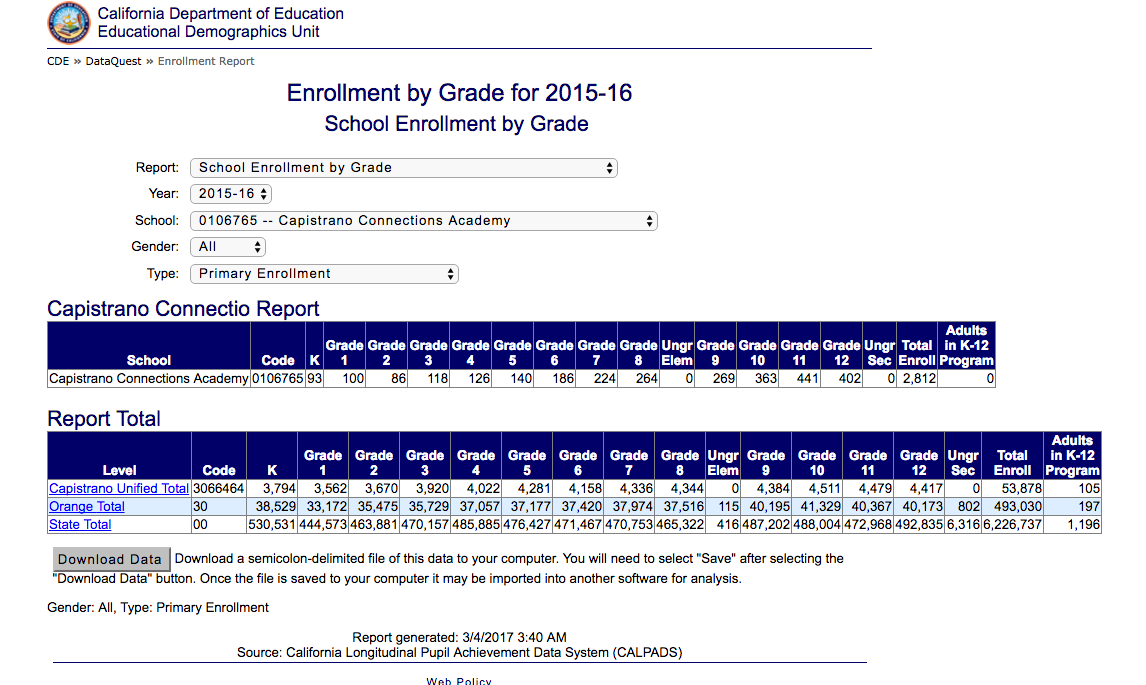
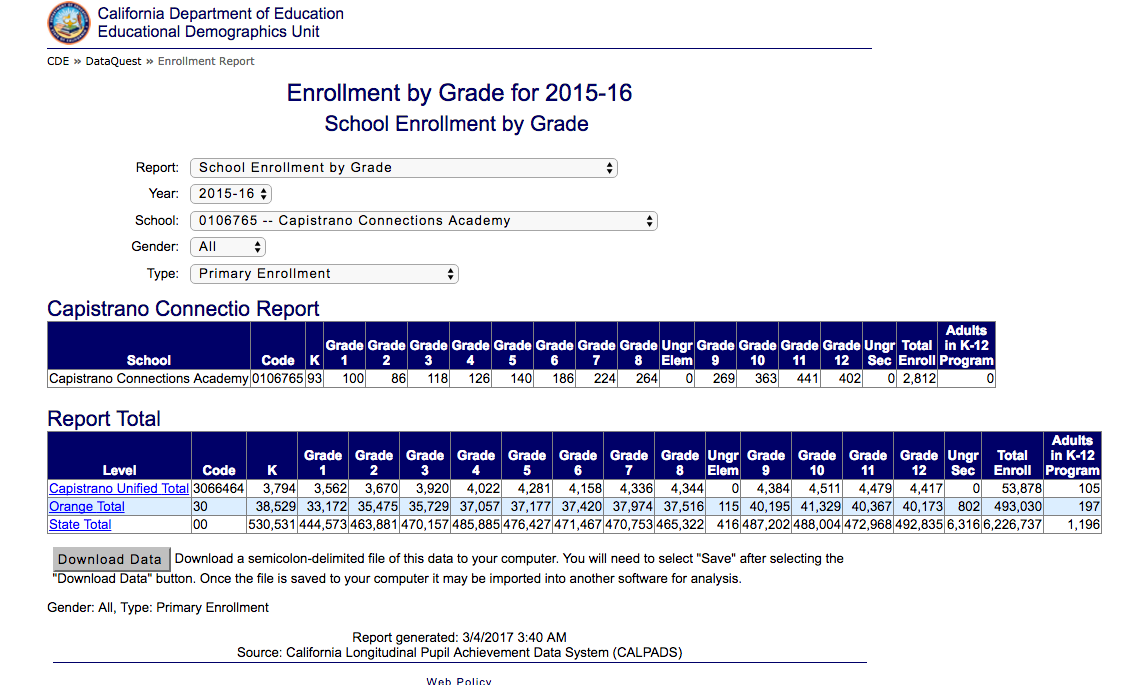
As of February 16, 2017 CUSD has spent $11,715,754.00 to educate 2,812 students.

Low- Cost Education Yields High Profits and Poor Academic Outcomes
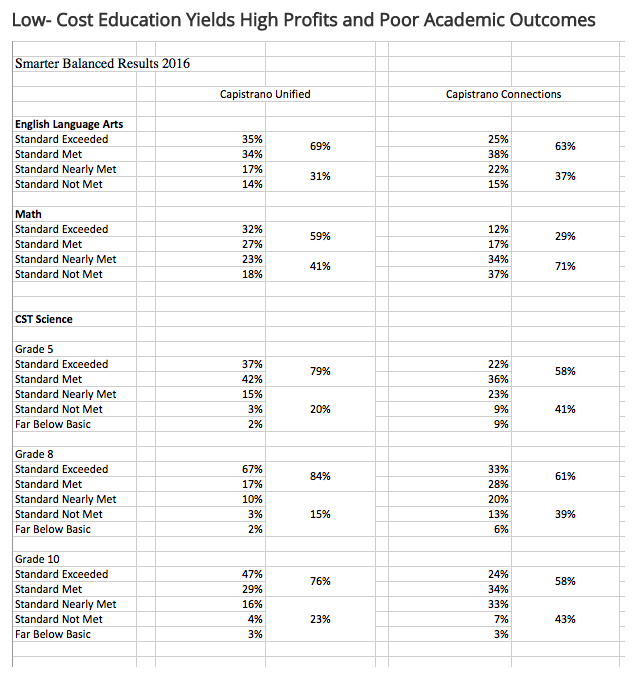
The Graduation Rate for CUSD is 96.7
The Graduation Rate for Capistrano Virtual Academy is 66.9%
"Virtual Schools" are publicly funded, but privately run, usually by for-profit companies.
A recent report published by In the Public Interest, which found that Pearson helps fund Foundation for Excellence in Education and Chiefs for Change. In turn, the foundation crafts policy that profits Pearson.
Student Data Mining
How does Pearson attempt to fine-tune its tests? Not by using paid research or paying students to take tests. Instead, it administers “field tests” to certain schools (Capistrano Unified) and subjects students to even further testing during the school year.
Parents in NYC were fed up, and protested against administering what some called “free pilot studies” for Pearson. Meanwhile, teachers were sent a memo from the NY State Education’s Office telling them to lie to students and pretend that these field tests were real.
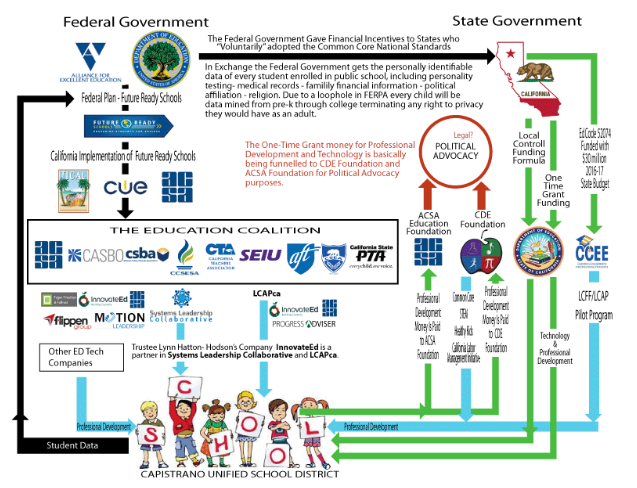
Capistrano Unified School District's Trustee Lynn Hatton-Hodson is currently under investigation by both, the California Fair Political Practices Commission and the Orange County District Attorney for Conflict of Interest. InnovateEd, Trustee Hatton-Hodson's company has grown from less than $1 million in sales to over $2.4 million because of her connections to ACSA and Ed Tech companies with whom she partners in what appears to be a State-wide Racketeering Scheme.
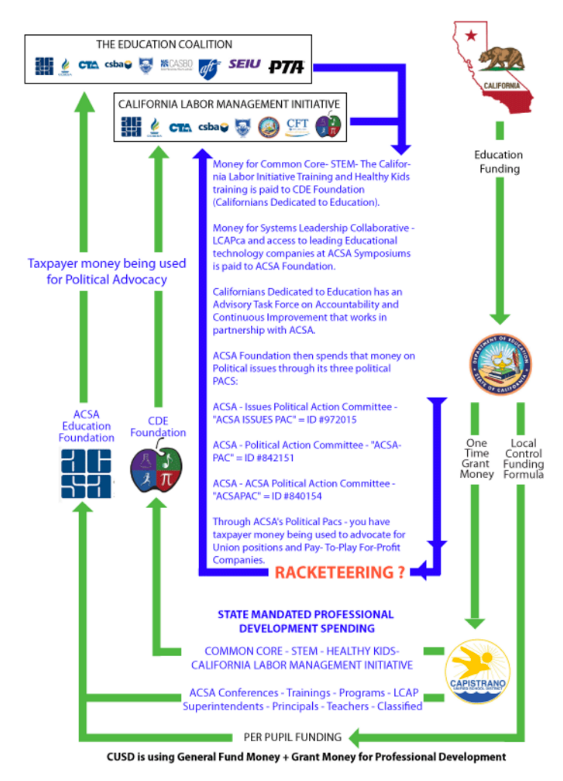
Conflict of Interest
PART I - CONFLICT OF INTEREST SHINES LIGHT ON NATIONAL EDUCATION PLAN
Capistrano Unified School District Trustee Lynn Hatton- Hodson owns a company called InnovateEd along with her partner Jay Westover.
web site: http://innovateed.com/

InnovateEd is in a partnership called LCAPca with ACSA (the Association of California School Administrators) and Progress Advisors.
web site: http://www.lcapca.com/expert-help.cfm
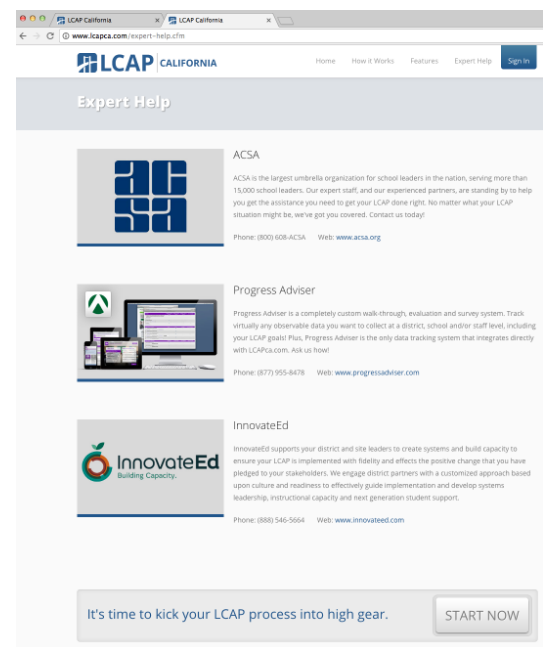
InnovateEd is also part of Systems Leadership Collaborative. http://innovateed.com/systems-leadership-collaborative/
Systems Leadership Collaborative, is led by ACSA, Fullan, InnovateEd, The Flippen Group, and Fagen, Friedman and Fulfrost. The Collaborative was designed to help 15 districts from around the state successfully implement their LCAP.
Trustee Hatton-Hodson failed to disclose her business interests in InnovateED, LCAPca and Systems Leadership Collaborative on her form 700. A complaint has been filed with the District Attorney for Conflict of Interest, and a complaint has been filed with the Fair Political Practices Commission for failure to disclose her business interests.

Letter to DA: http://disclosurecusd.blogspot.com/2016/08/august-28-2016-letter-to-da-tony.html
Fair Political Practices Complaint: http://disclosurecusd.blogspot.com/2016/09/fair-political-practices-complaint.html
InnovateEd has grown from a company doing less than $1 million in business to a $2.4 million dollar company because of Trustee Hatton-Hodson's partnerships with LCAPca, Systems Leadership Collaborative and the EdTech companies they have relationships with.
On August 30, 2016 the Capistrano Unified School District held a Special Board meeting to discuss potential conflict of interest charges alleged against Trustee Hatton-Hodson based on a $10,000.00 payment to ACSA/Foundation for Education for membership in Systems Leadership Collaborative.
The Board Agenda can be seen at this link: http://capousd-ca.schoolloop.com/file/1218998819331/1455438848279/7729939247661584722.pdf
The Board Audio can be heard at the following link: http://cusd.capousd.org/cusdweb/audio2016-17.html
As a Trustee, Lynn Hatton-Hodson makes decisions on curriculum and technology spending for the Capistrano Unified School District. The fact that these business relationships were not disclosed call into question some of CUSD's decisions regarding curriculum, and technology spending. Maybe $11 million on a poorly performing online charter school is not the best use of CUSD's limited financial resources.
Here is additional information that people have asked for it on other blogs and posts-
Any Ed Data can be found here: http://data1.cde.ca.gov/dataqu...