Community Corner
The Old Bell-Ringer and his Extravagant Swallows Fable
Acú, a Juaneño bell-ringer for Mission San Juan Capistrano, crafted the story about the swallows pilgrimage to the Holy Land.
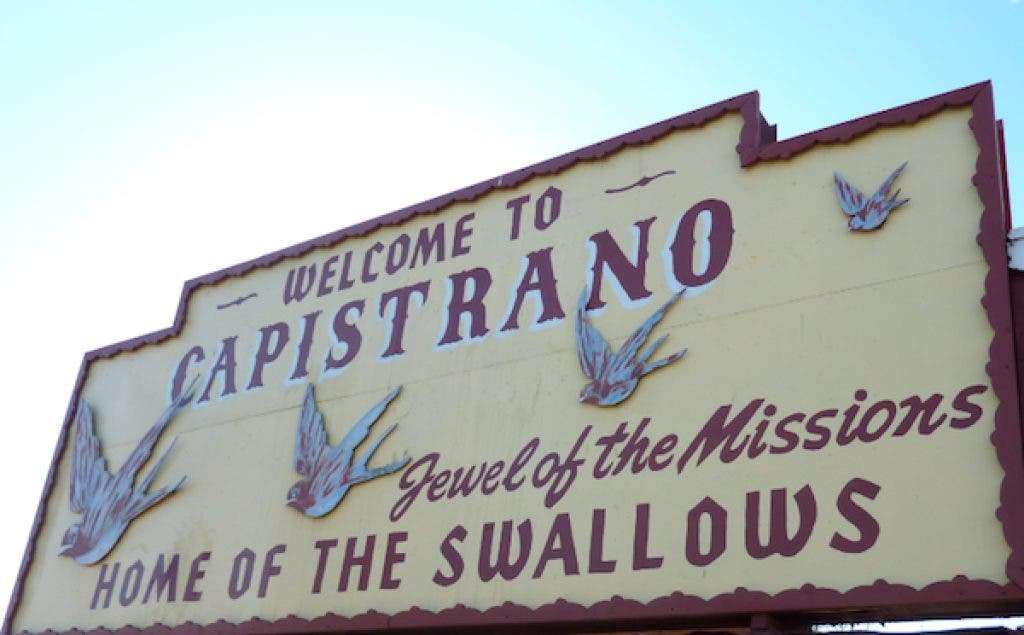
On Saturday, tand accompanying festivities that commemorate the . With these activities still fresh on our minds, I thought it would be fitting to share a legend of the vast journey the famous cliff swallows undertake each year.
The nice thing about old towns is that they tend to be not only rich in history, but in folklore as well. San Juan Capistrano is no different, and the swallows legend is one of the town’s most famous folk tales.
The story was first recorded in the book, Capistrano Nights: Tales of a California Mission Town. Originally published in 1930, the book was a collaboration between writer and naturalist, Charles Francis Saunders, and then-resident priest of Mission San Juan Capistrano, Father St. John O’Sullivan.
Find out what's happening in San Juan Capistranofor free with the latest updates from Patch.
Father O’Sullivan, you may , first came to the mission in 1910 and helped continue the landmark’s restoration, bringing it national notoriety. He is also credited with drawing the connection between the swallows’ annual arrival near , and for first popularizing the event as a major attraction for the town.
In the book, Father O’Sullivan recalls a story told to him by José de Gracia Cruz, one of the last full-blooded Juaneño Indians. Saunders described the aged Indian as, “a rather short, burly figure of a man with grizzled hair and a short tuft of beard.” Cruz, or Acú, as he was known in San Juan Capistrano, was a top-notch sheep-shearer in the town. The author also remarked that it was common to hear him proclaim: “Soy trasquilador número uno!” (I am a number one shearer).
Find out what's happening in San Juan Capistranofor free with the latest updates from Patch.
Also recognized as a trained bell-ringer for the mission during religious holidays, Acú had a strong relationship with Father O’Sullivan. The swallows’ legend, recorded as a dialogue between the two, goes like this:
“They say, padre, that when [the swallows] go away from here at the summer’s end, they fly to Jerusalem and stay there through the winter. I don’t know why, but that is what people say… and after that, they come back here again for the feast of Saint Joseph, and to build their little houses in the mission."
"'But, Acú,' said I, ‘between here and Jerusalem is a great ocean. How can they fly so far without getting tired and falling into the water?’"
"'You see, padre,’ he replied very deliberately, ‘they carry with them in their beaks a little twig of a tree, and when they get tired flying across the ocean they put the twig on the water and alight upon it and rest themselves. And do you know, padre, the swallows do not work on Sunday? I have watched them, and on Sunday they all stay inside their houses and don’t do any work at all. I have always wondered how it is they know when it is Sunday.’”
Though still a fanciful story at the time of its original telling, the grandness of Acú’s tale helped popularize the swallows event as a local town miracle. Local historian Pamela Hallan-Gibson noted that newspapers all over the United States reprinted Acú’s legend, which helped draw crowds from all over the country to witness the event.
Although we now know that the cliff swallows actually fly to Argentina each fall, we have Acú’s tale to thank, in part, for turning the swallows’ annual return into a grand event that has added to our town’s colorful history for generations.
Further Reading: Capistrano Nights: Tales of a California Mission Town by Charles Francis Saunders and Father St. John O’Sullivan