Community Corner
Horses Walk on Their Toes ... No Wonder They Need Shoes!
Did you ever wonder why we put shoes on horses when they don't wear them in the wild?
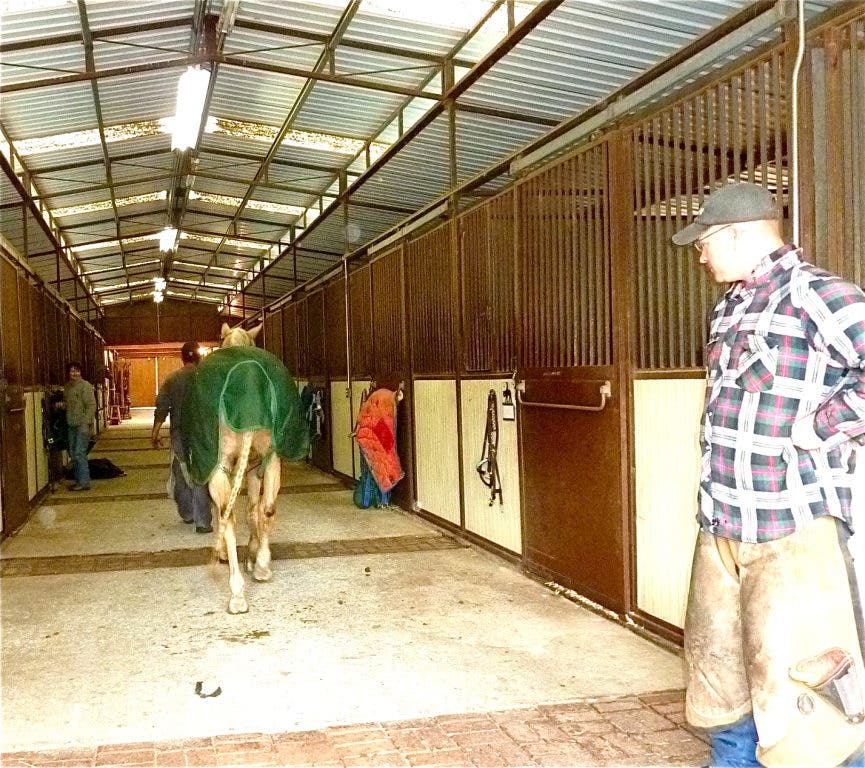


Recently I followed a local farrier, Shawn Melton, as he worked on a local horse named Gusto. Shawn uses a method called "hot shoeing," which involves heating the shoe until it is red-hot and then pounding it until it is shaped to fit the horse’s foot.
Long-time horse people have been known to say, "No feet — no horse." A bad shoeing can render a horse lame. A bad trim — too long or too short—can do the same. It’s all a matter of angles and also the job that the horse will be expected to do.
Think of toenails that are cut too short or at the wrong angle. You know how painful that can be. Now add 1,000 pounds to it. Plus horses actually walk on their toes — yes, on tiptoes like a ballet dancer, but bigger and clumsier!
Find out what's happening in San Ramonfor free with the latest updates from Patch.
A quality farrier is essential. It is actually a pretty exact science. Each horse is shod uniquely and the process is repeated every six to eight weeks.
California does not require farriers to be licensed. Anyone can call himself or herself a farrier in California, and a bad job can render your horse lame.
Find out what's happening in San Ramonfor free with the latest updates from Patch.
So the inexperienced horse owner needs choose a farrier carefully. Do your research. Go to a professional for advice — your trainer or vet.
But wait! What about wild horses? They don’t wear shoes.
Wild horses travel through difficult terrain in constant search for food. As a result, they wear their hooves down naturally. Wild horses that have weak hooves quickly become among the first to be killed by predators. So the horses that survive and become the breeding stock normally are the ones who have stronger hooves. It’s a good genetic trait that gets passed along.
Domesticated horses, on the other hand, live a different kind of a life. Breeding is decided by humans — not by natural selection. These horses often live in stalls or paddocks, so their hooves are not subjected to the rocky surfaces that would wear them down in the wild.
Another factor is the job that a horse is asked to do.
Wild horses have no job other than to survive. They wander the range in search of food. That is their job.
Domesticated horses, on the other hand, are asked to perform some pretty amazing feats — the tight spins of a reining horse, the repetitive jumps of the big jumping breeds, the fast bursts of speed of the racehorse and the tight turns of barrel-racing horses. We ask the domesticated horses to do much more with their feet than they would ever be asked to do in the wild.
A good farrier is an integral part of helping the horse to do those jobs and remain sound and healthy.
Shawn is a member of the Equine Lameness Prevention Organization and works collaboratively with veterinarians to help horses remain sound. He continually updates and hones his education by participating in clinics where vets and farriers work together with lame horses.
He is respected and well known throughout the East Bay and beyond as man who can work with “difficult” horses. Shawn is quiet and unassuming with a humble demeanor. He is also particularly gifted. He says he listens to the horse, and the horses talk to him.
I’ve watched him, and I believe it.