Community Corner
The Invisible Inheritance: Why Emotional Intelligence Beats IQ for Your Child
The hidden relational blueprints quietly deciding whether your teen will thrive in the AI-era workplace—and how to upgrade them.
This is a paid post contributed by a Patch Community Partner. The views expressed in this post are the author's own, and the information presented has not been verified by Patch
Every year, parents invest thousands of dollars and countless hours into their children's academic resumes. We hire college coaches, pay for intensive SAT prep, and enroll them in elite outside education programs, operating under a decades-old assumption: optimize for intellectual intelligence and high test scores, and your child's future is secure.
But in 2026, that traditional playbook is fundamentally broken. Academic achievement alone will not prepare teenagers for the AI-era workplace.
We are entering an automated landscape where technical skills are rapidly becoming a commodity; artificial intelligence can code, analyze, and process data in seconds. Intellectual intelligence is no longer the ultimate predictor of success. Instead, the modern workforce premium is entirely on emotional intelligence. According to landmark research published in the Psychological Bulletin, emotional intelligence explains additional variance in achievement even after controlling for traditional intellectual intelligence—meaning emotional intelligence contributes a massive edge that intellectual intelligence alone simply cannot capture.
What Google, Microsoft, and the World Economic Forum Know
If you think social-emotional skills are just "soft skills" that look good on a report card, the world's top employers strongly disagree.
In an Education Week feature, tech giants pulled back the curtain on what they actually look for when hiring. Google's global head of education impact, Jennie Magiera, stated that her teams heavily prize social-emotional competencies, noting that Google values these human traits just as much as technical talent. Microsoft's vice president of education, Paige Johnson, echoed this, adding that the top skills needed to navigate complexity and change in the age of AI remain uniquely human.
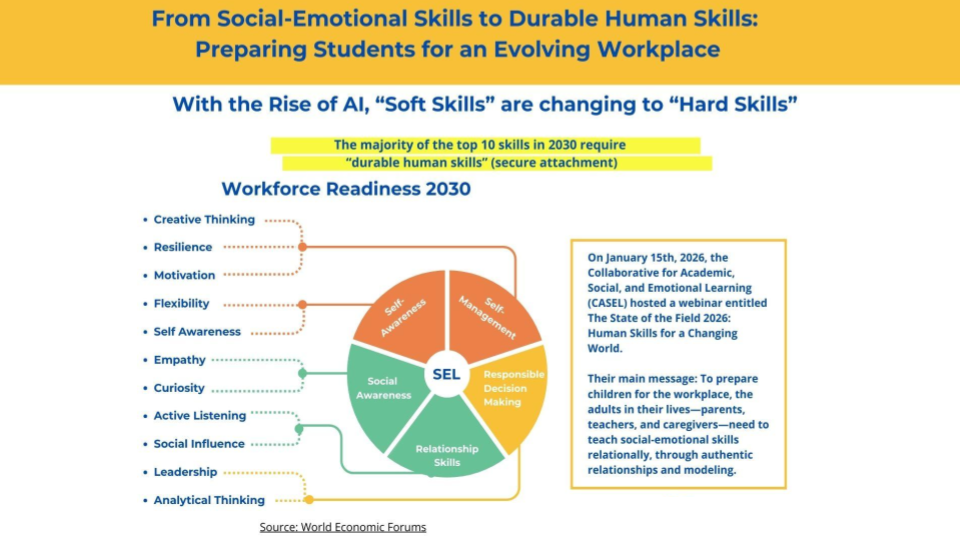
These human traits underpin the exact capabilities identified by the World Economic Forum's Future of Jobs Report as essential for tomorrow's workforce:
- Self-Awareness & Self-Management (incorporating emotional self-regulation and impulse control)
- Social Awareness & Relationship Skills (the ability to empathize, communicate clearly, and collaborate)
- Responsible Decision-Making & Problem-Solving (navigating workplace ambiguity with integrity)
These traits fuel the resilience, flexibility, and creative thinking that no machine can replicate. Yet, we are sending teenagers into the world technically brilliant but emotionally fragile. Nationwide corporate data reveals that 60% of employers end up firing recent college graduates within just months of hiring them—not due to a lack of intellectual intelligence, but because of a severe deficit in social-emotional skills. They struggle to take initiative, lack basic communication, and shut down or become intensely defensive when given feedback.
.png)
The Missing Link: Why Parents Are the First Responders
Many parents don't realize that schools are already trying to teach these competencies. Modern educators heavily rely on CASEL (the Collaborative for Academic, Social, and Emotional Learning), the world's leading organization for integrating social-emotional curriculum into schools.
In their recent milestone address, State of the Field 2026: Human Skills for a Changing World, CASEL leaders Dr. Aaliyah A. Samuel and Dr. Timothy Shriver emphasized that while it is impossible to predict what the next ten or twenty years will bring, getting "back to the basics" of these foundational human assets is what equips students to navigate an uncertain future. They note that alongside math, reading, and science, these skills are critical to lifelong success—no matter how the economy or technology advances.
But here is the critical missing link that schools and textbooks cannot address alone: You cannot successfully build these human skills on top of an insecure attachment style.
Attachment theory proves that human children are biologically driven to connect with their primary caretakers. Through us, they form an internal map of whether the world is safe. If a child grows up with an insecure attachment style—whether they cope by becoming hyper-vigilant and people-pleasing (Anxious) or by emotionally shutting down and isolating (Avoidant)—their cognitive energy is constantly hijacked by relational anxiety.
The Reality Check: A teenager cannot practice self-management, draw on resilience, or effectively collaborate if their nervous system is locked in an insecure state of survival.
A 2024 meta-analysis published in the Journal of Business and Psychology found that a person's attachment style predicts job performance, satisfaction, and leadership capability far beyond basic personality traits. Furthermore, peer-reviewed data highlights that secure attachment styles act as a vital shield for teen mental health, significantly protecting adolescents against depression, anxiety, stress, and loneliness.
While teachers are vital secondary caregivers, they cannot install these skills in a classroom if a child feels unsafe at an emotional baseline. Parents are the true first responders. We rely on these skills every single day—whether we are regulating our own frustration with traffic or coaching a child through a meltdown. A teen only develops true self-awareness and emotional regulation when a primary caregiver learns to model and mirror those behaviors safely.

Upgrading the Blueprint: It is Not Too Late
The honest truth that every parent needs to hear is this: We cannot teach skills we were never taught ourselves. We inherited our parenting habits from our own parents, who were parenting in the dark without the decades of neuroscience and attachment research we have today. It is not your fault you weren't taught this—but it is your responsibility to break the cycle.
The beautiful news is that unlike traditional intellectual intelligence, emotional intelligence is highly trainable. A landmark meta-analysis covering over 270,000 students proved that social-emotional interventions yield massive, sustained positive impacts on behavior, well-being, and even an 11-percentile-point gain in academic achievement.
And here is the part that should reassure any parent still worried about the transcript: this is not a trade-off between your child's emotional wellbeing and their grades. The same secure foundation that protects mental health also drives academic performance. In a longitudinal study published in Developmental Psychology, researchers tracked students across the high-school-to-college transition and found that securely attached students maintained stronger learning dispositions—attention, motivation, and persistence—while students with a dismissing attachment style earned the lowest college grades, an effect explained largely by a decline in their quality of attention during the transition. Decades of classroom research point the same way: secure attachment is consistently linked to higher grades and test scores than insecure attachment, with the strongest benefits appearing for the most at-risk students. In other words, the emotional foundation isn't competing with academics. It's quietly powering them.
Secure attachment is the foundation parents build at home; emotional intelligence is the skillset that grows on top of it. You do not have to be a perfect parent, but you do have to be an intentional one. We cannot prepare our children for tomorrow using yesterday's map. It is time to move from blind reactivity to thoughtful responsiveness, and give our children the emotional armor they need to thrive.

Upgraded Toolkits for the Automated Era
To help parents bridge the gap between academic pressure and future career readiness, Attachment Matters, LLC is hosting a specialized, 90-minute workshop for parents and caregivers:
"How to Ensure Your Teen Has the Durable Human Skills to Succeed in the AI Workforce and Life."
Led by Heather Thompson, this interactive session explores exactly how attachment styles shape a child's capacity to develop core social-emotional competencies.
What You'll Explore
- The 2030 Skills Landscape — Which durable human skills employers will demand, and why AI makes them more critical, not less.
- The 4 Attachment Styles — How your child's early bonds shape their capacity to think creatively, collaborate, and bounce back.
- When Attachment Gets in the Way — How insecure attachment quietly blocks the very skills the future workplace requires most.
- What You Can Do Right Now — Practical, everyday ways to build the secure foundation your child needs to truly thrive.
Duration: 90 Minutes (Live Interactive Session)
👉 Click Here to Reserve Your Seat for the Workshop

References & Deeper Learning
To watch the complete broadcast exploring how the fundamentals of emotional regulation, persistence, and curiosity dictate long-term workplace readiness, watch the CASEL State of the Field 2026 Presentation on YouTube.
- Lieberman, M. (2025). "The SEL Skills Google, Microsoft, and Other Top Companies Want Schools to Teach." Education Week.
- World Economic Forum. (2025). The Future of Jobs Report.
- MacCann, C., et al. (2020). "Emotional intelligence predicts academic performance: A meta-analysis." Psychological Bulletin, 146(2).
- Warnock, et al. (2024). "Attachment at Work: A Meta-Analysis." Journal of Business and Psychology.
- Larose, S., Bernier, A., & Tarabulsy, G. M. (2005). "Attachment State of Mind, Learning Dispositions, and Academic Performance During the College Transition." Developmental Psychology, 41(1), 281–289.
This post is an advertorial piece contributed by a Patch Community Partner, a local brand partner. To learn more, click here.