Neighbor News
Tim Sbranti on Education with PLAY Members
The Promoting Leadership in Aspiring Youth organization (PLAY) interviews Deputy Chief of Staff for Congressman Eric Swalwell, Tim Sbranti.
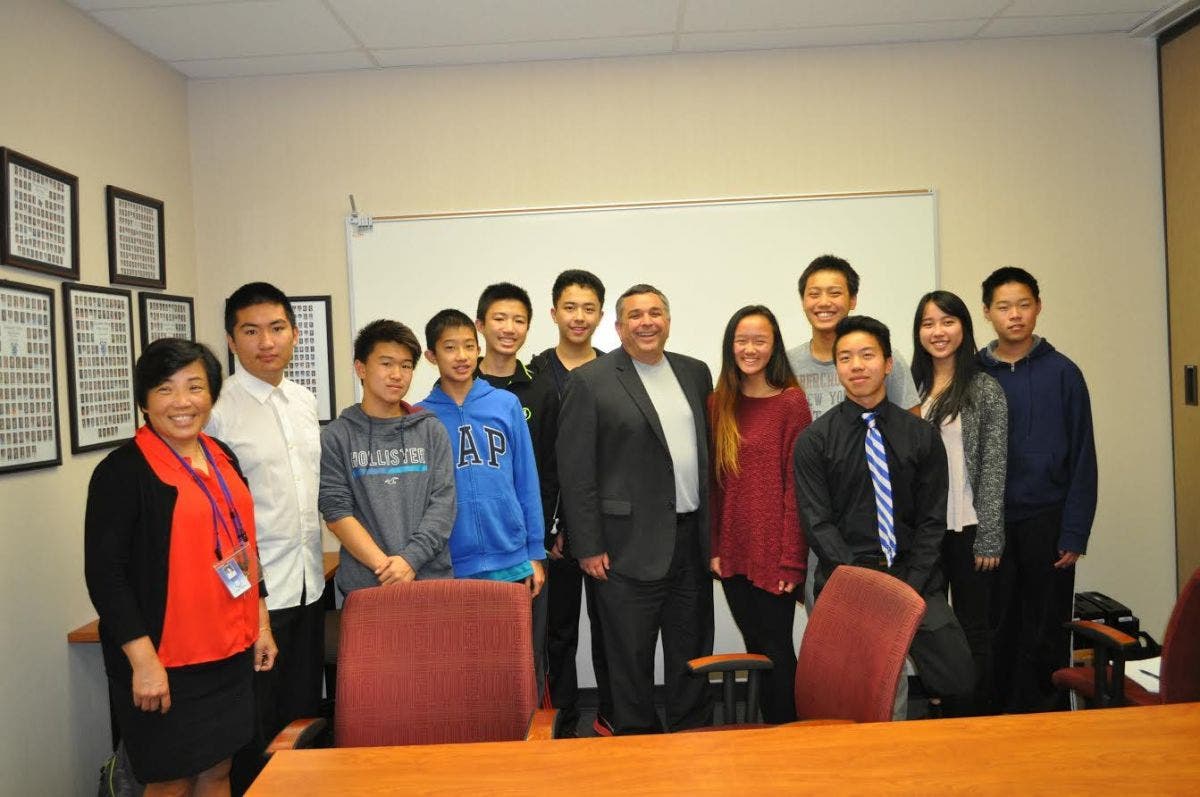
Photo caption - From left to right: DVHS Chinese teacher Jennifer Shuen, Mark Zhao (10th), Andi Liu (9th), Richard Wu (9th), Christopher Li (10th), David Si (10th), Tim Sbranti Deputy Chief of Staff for Congressman Eric Swalwell, Angela Kan (9th), Steven Yuan (11th), Edwin Mui (11th), Alison Fang (11th), Andrew Zhang (10th)
by Christopher Li
Being California's youngest Congressman in 2012, Eric Swalwell has accomplished much in politics and leadership. His experience and skillsets provide a good model for the PLAY (Promoting Leadership in Aspiring Youth) club members. On October 28, 2016, PLAY members got the chance to meet Tim Sbranti, Deputy Chief of Staff for Congressman Eric Swalwell, for a very stimulating and motivating interview on politics and education reforms.
Find out what's happening in San Ramonfor free with the latest updates from Patch.
Before the interview started, Mr. Sbranti introduced himself to the PLAY members. He switched from his 17-year teaching career to join Congressman Eric Swalwell as deputy chief of staff last June. He then highlighted the great relationship he has with Congressman Eric Swalwell. Eric Swalwell went to college through a Division I soccer scholarship. During college, he worked as an unpaid intern in the office of his representative and that laid his path to office at a very young age. In 2012 Eric Swalwell was elected as the representative for California’s Fifteenth Congressional District, the youngest at age 31.
At the beginning of the interview, Steven Yuan, a junior at DVHS, asked a question on the quality of the STEM teachers in public education: “We are in the modern age now and STEM related careers are rising rapidly. But at the same time the number of teachers who teach these topics is decreasing at 11% per year. How can we improve the quality of K-12 STEM public education in such a situation?” Mr. Sbranti acknowledged the challenges facing public education teachers especially in STEM subjects. He told his audience that Congressman Eric Swalwell’s office has introduced a bill (H.R. 2082, the "STEM K to Career Act”) that provides federal student loan relief to STEM teachers and offers tax credits to some employers that provide paid internships or apprenticeships in the STEM fields. Mr. Sbranti said that the Congressman’s office is working to connect things happening at K-12 public schools, at colleges, and at private sectors as a meaningful path link that will make a difference.
Find out what's happening in San Ramonfor free with the latest updates from Patch.
The second question was concerned with Common Core. Edwin Mui, a junior from DVHS, asked: “Common Core is still receiving animosity from students, parents, and teachers. Do you have any suggestions on how to improve the system so it can benefit everyone?” Mr. Sbranti provided his answers from three different angles. The first is the professional development of teachers so that they can teach Common Core more effectively. The second is the need for a bottom-up approach so inputs from local communities and businesses should be taken into account for curriculum development. The third is that it’s an evolutionary process, and this evolution is needed to make Common Core a success.
The third question was about women and STEM. Angela Kan, a freshman from California High School, asked: “What steps has California taken to encourage women into STEM fields?” Mr. Sbranti answered it by stating that he can only speak at federal level. Then he told people about the upcoming “Congressional App Challenge” that is designed to engage student’s creativity and encourage their participation in STEM education fields. This nationwide event allows high school students from across the country to compete by creating and exhibiting their software application skills for mobile, tablet, or computer devices on platforms of their choice. Female students are highly encouraged to get involved. Going back to the core of the question, he stressed that it is nearly not enough and actions need to happen to support women to get into STEM. “We should start early at school to encourage girls into STEM. That needs to happen at preschool and kindergarten where they need to be encouraged, and they need to have these pathways. This is the only way to get girls into STEM and infuse them into the early curriculum,” says Mr. Sbranti. He then related this to his 2 and half year old daughter: “We’ve got her working on different things and it is amazing how bright she is. You see the gains and big differences they make, and the differences only grow over time. The key is to get them involved at the early grades.”
Afterwards, Mark Zhao, a sophomore at Amador Valley High School, asked about vocational schools: “Are they effective at all and should we implement more?” “Absolutely,” said Mr. Sbranti. “Not every student will get into college. We need to give them second option and we need to offer such opportunities. We need to capture them after school and get them into these programs (vocational schools)”
With all the competitiveness in the area, many students face high amounts of stress. Edwin Mui raised this concern and asked Mr. Sbranti: “Do you have any suggestions on how to implement something that will alleviate that stress and overall have a better environment for schools?” Mr. Sbranti started by acknowledging it: “It is a systematic problem.” He then provided more insights into this supply demand issue where colleges keep their admissions flat while population keeps growing. In order to solve this, colleges and universities should have more spots for students. More funding for higher education should occur, so that more colleges and universities can be built. More spots open for students means less pressure on those students. “There has to be balance between what is realistic. We have to do a better job to fund higher education,” says Mr. Sbranti.
As a booming, technologically advanced area, Silicon Valley basks in its success but also feels its pains in congested traffic. David Si, a sophomore from DVHS, posed a question and tried to find alternatives from Mr. Sbranti: “What happens to alleviate the traffic problems at local and state level?” Mr. Sbranti concurred and stated, “Infrastructure is huge and there is not enough done at federal level.” Using the missing link among K-12, college, and private sector for education as an analogy, he said that the links between regional level transportation authorities is not in place. Each have different priorities and are reluctant to work together to solve the traffic problem at a higher level. “Having conversations and be smarter about what we do” probably will provide the solution, he concluded.
Christopher Li, a sophomore from DVHS, raised his concerns on the competing teaching resources at public schools: “How can you solve the problems on growing school sizes and less student teacher interactions? And how can students get the classes they want?” Mr. Sbranti jokingly opened his answers with this statement: “Dougherty Valley High is the victim of of its own success.” “DVHS is one of the highest performing schools anywhere you will ever find. It becomes a highly desirable place for parents to do everything they can so their kids will go to a great school. It is a challenging and hard to solve problem.” He then offered his view, and how to fix the problems from a funding perspective: “We are doing two things to address the problem: Prop 51 and 55. There has always been three-legged stool fund in building and expanding schools: local property tax, developers, and state of California. In 2014 State of California dropped its funding for schools. That is why classes are now constrained. Prop 51 should help if it is passed. ” Mr Sbranti briefly mentioned that the funding from Prop 55 (if it is passed) will go directly to classes and may be helping technology. Since the current funding is still from Prop 30 (passed in 2008) but the students have increased a lot after that, Prop 55 will only help to make it even with the current student size. “Prop 51 is the key since it provides the infrastructure we need,” Mr. Sbranti stressed.
Mrs. Shuen, a Chinese language teacher at DVHS, posed an interesting question about racial barriers to college admissions. "Are they race blind... [are] our students actually competing within the same race?" she asked. Mr. Sbranti replied that the issue is more of a state issue than a federal one, but he affirms that "the best and the brightest should absolutely get in." When further asked by her about private school admission, Mr. Sbranti again stated that this was more of a state problem and said that although "private schools... tend to have a little more leeway, ... there's still civil rights laws that they still have to follow."
“What would be the one quality of all leadership should have?” was the last and the most important interview question, asked by Steven. “Public speaking,” Mr. Sbranti answered right away. “It does not matter what field you are going into, being able to communicate to groups large and small is the key. Technology changes but the fundamentals of communication stays. Being able to hear what people are saying and being able to respond effectively, you, as the inspiring leaders, will have success!”
The half hour interview session quickly drew to an end. It was a very fun and educational experience. All participating PLAY members learned a lot more about education inside the bay area in particular and California state as a whole. They truly respect Congressman Eric Swalwell and Mr. Sbranti’s dedication to improve the quality of education for students of all ages, and appreciate Mr. Sbranti for spending his precious time in sharing his and Representative Swalwell’s insights and plans to better prepare students to compete in today’s economy.
Additional reporting by Steven Yuan. Photo credit: PLAY.