Thoughtful parents may question themselves when it comes to their children and snacking. Is snacking necessary? Is it okay for kids to snack? Is it a bad idea? Will it lead to obesity or emotional eating? Is my child eating enough -- should I encourage snacking?
When I was a little girl I often heard my mother say things like, "Don't just fill up on junk," if I was helping myself to a handful of chips before our evening meal. I also remember hearing my grandmother's disappointment if I came into her kitchen scrounging around for something to nosh on between meals. "Say, I'm making a good dinner and you won't be hungry if you eat that now, " she would say. Sometimes my mother and grandmother were right. Sometimes a snack portion would turn into a meal and sure enough, I would sit down to a nutritious and lovingly prepared dinner and pick at it. Other times I would eat my snack and then devour what was later put on the table.
Now, as a mother of two (one of whom is a very active five year-old boy) I struggle to find the balance. One of my beliefs is not to make food an issue. Still, I hear the voices of my mother and grandmother in my head when my son comes in to the kitchen asking for something to eat an hour before dinner. Rather than allowing this fairly predictable event to continually take me by surprise, it seems to make sense to anticipate and take charge of the situation. In our case, a morning snack seems excessive since only about four hours pass between breakfast and lunch. However, between lunch and dinner there has not only been a tremendous amount of physical activity on my son's part, but the gap between lunch and dinner is more like five and a half hours.
The idea behind successful snacking is to do more than simply stave off hunger, but to take every opportunity to introduce deliciously beneficial foods. Take advantage of snack time as a chance to create nutritionally power-packed mini morsels. Make it healthy, fun and appetizing -- think teeny tiny tapas!
Here are some additional snacking guidelines to consider.
1). The parent creates the menu for meals and for snacks. This concept not only keeps every meal from being comprised of peanut butter and jelly sandwiches but also keeps snacks reasonable and healthy. You, the parent, take charge. Leaving snacks to chance is a slippery slope that can lead to poor choices and overindulgence. Choose an official time for a snack and present a healthy and satisfying selection -- tiny portions are key. Make it look and taste pleasing but stay firm when you are asked for seconds, "That is all. We will be having dinner shortly."
2). Since you are probably busy with meal preparations and a million other things, keep the snacks as simple and healthy as possible. Have foods on hand that are ready-made but not processed, like olives and nuts.
3). Theoretically, a handful of nuts should suffice as a snack, but by simply serving them in a pretty little bowl at the table with a napkin and a glass of water you've made it so much more satisfying. Try to serve snacks at least an hour and a half before dinner so your child is hungry by the time you're ready to sit down to eat.
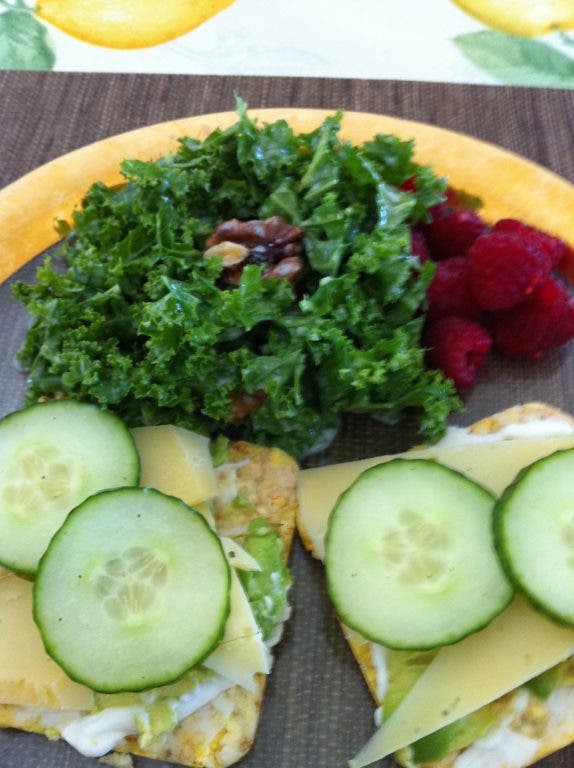
Here are some ideas for easy, healthy snacks that are full of flavor. They require minimal preparation, but if you make just a little extra effort and plate them beautifully and present them cheerfully, they will go a long way. Using small ramekins or condiment cups for things like berries, nuts and olives keeps the portions small and adds to the presentation.
-Three Dates stuffed with cream cheese and nuts
Dates contain potassium and manganese. Cream cheese is high in vitamin A. Nuts contain protein, unsaturated fats, fiber, vitamin E.
-Five tortilla or rice chips topped with cream cheese and olive slices or tapenade
Olives have vitamin E, copper, iron and fiber.
-Tiny ramekin of olives, five slices of manchego cheese, five strawberries
Manchego has vitamins E, D, A and calcium, strawberries are rich in vitamin C.
-Avocado slices, three crackers, tiny ramekin of blueberries
Avocados are anti-inflammatory, contain folate and essential fatty acids. Blueberries are antioxidants and contain vitamin C.
-Egg salad with crackers. This may sound like more prep that you'd want, but simply boil one egg then add Vegenaise, walnut oil and your choice of seasonings. That's it! Try it with tofu or tempeh to change it up.
Eggs are high in protein, choline, omega-3 fatty acids. Be sure to buy free-range, local and organic. If you only have access to big, factory farm eggs, it's best to skip them altogether.
-Apple slices, Pecorino Romano, walnuts
Walnuts are high in omega-3 which is associated with cardiovascular health and brain function. Apples contain fiber and vitamin C, Pecorino Romano contains Conjugated Linoleic Acid, omega-6 and is associated with the long, healthy lives of the people of Sardinia, Italy.