Arts & Entertainment
Santee Man Preserves Old-Time Tradition of Southern Gospel Songs
The Sacred Harp- the voice- lives on in Santee.
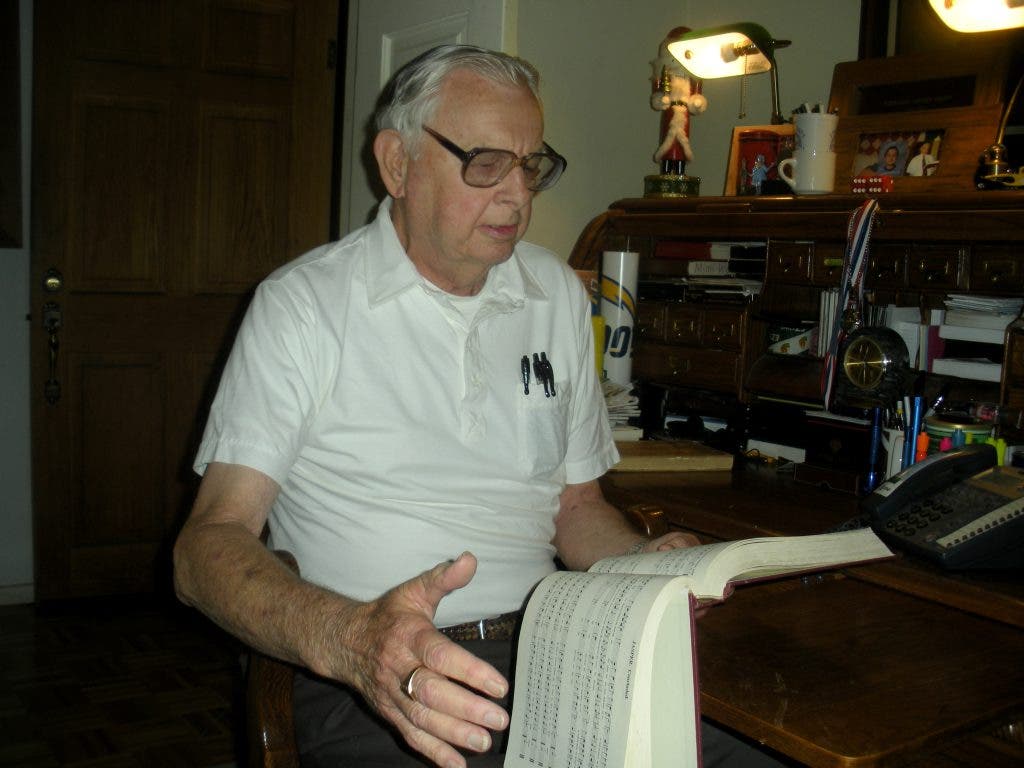


The first time I saw Carroll Lunsford, he smiled grandfatherly at me and said I was most welcome to join the Sacred Harp singing group. A friend had taken me to hear and sing along “if you want to,” she’d told me, and within minutes I was carried away by an other-worldly sound.
Carroll took the tenor side of the four-square form of this singing which dates back a couple of centuries. Think of that chapel scene in “Cold Mountain” where Nicole Kidman joins in singing a haunting little number called “I’m Going Home.”
At my first Sacred Harp singing group, meeting at the time in a church in El Cajon, I took my place in the trebles, or sopranos. On my left side was the tenor side of the four-square; to my right were the altos. Straight ahead were the bass singers. As I sang in that odd counter-point harmony that is a trademark of Sacred Harp, I looked around. Carroll had his hymn book open, but he had his eyes closed, singing by memory every note and word.
Find out what's happening in Santeefor free with the latest updates from Patch.
I kept returning to the “sings,” as they call them, always reassured by Carroll’s calming presence and confident singing near me. After I’d sung a couple of times with the group, Carroll looked over at me and asked if I wanted to request a song. I shrugged my shoulders, timid. “I know what you want,” he said, reassuringly. “Number 282.”
It was what everyone calls my song, since they know it’s my favorite: “I’m Going Home,” and I sang strong and loud like a bird, with Carroll crooning in rich tenor melody.
Find out what's happening in Santeefor free with the latest updates from Patch.
Sacred Harp singing is often called shape-note singing, referring to a different shape to each of the four syllables—fa, so, la, me—in the musical scale. The shapes facilitate music reading for people who are not familiar with the musical scale. After a singing of the shape-notes, the people all sing the song straight through, no practicing until perfect, no choir director stopping to correct someone’s pitch.
“We like to say that if you can hear someone else next to you singing off-key, then you’re not singing loud enough,” says Carroll.
“The sacred harp is the voice,” Carroll explained.
But unlike the traditional harp whose strings are plucked gently, creating angelic strumming sounds, Sacred Harp singing is loud and strong.
The whole idea is for everyone to sing out as loud as they can.
“It’s singing therapy,” Carroll said.
Over the past two years, I have come to look forward to seeing Carroll and joining in the singing that takes place every single Sunday of the month, at rotating locations. He also was my heartiest encourager when I volunteered to get up and lead “I’m Going Home” at the California Sacred Harp convention right here in San Diego.
When I went to interview Carroll at his home, he was sitting in his porch swing like a true Southerner. “I like to watch my neighbors go by and listen to the birds sing,” he said.
We exchanged memories for awhile of the different sings we’ve been to, including the California Singing Convention where I led my first songs.
“I tend to remember songs by who led them and where that happened,” Carrolli said, who was introduced to Sacred Harp as a young boy growing up in Hackelburg, Alabama.
“The two brothers who made this type of singing famous, Thomas J. and Seaborn Denson came to my hometown to sing,” he said. “We called them Uncle Denson. Everyone called older people aunt and uncle back then.”
Carroll was about eight years old when “Uncle Tom” first came to town.
Every year, there was a summer sing, as they called it, in Carroll’s hometown. The sing took place the third Sunday of June in the high school auditorium.
“It was filled to the brim,” Carroll remembered. “There were loud speakers in the windows so that the music could be heard all over town.”
Carroll will be leaving shortly to return to his home state where the National Sacred Harp Convention is held in Birmingham. Once he is done with his visit there, he will be getting right back in tune with his “home group” in San Diego.
One of Carroll’s personal favorites is “Abbeville.” He sang solo for me, keeping time with his hands the way it was taught in the old shape-note singing schools.
Carroll is among those preserving a historic tradition that evolved over two centuries ago. In the 18th and 19th centuries, each time people met for a sing, they vigorously intoned hymns and anthems from a hymnal. The poetry of the songs is written by well-known authors like Isaac Watts, Samuel Pearce, and Robert Robinson.
Sacred Harp music is divided into four parts of treble, alto, tenor and bass, with tenor as the melody and treble as the highest voice.
There are no auditions, nor rehearsals. If a song doesn’t sound quite right, they simply move onto the next one. At the sings, nobody gets told that they are singing off-key or even too loud. The music’s origins are in folk music sung by ordinary people.
“As I was growing up, lots of people used to make fun of Sacred Harp music. They considered it a low-class type singing, as opposed to the other type of popular singing in my town, called seven-note singing,” Carroll said.
Over the years, however, people came to love Sacred Harp. The music swept across the states of Georgia, Alabama, Tennessee and Mississippi.
Sacred Harp singing was featured in two different scenes in the 2003 movie “Cold Mountain.” A song called “Idumea,” written by Charles Wesley, played on the soundtrack during the brutal battlefield scene near the start of the movie.
Just like the townspeople sang “I’m Going Home” in the chapel of “Cold Mountain,” a song leader often stands in the center, beating out the rhythm, moving their hands to keep in time with the meter. True to tradition, everyone has a chance to lead the song of his or her choice, including newcomers.
The theme of the songs tends to be of a solemn nature. In fact, many of them tell of coming death or resting in the grave. That is because a majority of the texts are hymn or camp meeting songs. Shape Note music took root as a way to teach Americans how to worship through song.
“But this music is not meant to be associated with any religion. It appeals to people from all walks of life.
"It’s just beautiful music,” Carroll said. He put down his Sacred Harp hymnal on the porch swing and listened to the birds.