Politics & Government
Saratoga's CERT Ready If Disaster Strikes
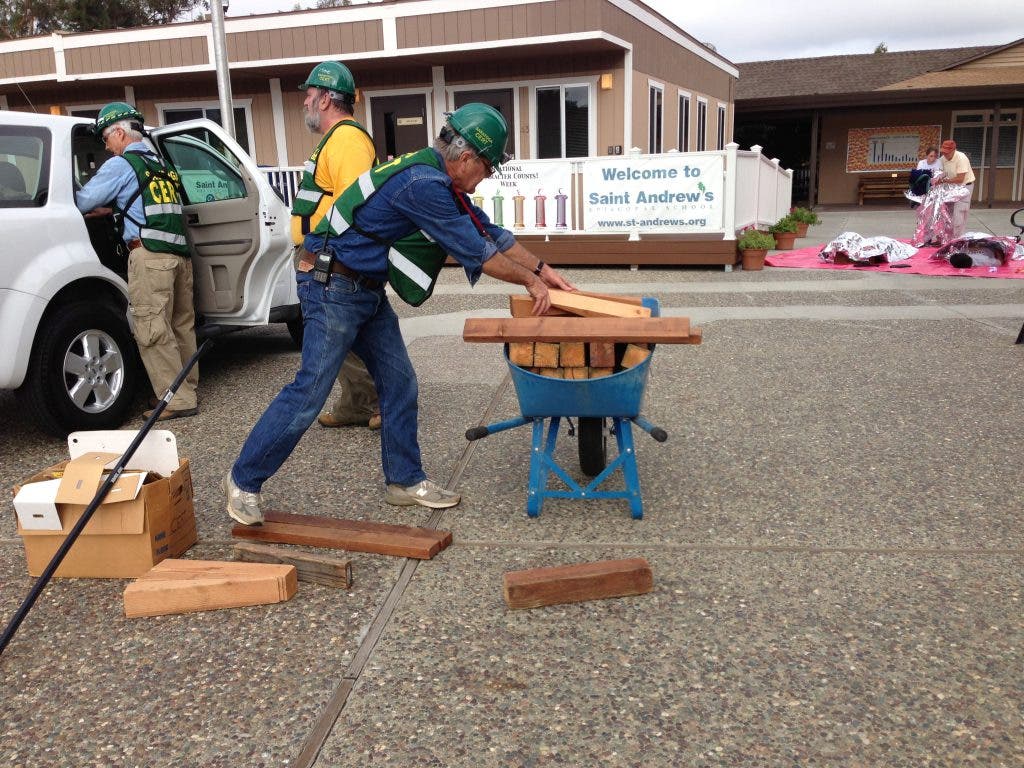
On a Saturday weekend I watched the city's emergency responders participate in an annual disaster preparedness exercise.


Editor's Note: Robert Rodarte is a San Jose State journalism student who wrote this piece for Saratoga Patch as part of a class assignment.
I took a trip to the City of Saratoga on Saturday, Oct. 20 to meet Jim Yoke, an emergency services coordinator for the Santa Clara County Fire Department.
After a brief introduction, sounds from the amateur radio nearby instantly became flooded with transmissions from other Community Emergency Response Team, or CERT members.
Find out what's happening in Saratogafor free with the latest updates from Patch.
An earthquake had just struck the city, causing major damage to nearby locations, including its Emergency Operations Center.
We immediately relocated to the new EOC for the duration of the day. All the while the radio continued to announce reports of casualties and injuries.
Find out what's happening in Saratogafor free with the latest updates from Patch.
The three locations affected the most were the Saratoga Sub-Acute Children’s Hospital, Saint Andrew's Episcopal Church, and Our Lady of Fatima Villa.
Saint Andrew's was the first to request supplies from incident commanders, who then relayed the information to Yoke, acting as logistics, to retrieve and deliver. We left promptly toward the supply storage, zooming past traffic lights and cars nearby.
Over the radio, Saint Andrew's was reporting five "red," "three yellow." Yoke explained that what I was hearing was triage. The different colors of the victims represented the different levels of immediate treatment that each required. Green was for minor injuries, yellow was for delayed non-life threatening, red required immediate attention, and black represented a fatality or a non-breathing victim.
When we finally arrived, Yoke opened the trailer, which was filled with lamps, tents, and a generator, among other things. Shuffling past some boxes, Yoke reached and clutched onto a pile of blankets and two emergency aid bags, before placing them in the back seat, closing the trailer, and driving us speedily back towards the church.
When we arrived, victims were lying across the sidewalk pavement, bearing minor, major, and fatal injures. Covered in space blankets, some of them yelled out in agony, while others wore expressions of worry and fear upon their faces.
The CERT team leader coordinated with the rest of the group, who would go back to retrieve more of the injured. Into the damaged church, a group of CERT members would enter, find a hurt victim, taking all the precautions needed, before finally placing them onto a stretcher and carrying them out to safety.
When Yoke was no longer needed, we hastily got back into the cruiser and traveled over to the Saratoga Sub-Acute Children’s Hospital. With the next trip being more distant than the first, I got a better understanding of what went into an emergency preparedness exercise.
Yoke explained the CERT volunteers work closely with the American Red Cross when disaster strikes.
When we finally arrived at our destination we met other CERT team members who shared details about the victims inside.
I learned that Milton Wheeler, the administrator of the Saratoga Sub-Acute Children’s Hospital, along with the other members of the facilty, went through their normal emergency procedures following the earthquake's conclusion.
The patients were evacuated to the parking lot until it was safe to return inside. The earthquake's striking impact had led to a power outage in the area, and the hospital was forced to run its emergency generators.
Everyone appeared to have a hold on the situation. The CERT team communicated to Yoke that everyone and everything was in order, before we headed back to the EOC.
Watching the CERT team members work together in unison was a relief because, had this whole scenario been real, those in trouble would have had a well-trained group ready to help them.
Had the simulated earthquake been real, Yoke said he would have wanted two or three people for logistics and pick-up trucks. He added that the team is in the process of building another shed with emergency supplies on the other side of Highway 85.
I talked to radio communicator Don Steinbach, a CERT member since the program started in Saratoga, who said equipment failure can be problematic. During the exercise, 13 people had hand radios, but three of them were dead, he said.
Miguel Grey, who works at the Santa Clara County Fire Department headquarters in Los Gatos, said ideally cities can become self sufficient in case of disasters. "The idea is that we're helping them to build their own resiliency so that they’re not completely dependent on the fire department,” he said.
West Valley College appears to have its own operation for emergencies, according to Yoke. The college has a so-called "C" container full of emergency supplies and employees have gone through training and have their own radio frequencies.
“We kind of have an informal understanding that the day we need to respond to something, the city will take care of the city, and the college will take care of the college. But, once we get a hold on what’s going on, if the city needs help from the college then the college will help the city out and vice versa,” Grey said.
If Saratoga were to need more resources than available during a disaster, Ken Foot, the emergency services program manager for Santa Clara County, said the city would contact the county and it would either broker with other cities in the area to help, or work with the state and federal government to get the additional resources.