Schools
Simitian Paints Bleak Picture for Public Education Funding
Sen. Simitian held a Town Hall meeting to address the issues and give an overview on where school districts stand.

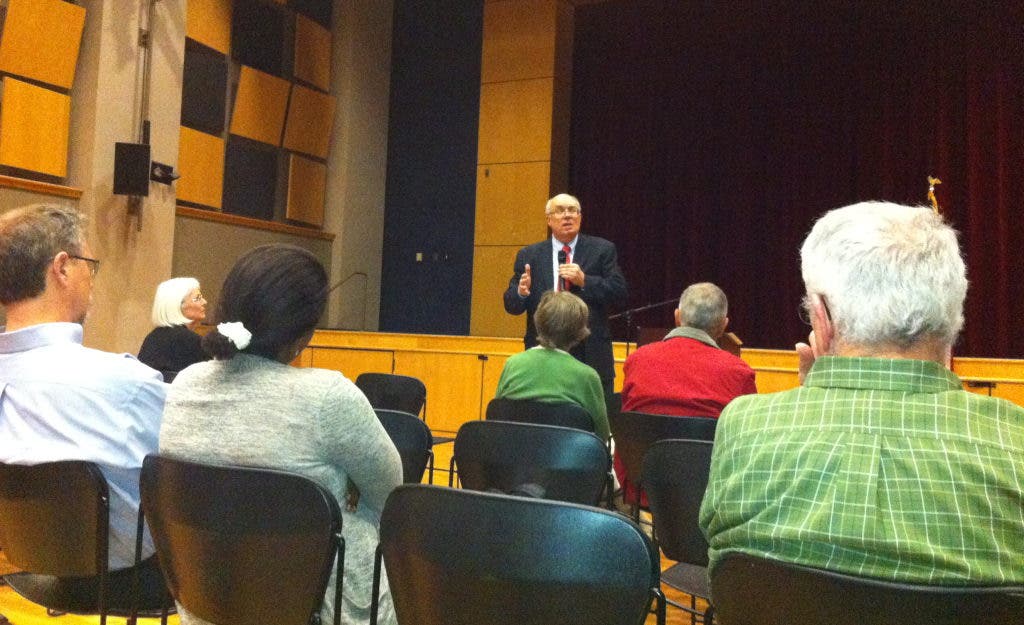
In a Town Hall meeting attended by teachers, school administrators and concerned parents from around the county, State Sen. Joe Simitian discussed the budget concerns local school districts are facing and what they can expect down the road.
Co-hosted by the Santa Cruz Education Foundation and the Scotts Valley Educational Foundation, the Thursday night event focused on issues related to public education funding and legislation in California.
Simitian, D-Palo Alto, whose district encompasses about half of Santa Cruz County, has an extensive background in education. Before joining the state legislature, he was a school board member for eight years in Palo Alto, chairman of the Santa Clara County School Board Association and practiced school law for 4 to 5 years, representing school districts. Since being elected to the state legislature, he has spent four years as the chairman of the Budget Subcommittee on Finance in the state assembly and has been on the Senate Education Committee for eight years.
Find out what's happening in Scotts Valleyfor free with the latest updates from Patch.
With all his experience in education, he gave a good insight and overview of the problems California schools are currently facing.
“I wish that I could bring you good news but that’s probably not on the agenda tonight,” Simitian told those in attendance at Thursday night’s meeting. “I think most of the news I’m going to have is going to be bad news, and the good news there is, is largely speculative.”
Find out what's happening in Scotts Valleyfor free with the latest updates from Patch.
Simitian said that since the financial crash of 2008, every year has been bad for schools, many of which were already in marginal shape and struggling.
“By the time the crash came, we then saw a series of very bad budget years in the state of California,” he said. “Because K-12 schools rely so heavily on the state for funding, that meant very bad budget years for the schools.”
Simitian said public school financing can be hard to understand and navigate and likened it to the Winchester Mystery House.
“It is an absolutely convoluted structure that no one would design from scratch,” he said of the budget. “If you had a blank piece of paper no one would say lets design it this way. But just like the Winchester Mystery House, every year we add another room and every year it gets a little more complicated, but every year it’s also something we’ve invested a little bit more into so it’s not like we can just raze it and start from scratch, which is what I think a lot of people think should be done.”
As far as how bad the situation is, Simitian said that school funding is about 20 percent below where it should be had things just moved along at a normal pace. To aggravate the problem, he said that funds that do go to schools are deferred to the tune of about 20 percent.
“So not only have districts seen a real shrinkage to the money they get to get the job done, they have seen a deferral every year of the funds that are forthcoming,” he said. “That has been an immense challenge for districts in terms of cash flow depending on the reserves in the individual districts.”
So what is the solution? Well, Gov. Jerry Brown will ask voters to approve a half-cent sales tax increase in November that if passed could bring in $6-8 billion to help prevent further education cuts. That money would be used to buy back deferrals and get schools back to where they should be with their state funding.
However, if the measure doesn’t pass, public education funding could be looking at another $2-2 ½ billion in cuts.
“The consequences of a failure in November are that the getting-us-back-on-track money doesn’t get pushed into the system and in fact there is a further shortfall which ends up meaning additional cuts to where we are at present,” Simitian said.
On Monday, the governor’s May revision will take place. This, Simitian said, will give everyone a clearer picture of what the state’s revenues and expenditures look like and how that will affect school funding.
“The bad news is that revenues have been less than expected and that means that things on Monday will be even more daunting than what we heard in January,” Simitian said. “What did we hear in January? There is good news and bad news. The good news is that the governor said we are going to put some extra money into K-12 education. The bad news is that [the money] is both invisible and speculative.”
Get more local news delivered straight to your inbox. Sign up for free Patch newsletters and alerts.