Schools
School District Works Toward Incorporating New Technolgies
Scotts Valley schools may not have the most technology, compared with other schools in the county, but it's getting there.

The may be a leader in many ways, but as far as technology goes, it's lagging behind some of the other schools in the county because of the way the state allocates funds, according to Carl Guerin, technology director for the district.
“You have an area like Scotts Valley that's generally well off, as far as income, but gets the lowest funding from the state [because] a lot of government money and technology funding goes to schools with a high number of socially disadvantaged students,” he said.
In order to receive a larger slice of the federal-funding pie, around 40 percent of students have to be classified as “economically disadvantaged,” a measure that's based on the education level of the parents, as well as whether students qualify for the National School Lunch Program.
Find out what's happening in Scotts Valleyfor free with the latest updates from Patch.
As for Scotts Valley's district, around 15 percent of students are classified as economically disadvantaged, ultimately blocking them from valuable grants and resources, such as e-rate funding, created to improve telecommunications and Internet access, according to Guerin.
“For us, we get level 1 funding, which pays for the Internet connection itself, but other schools get funding for servers, routers and sometimes even the computers,” he said. “We do well that we get our connection covered, but we don't get the rest covered.”
Find out what's happening in Scotts Valleyfor free with the latest updates from Patch.
Fortunately, through donations and fundraising efforts, the district has been able to introduce new technologies into some classrooms, with a private donation that provided with 32 new computers, and fundraising that enabled to provide every classroom with document cameras.
Guerin said the district's ultimate goal is to use technology to help improve student achievement and that its new superintendent, Penny Weaver, will be a great asset in reaching the goal.
“We do a lot of fundraising, [and] our new superintendent is focused on technology and is going out looking for grants for technology, so things are looking very promising with her,” Guerin said. “I think we'll be doing a whole lot more with new technology in the future.”
As of now, the district has laptops in every classroom and hopes to have projectors, document cameras and perhaps even Interactive Whiteboards incorporated into every classroom down the road.
Here's a look at some of the new technologies making their way into the district's schools:
- Document cameras. Guerin said the district purchased a number of document cameras last year, which are a high-tech replacement for the old overhead projector when combined with an LCD projector and computer. He said they offer more flexibility, as well as the ability to project images from books and 3D objects, and further enable users to zoom in on small objects, among other things. Although there are around 20 more classrooms in need of document cameras, Guerin said the district's goal is to eventually provide a document camera for each one.
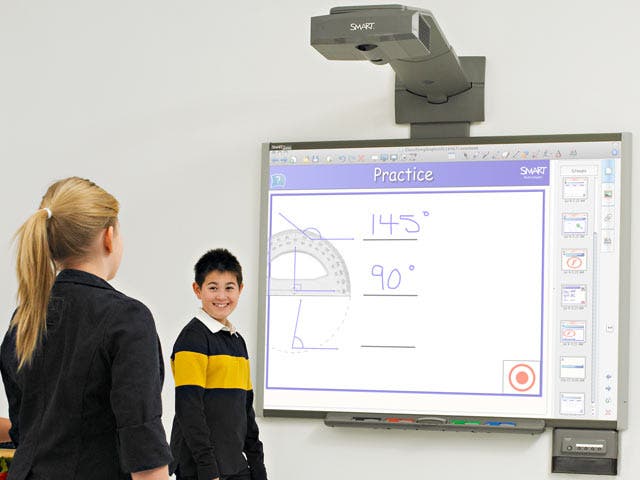
- Smart board in the Brook Knoll Computer Lab. Last year Brook Knoll used proceeds from its book fair to put a Smart Interactive Whiteboard in its computer lab, which allows students to walk right up to the projection screen and use their hands or a special pen to write on the board. Guerin said they will also add a short-throw projector, which is a projector-type device mounted up high that projects downward so students can walk up close to the screen without causing a shadow.
- Help desk for teacher tech support. The district's IT department is launching a virtual help desk to provide more immediate technological support for teachers and staff.
- Teacher software in elementary school computer labs. Guerin said that both Brook Knoll and Vine Hill elementary schools have new software in their computer labs that allows the teacher to control all the students' computers at once. One example of how this is beneficial is by allowing teachers to launch a website on all computers at once, which reduces any lag time that could result from students encountering problems when logging in themselves.
- Google Apps. Over the year, teachers and staff will be migrated to Google Apps for email, shared calendars, documents and Web pages, among other things. Guerin said Scotts Valley's middle and high school students will also receive Google Apps accounts so they can work collaboratively on projects.
“In the past, they used something [that would] download email right to the computer; that's the old way,” Guerin said. “The majority of people use Microsoft Outlook, so what we're basically doing is moving everything to gmail so it's Web based. Google Apps can do voice and video chat, and the list goes on and on—there's hundreds of applications that tie into it.”
Get more local news delivered straight to your inbox. Sign up for free Patch newsletters and alerts.