Schools
Exceptional Minds Marks First Year as Vocational School and Working Studio for Young Adults with Autism
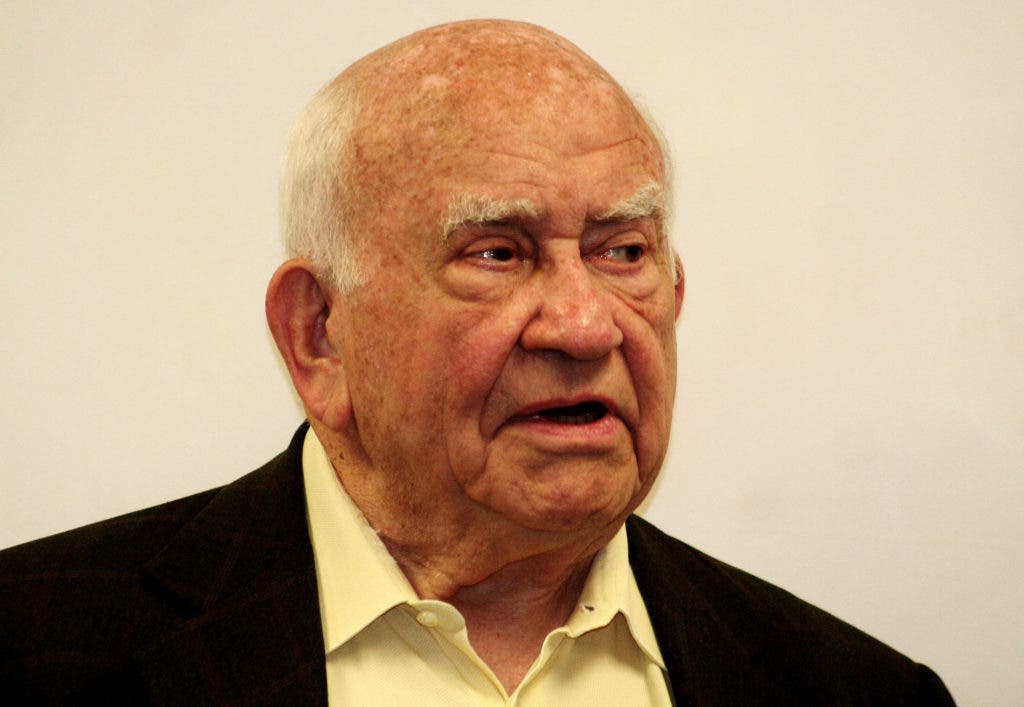
Students proudly showed their work in an open house sparked by the presence of Ed Asner.


“This is a place where I can use my creativity,” said Danny Gott, 18, as he sat in front of his computer monitor.
On the screen before him was a still from an animation he created in which he played the part of horror movie character Freddy Kreuger.
Danny is one of many autistic young adults currently studying – and creating – at the remarkable school and studio in Sherman Oaks.
Find out what's happening in Sherman Oaksfor free with the latest updates from Patch.
Asked how, at 18, he already mastered the art of computer animation and cracked the complex code of game design, Danny said, “I learned due to the wonderful teachers here. I learned it all here.”
Celebrating its first successful year Friday with an open house at its Sherman Oaks studios, Exceptional Minds hosted legendary actor and activist Ed Asner as well as other supporters, including Mike Kanfer, Sr. Business Development Manager of Adobe Systems.
Find out what's happening in Sherman Oaksfor free with the latest updates from Patch.
Although students on the autism spectrum often have deficiencies in certain areas, they also have a special kind of genius and hyper-focus, often, for certain creative endeavors. All the students at Exceptional Minds are gifted visually, and love nothing more than spending long hours completely absorbed in their work.
“Most of them prefer not to even stop for lunch,” said publicist Dee McVickers. “They’d rather just work straight through.”
Indeed, as Danny explained, computer animation and game coding is extremely laborious, often tedious work, which requires long hours to achieve even small results. And he loves it.
“It’s the most fun there is,” he said.
To exhibit the results of that work, he showed me two animations. The first one was called “Danny Earth Defense,” which presented a beautiful meteor gliding through space, about to collide with earth until it is destroyed by a missile from earth.
The second, called “Freddy Kreuger Animation,” is about the horror character.
“I did it by taking photos and then animating those photos. And,” he added in a conspiratorial whisper, “I was the one in the costume.”
“I finished the whole movie in one day,” he said proudly. “All on Halloween!”
All of Danny’s work, and that of the other students, can be seen on the school’s website.
Exceptional Minds is a non-profit organization, and was chartered in September 2011 as the only school of its kind to offer Autistic individuals instructional training in computer animation and special effects.
Building a bridge between high school and the working world has been a fundamental goal from the start. According to a recent study prepared for the U.S. Department of Education, one in three young adults with autism lack job experience and college or technical training eight years after high school graduation.
Among its more notable accomplishments: Exceptional Minds received credit as the post-production studio for the closing credits of the movie Lawless, a Weinstein Company production that was accepted into the prestigious 2012 Cannes Film Festival competition.
That’s right – these students are working already on major motion pictures.
And because of the school's non-profit status, those studios which use work from Exceptional Minds get a tax benefit.
Kevin Titcher, 21, a student from Calabasas, said he’d done animation only a little bit before coming here. One of his first projects was completing the animated invitation for this event sent out to guests.
“Did you get it?” he asked. “That took me a few months!”
To explain how long it takes to do a short piece of animation, he brought up the animation time-line on his screen.
“See there,” he said, pointing, “that’s just over 2000 frames. And it’s only 77.9 seconds. That took me four days.”
Four days of solid work for just over a minute of animation. That’s a common equation for the breadth of work required.
All the students here will graduate not only with knowledge, but with full Adobe accreditation, which is necessary to work in Flash animation, and an impressive animation reel.
Ernie Merlan, the school's director, welcomed all in attendance, and figuring, as he explained later, that the man needed no introduction, he brought on Ed Asner with just a few words.
The legendary actor and longtime activist Ed Asner is an honorary boardmember, and the father of a autistic son. He addressed the crowd, and within seconds, had the whole room in hysterics by first complaining that Merlan's introduction wasn't glowing enough.
Then Asner turned his attention to his drive over. With the impeccable comic timing that has kept America laughing for decades, he addressed his designated driver for the event, Cathy Weiss. She stood there grinning sweetly beside her daughter Sarah, as if she'd been the object of his derision before countless times before.
“I want you all to know that I was driven here by Cathy Weiss. The fact that I can say a few words now is a miracle after riding with her. It was the most impossible ride I have ever. God strike me dead if I ever get in her car again.”
The room erupted into laughter.
“I would quote my last wife,” Asner said, “who helped raise my youngest son Charles, who is high-functioning autistic. He’s in college at the University of Southern Connecticut. Doing very well.
“My wife said that Charles did not suffer from autism, he suffered from Asnerism.
"So you might think of those terms as interchangeable. If you get tired of being called autistic,” he said to the students, “call yourself Asneristic! It’s a much more euphonious term.”
Asner then introduced Mike Kanfer, the Sr. Business Development Manager of Adobe Systems.
“I hear he has a heart of gold,” Asner said. “So we’re going to kill him here, and dissect him.”
When the laughted subsided, Asner said, “Without the help of this bum, there would be no Exceptional Minds program.”
With that he threw his arms around Kanfer, and the two embraced, with Kanfer smiling widely.
“I am so surprised that you are here today,” he said to Asner. “I grew up watching you on television.”
“You grew very well,” Asner replied.
When Kanfer continued expressing his early recognition of the actor’s singular genius, as portrayed for years on TV, Asner interrupted.
“Oh, you were too young to know anything,” he joked.
Merlan returned to amend his previous brief introduction for Asner by explaining the reality of Asner's impact on Exceptional Minds.
“I thought the man needed no introduction, right? But the fact remains that there are very few people who have done more for the world of autism than this gentleman right there," he said, gesturing towards Asner.
"He’s raised more money than anyone we know of. When he shows up, as we can see today, people come. Everyone wants to hear what Ed Asner has to say.
"One of the things I love most about Ed is that when he gets up to talk about austism, he doesn’t talk about it like some problem, how everyone has these special needs.
"He talks about how great it is that these guys have an advantage over everybody else. He always talks about how [autism] is a blessing. And for that, and for so many other things, we love Ed.”
The need for a school, and a solution, such as this is vast. According to a recent study prepared for the U.S. Department of Education, one in three young adults with autism lack job experience and college or technical training eight years after high school graduation.
Roughly a half-million autistic kids will reach adulthood in the next decade.
“I’m really proud of this school,” said the school’s director, Ernie Merlan.
“These guys are over the top. When I came in, I didn’t know what to expect. I am not from an austistic background, I was asked to be the director of this new school. And I was overwhelmed by the sheer talent these students have.
“They might now have the communication skills or social skills that most people have. But when one door closes, another one opens. And these students are clearly talented in something. Our goal is to find that. “
Asked about the level of talent and competence the students have coming in, Merlan said, “Some of them already have talent for this, some have experience. Others don’t. But all of them are excited about what they are doing.
“What we find with people on the [Autism] spectrum is that they are geared one way or the other, they might be visually inclined, they might be musically inclined. And when we see someone walk in here with a spark, that they’re excited, we know if we keep digging we’ll find what they’re excited at.
“If they are not excited, there’s nothing we can do with them. But if they are, we can teach them all sorts of things when they’re here.”
Asked to explain the evidently successful methods of teaching he's devised, Merlan said, "Most of these students have gone to college and failed. Or dropped out.
"So I decided to make it not like a college. In the sense that they weren’t going to take five classes in a day. Instead, we’re going to focus on one subject, one thing only. And that thing is taught once in a week, for twenty minutes. And that’s it.
“Then for the next two weeks, we do a project which reinforces that lesson which we taught. It might be a video game, an animated video or a website. But it’s all geared off of that one lesson.
“All of our lessons are geared towards ACA certification, which Adobe puts out. So when companies are hiring, if you have that certification, they know you understand the system, and you can be hired.
“So they’re all being certified, here, through online tutorials and through our classes.”
“I found when I first walked through the door,” said Merlan, “and first met the students, that I got them. These students have always been treated like kids. I don’t do that. I come from the studio world, where if you mess up, you’re out. So I walked in and shook everyone’s hand. I insisted they stood up and shook my hand. I insisted they got here on time. Those kind of social skills are what they’re gonna need to walk into a job.”
The students all agreed they loved being where they were, because it was fun work, and so suited to their way of working.
“I like to focus on one job for a long time,” said Danny. “And you can do that here. You can work for many hours for weeks or even months, just to get the job right.
“But once you get it right, it’s always right! And that is a good feeling.”