Schools
Local 7th Graders to Compete in Finals for National Science Award
A team of Mirman School seventh-graders to head to Orlando to face off against seven other teams selected to compete in a national science competition.
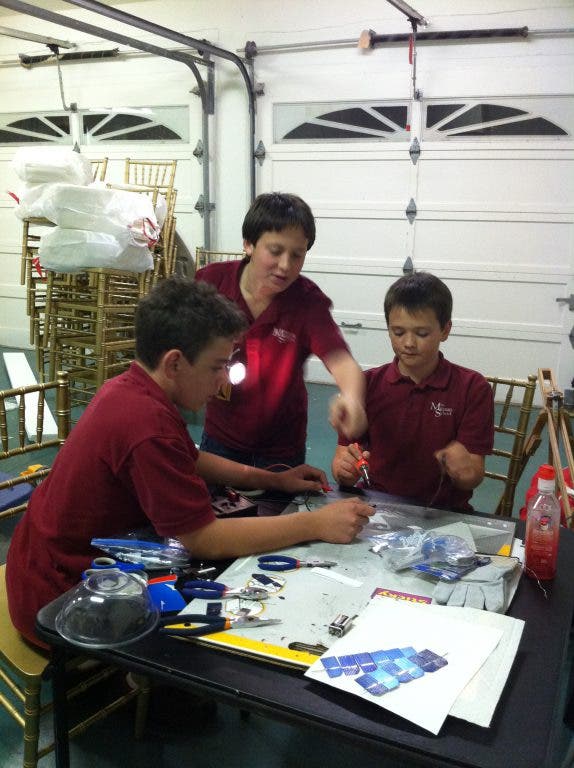

Three local seventh graders, who were selected as finalists in a national science competition, will head to Orlando, FL, in June to compete for a $25,000 grant.
Jonathan Berman, Benjamin Kotzubei and Austin Veseliza, all of whom attend the Mirman School for Gifted Students on Mulholland Drive, were selected along with seven other teams from across the country as finalists.
The teams and their coaches will receive an all-expense-paid trip to Walt Disney World to attend National Championship Week and compete for U.S. Savings Bonds and the $25,000 Columbus Foundation Community Grant, plus a $200 development grant to further refine their idea.
Find out what's happening in Sherman Oaksfor free with the latest updates from Patch.
The Christopher Columbus Awards is a national, community-based science, technology, engineering and math program for middle school students. The program challenges the students to work in teams of three to four, with an adult coach, to identify a problem in their community and apply the scientific method to create an innovative solution to that problem.
The trio of Mirman School seventh graders decided to focus on finding a solar solution to our country’s dependence on fossil fuels as their project.
Find out what's happening in Sherman Oaksfor free with the latest updates from Patch.
“The boys felt the use of fossil fuels is pollutive and they are running in short supply,” said Deborah Kotzubei, the team’s coach and Benjamin’s mother. “They decided they needed to find a way to make solar collection more readily available and versatile.”
During their experiments, Jonathan, Benjamin and Austin discovered that the commonly used flat solar panels do not make the best use of the sun’s energy. They also have to be installed at a certain angle and face due south, Benjamin said.
Some of the sunlight is reflected off photovoltaic panels and lost. That reflected sunlight is not absorbed by neighboring panels because the panels are flat and all face in the same direction. The middle schoolers concluded that if the panels were constructed into different shapes the panels would be able to capture and absorb some of that reflected sunlight.
What impressed Kotzubei most was the boys’ determination in overcoming challenges faced as the project progressed. Originally the middle schoolers had planned to construct physical models in several different shapes to uncover which shape was the most energy efficient.
They discovered that although the photovoltaic cells, at $2 each, were inexpensive, the cells were delicate and broke easily. As a result, to do the experiment in the manner they had originally planned would be cost prohibitive, because the amount of cells they needed would cost several thousand dollars.
“I was impressed that they didn’t get bogged down by that hurdle and decide to quit,” Kotzubei said. “Instead they came up with a creative solution using a computer program.”
The middle schoolers modified a computer program so they could use it to create simulated three-dimensional experiments to find out which shapes were the best. Using that method, they were able to discover that dome shapes worked the best, so they could focus on building them and one other control shape to test.
Officials at Mirman School allowed the boys to use the roof of the science building to conduct their experiments.
As part of the project, the students also have to establish community partners to enable them to go forward with the project. UC Irvine has agreed to be one of those partners. If the students win the grant, the university would administer it.
This wasn’t the trio’s first national award. As sixth graders, they took first place in the sixth grade division in the eCybermission contest sponsored by the U.S. Army. The team experimented with multiple materials for possible use in sports helmets, concluding that gel rubber remains far more shock absorbent than foam.
As a result of that award, they were invited to participate along with 28 other teams from across the country in President Barack Obama’s first science fair on Oct. 19, 2010.
Between that experience and being asked to be keynote speakers at a PSAT awards ceremony held May 14 at UC Irvine, the boys are becoming old hands at public speaking.
When asked if he would be nervous giving the presentation in Orlando before a panel of judges, Benjamin replied, “I get a little nervous every time we have to speak publicly, but at least it’s just a panel of judges instead of a large audience.”
At this point, he is more nervous and excited about the prospect of winning the $25,000 grant that would enable them to take their discovery further and implement it in the community.
Benjamin’s long-term goal is to earn an engineering degree in the hopes of creating real world solutions to global problems. According to Kotzubei, Austin also aims to be an inventor with an engineering background, while Jonathan wants to be either a mathematician or computer programmer.