Politics & Government
No Change Made to Development Fees
Despite some debate and disagreement, the vote was unanimous.
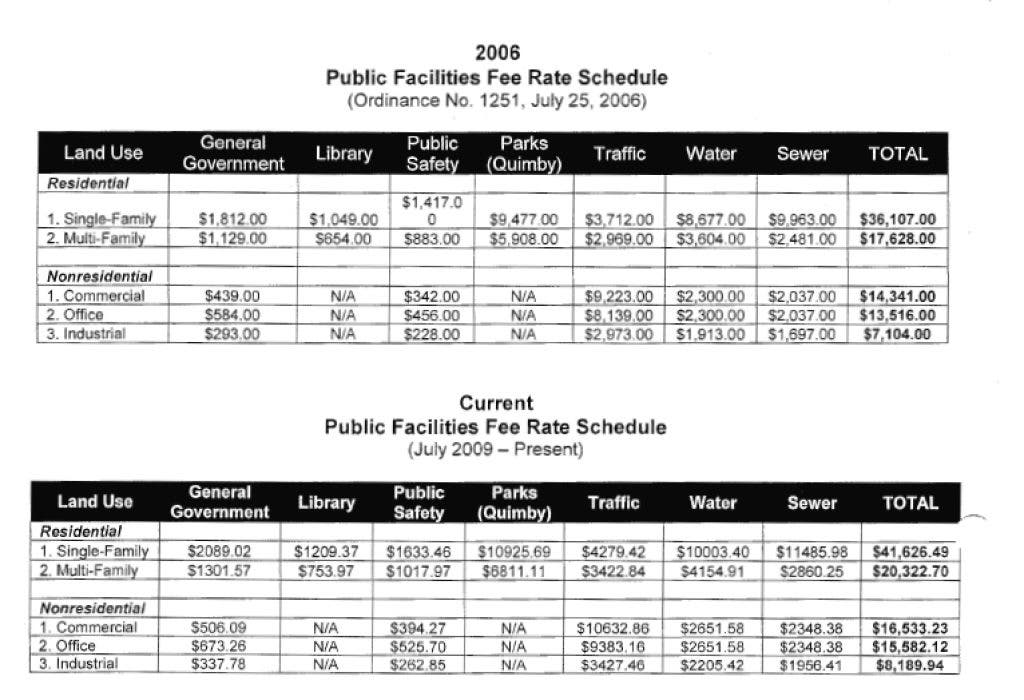

The City Council chose not to make any adjustment to current Public Facilities Fees, which have not changed since 2009, though not without quite a bit of debate during Tuesday’s meeting.
The Public Facilities Fees, also known as the Development Impact Fees, are a bundle of charges collected from new developments to help pay for public services such as water, sewer, parks, police and library services. The fees are collected from residential, commercial and industrial developments.
Council Member Joe Mosca suggested that the fees be brought back to 2006 levels, noting that when the amounts were set, the council had planned for 100 percent cost recovery, based on the fee study at that time.
Find out what's happening in Sierra Madrefor free with the latest updates from Patch.
“The fee is very high, and it’s still going to remain high and the reason is, we are a small community,” Mosca said.
The current fees total $41,000 for a single family unit. Mosca felt that rolling back to the rate set to 2006 would “make sense” and will “give a little relief” to those who voiced their opposition to the high rates.
Find out what's happening in Sierra Madrefor free with the latest updates from Patch.
Council Member MaryAnn MacGillivray disagreed with Mosca’s sentiments in what became a slightly heated debate.
“At a time when budgets are so tight, to not recoup 100 percent of the cost, based on 2009, puts a challenge to the city in terms of dollars and cents,” MacGillivray said.
She went on to call the fee study a "good study" and therefore the fee should remain the same.
Mosca continued to make his case stating “[the fees] are too high compared to every surrounding community,” he said, and this may inhibit certain types of development from happening in the city [larger units].
MacGillivray disagrees
“The large developments are going to have a big impact and are the one’s that ought to pay these fees,” MacGillivray replied.
After Mayor John Buchanan jumped in to attempt to stop the two Council Members from talking over each other, Mosca backed down, saying leaving the fees at the 2009 level was not a “deal breaker” for him.
But the discussion and at times testy exchange, did not end there.
Instead, it just shifted gears as Mayor Pro Tem Josh Moran weighed in and agreed with Mosca, giving his own take on why the fees are too high.
“In 2006 and 2007, the cost for construction was a hell of a lot higher than it is right now,” Moran stated. “We’ve seen a drop in the cost of construction material in every project we’ve done this year. The cost of concrete and steel were very high in 2006 because we were rebuilding a country overseas and there was incredible growth in China…everything was through the roof,” said Moran.
The Mayor Pro tem also noted that if you based the impact fee on this latest fee study and factor in the change in cost of construction, “We are already in a gain if we use the 2006 numbers.”
MacGillivray attempted to correct Moran by pointing out that “the current fee rates do not reflect maximum justified public facilities fees.” Moran fired back, “Right now it doesn’t, because we are stuck in 2009.”
Council Member Nancy Walsh sided with MacGillivray, stating that there is not sufficient data to support shifting the fee back to 2006 levels.
Mayor John Buchanan, while understanding the arguments for rolling the fees back, chose to stay with “a sense of stability” and fully recoup 100 percent of cost expected to accompny any new development.
Though Mosca and Moran disagreed on various issues of the policy and adjourning fees, the resolution vote was unanimous to keep the fees as is, though Mosca hoped there would be further discussion regarding possibly a new fee study and hiring a committee to look at the closely to see how future City incentives are effected by the current policy.