Community Corner
Search and Rescue: 60 Years 'Anywhere in the Wilderness'
For 60 years, the Sierra Madre Search and Rescue Team has been on call to aid hikers, mountain climbers and others lost in the wilderness.


"Anywhere in the Wilderness That Someone Needs Help...." has been the operating principle for the Sierra Madre Search and Rescue Team for six decades.
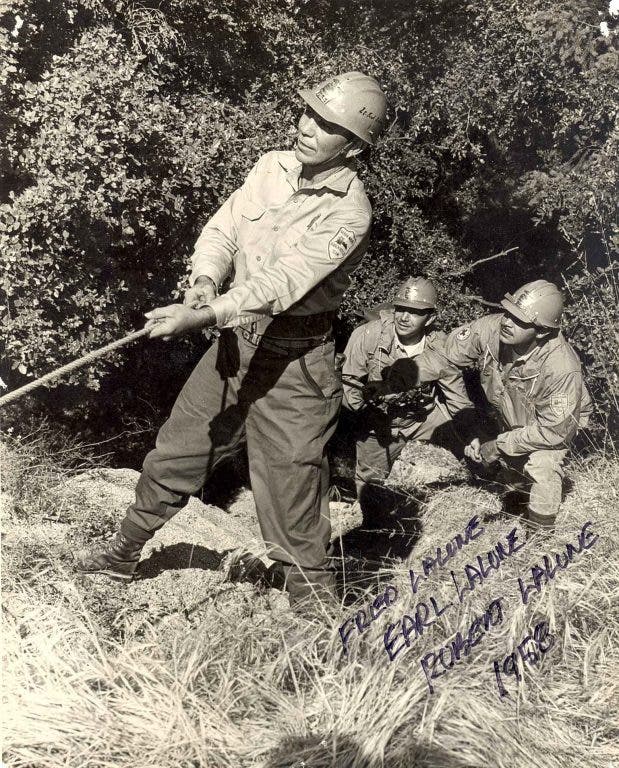
The first search and rescue team in California, it was formed in 1951 by Fred La Lone and Larry Sheperd, in response to the disappearance of a teenage boy and a disorganized rescue effort that followed. In August 1951, 17-year-old Walter Weirick strayed from a trail in Bailey Canyon, and slipped into a ravine, breaking his back and leaving him wedged upside down in a rock crevice. For three days, volunteers searched in vain for the youth.
"Some were inexperienced, wore improper clothing and had to be helped from the hills themselves," recalled Bill Wark, former SMSR public relations officer and treasurer. "They covered the same spots over and over again and missed some areas completely. Any attempt at tracking became useless." The boy was eventually found in critical condition and made a slow recovery from his injuries.
Find out what's happening in Sierra Madrefor free with the latest updates from Patch.
Seeing the need for a more coordinated organization that could aid in future efforts, two Sierra Madreans--Fred La Lone and Larry Sheperd--proposed a volunteer rescue organization that would function with military precision.
La Lone knew the territory well—he had worked with the Forest Service since 1938 and was one of four brothers who had spent years trapping animals in the San Gabriels. Because of their familiarity with the area, the brothers became the go-to men for rescues. "Whenever an emergency of any kind arises in the mountains," noted the L.A. Times in 1951, "the call is 'get La Lone to help.'"
Find out what's happening in Sierra Madrefor free with the latest updates from Patch.
The Sierra Madre Search and Rescue Team held its first meeting on Aug. 30, 1951, at Sheperd's home. Later, a cellar in was set aside for all meetings.
Volunteers came from a variety of backgrounds—among them were accountants, postal workers and professors—but were united by their mission. “We do it because we’re afraid it might be us or our kids in the mountains some day, and there’d be no one to look for us,” Larry Sheperd told the L.A. Times in 1952.
Arnold’s Hardware sold the team discounted equipment—ropes, flashlights and other materials, while the Kiwanis club donated orange helmets. Eventually the team's equipment came to include ice axes, snow shoes, radios, rescue sleds and stretchers—paid for through donations.
To avoid repeating the chaos surrounding Weirick’s rescue, team leaders devised a system of signals that could be placed on the ground for plane crews to spot from above, hastening their efforts. A letter “F,” for instance, symbolized the need for food and water. Each rescue was discussed after the fact, flaws were noted and improvements suggested.
Team leaders were chosen by circumstance. A call list with each voluneer’s phone number on it was given to the Sierra Madre Police Department, and when word of an emergency was received, whoever picked up the phone first became leader of the rescue operation.
The team also provided recommendations for lost hikers: “Stay put” was the key motto. Inspired by Sierra Madre’s efforts, Altadena and San Dimas soon formed similar rescue units.
The team became an arm of the L.A. County Sheriff’s Department in 1956, which allowed them use of helicopters and mountain jeeps equipped with generator-powered searchlights; and 10 team members were selected to form the nation's first civilian Helitak (Helicopter Initial Attack) unit.
In the late 1950s, the team added bloodhounds to their rescue efforts. After hearing about their success in tracking down escaped inmates in the Midwest, team member Miner Harkness contacted trainers and eventually secured several animals.
The bloodhounds gained a favorable reputation and were even the subject of a 1959 L.A. Times profile, which noted that team helicopters were modified with “portable aluminum kettles” on both sides to accommodate the dogs.
Early calls for help came from Big Santa Anita Canyon and Chantry Flats, but the discipline and tirelessness of the Sierra Madre Search and Rescue Team put them in high demand and eventually took them on missions as far away as Nevada, Arizona, New Mexico and Baja. Team members once scaled the summit of the California's highest ice formation, the 14,242-foot-high Palisade Glacier in Inyo County, to retrieve a mountain climber's body.
Volunteers have come from all walks of life over the years, but as the SMSR website notes, “a common thread binds these individuals together: a love of mountaineering and a unique desire to help others.”