Arts & Entertainment
Sierra Madre Library Hosts Distinguished Poets for Discussion and Readings
Presented in observation of National Poetry Month, the event was second in a group of three celebrating and disseminating the art of poetry at the Library throughout April.
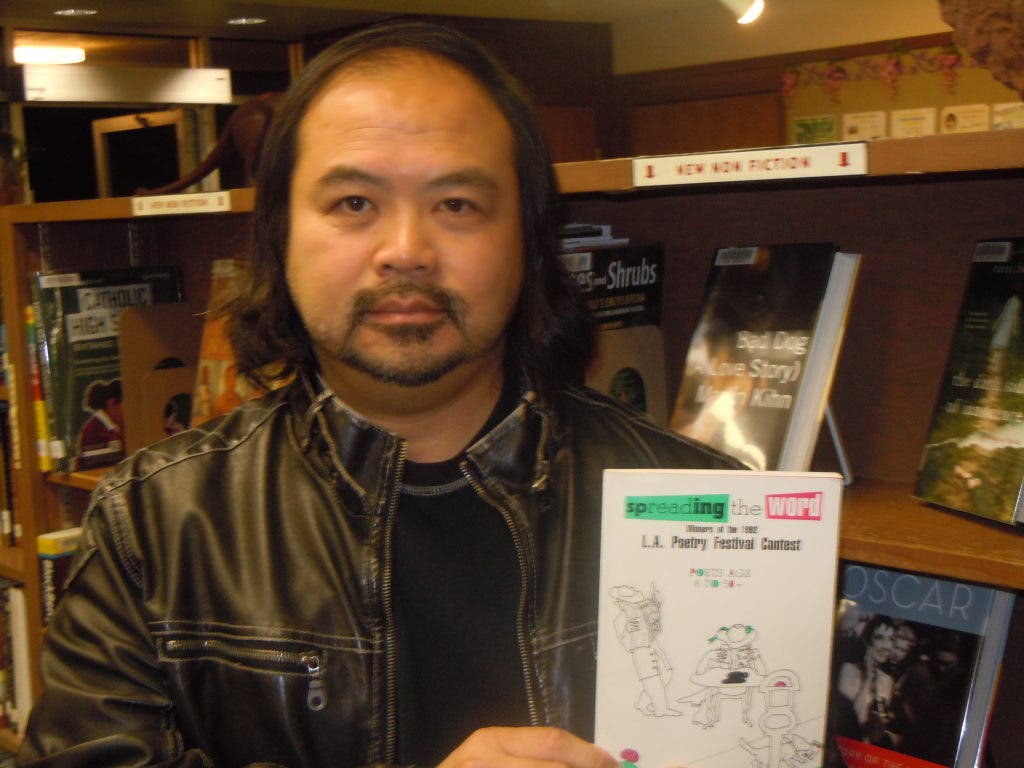


Guests of the were treated to poetry readings and enlightening commentary by four noted poets, Carol Lem, Alex Luu, Zahava Sweet, and Urith Walker, Thursday evening. Presented in observation of National Poetry Month, the event was second in a group of three celebrating and disseminating the art of poetry at the Library throughout April. Library staff member Sophia Duran, herself a poet, coordinated the event of two months in the making, bringing together poets of diverse backgrounds in an informal panel setting, complete with cookies and good coffee.
“Turnouts at poetry readings are often poor, with only a few people in the audience. I thought the panel format would encourage people who might be uncertain about poetry to come, listen, and be inspired,” Duran said.
If the full-house crowd is any indication, her idea worked. Audience members followed intently as each panelist recounted life-experiences informing their poetry in a discussion moderated incisively by Lida Bushloper, a Library Trustee.
Find out what's happening in Sierra Madrefor free with the latest updates from Patch.
First up to introduce herself and her body of work was Polish-born Zahava Sweet.
“I don’t like speaking about myself very much” she cautioned, “except through my poetry.” A holocaust survivor, Sweet frequently addresses students on her experiences during World War II, “the only period in my life when I could not write,” she noted.
Find out what's happening in Sierra Madrefor free with the latest updates from Patch.
Sweet’s collection of poems, The Return of Sound, evokes her life during the holocaust, but she also writes on topics unrelated to her immediate background: “I might not write about my background. I often just start with an image. The poems then come to me and I revise them, which is the difficult part.” Taking on challenging subjects for much of her poetry, she states that “any topic is a valid subject for poetry, as long as it has a good ending.”
“You can talk about anything in good taste,” added Urith Walker, who followed Sweet on the panel. “You can say what people are already thinking, but don’t know how to express. I’ve been told I do that in my poetry.”
While attending Pasadena City College, Walker studied with English Professor Beverley Tate, who encouraged her to write and publish poetry. “I’ve been writing poetry for several years now, but it still seems new to me.”
Walker composed lyrics to Jazz songs before moving into poetry and spoken-word in the mid-90’s. The importance of music to her is apparent in the title of her collection of poetry, Then Sings My Soul, a phrase adapted from the hymn “How great thou art.” Her poems “My life, my song” and “Dismiss,” recited exuberantly by Walker, expressed courage in the face of pessimism. “When people discourage you, you have to get on your own beaten path. You can dismiss all the negatives,” she explained in contextualizing remarks.
Carol Lem was born and raised in Los Angeles, and while Chinese-American, she is “sometimes considered more American than Chinese,” especially by her students at East Los Angeles City College where she teaches creative writing. “You’re American, your gestures are American,” she has been told.
Her collections of poetry Shadow of the Plum and Gathering the Pieces explore in part her routes, clarifying memories with parents and reconstructing stories she was never told. “My family didn’t tell stories, they listed facts.” That sentiment, foreshadowed in her introductory statement, was hauntingly reiterated in one of the two poems she recited. “In my writing classes, I ask my students to tell their stories and talk about what they know.”
Lem’s own stories continued as she recited a poem about cooking a recipe with her mother. “Cooking is a way of transferring culture from one generation to the next,” she explained. Lem used “chicken in black bean sauce” as a metaphor, “a microcosm” of the differences and similarities between generations. “Poetry is a way of paying homage. Writing poetry is a means of processing, a form of channeling, of re-seeing pain in a way that heals it.”
Alex Luu began writing poetry and autobiographical performance art while a student at UCLA’s School of Film and Television.
“Autobiographical performance art is hard to describe,” Luu reflected. “It’s not running around on a stage naked, as many people think.” The Chinese-Vietnamese poet uses performance art as a vehicle for comprehending the past. “For me, poetry is about looking at the past, facing it, and making sense of it. It’s ultimately very healing for me.”
His epic one-man performance theatre work Three Lives, from which he read two excerpts, depicts his narrow escape from worn-torn Saigon in 1975 and his family’s search for identity in America. Playing four characters, Luu speaks in English, Chinese, and Vietnamese in a “very physical, visceral monologue,” conveying a collision between three generations with humor and feeling. “The artist must put content in a way that is entertaining first and foremost, but also challenging.”
Beyond performing, Luu is a frequent guest artist and lecturer at universities and community arts organizations around the U.S., teaching adults and students through an autobiographical performance art workshop entitled My Own Story.
Audience members remained enthusiastic throughout the reading and discussion, eagerly engaging the panel with questions ranging from finding inspiration to choosing poetic forms.
“We were very pleased by the level of interest this evening,” said Polly Bonnett, Assistant Director of Library Services. “We haven’t had a poetry festival here at the Library for a few years,” Bonnett noted.
As the clock approached 8:30 p.m., the event was brought to a close, but many didn’t want it to end. In light of the event’s warm reception by audience members, it will hopefully return as a regular staple of Sierra Madre’s cultural life in future National Poetry Months.