Community Corner
'Un-American' Graffiti Revealed Local Prejudice
In March 1945, racist vandals defaced the Altadena property of scientist Linus Pauling after he hired a Japanese-American gardener from Sierra Madre.
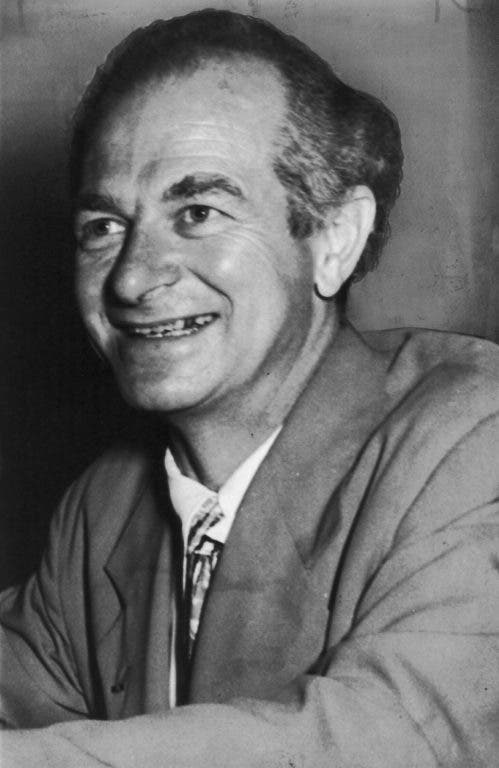


On the morning of March 6th, 1945, scientist Linus Pauling and his family awoke to an unwelcome surprise at their Altadena home.
On his garage door, Pauling found the words “Americans die but we love Japs” and “Japs work here--Pauling” scrawled in red paint, along with a crudely-painted Japanese flag. On his mailbox was smeared “Jap.”
Pauling, who lived with his wife and four children on Fairpoint Street, was then chairman of the chemical engineering and chemistry departments at Caltech and had recently helped to develop a synthetic substitute for blood plasma from gelatin.
Find out what's happening in Sierra Madrefor free with the latest updates from Patch.
Several days earlier, the Paulings had made a bold decision—they had hired a 24-year-old Japanese-American gardener from Sierra Madre to come work for them.
George H. Nimaki, a U.S. Army inductee, had recently been released from Heart Mountain Relocation Camp in Wyoming and was living on North Adams Street while waiting to be shipped to Camp Shelby, MS, for basic training.
Find out what's happening in Sierra Madrefor free with the latest updates from Patch.
Despite the claims of the vandals, Nimaki was not Japanese—he had been born in Gardena and graduated from Monrovia High School. In 1942, he had been interned along with his parents, as part of Executive Order 9066.
From 1942 onward, Linus and Ava Pauling had been outspoken critics of Japanese-American internment, which they found unconstitutional and deeply troubling. Pauling had even put his reputation on the line at Caltech by affirming the loyalty of several Japanese-American students and faculty.
Pauling was no peacenik, however. Though he would later become an outspoken pacifist, he was, at the time, a strong supporter of the U.S. government and had even helped to develop explosives, rocket propellants and armor-piercing shells to help fight America's enemies overseas.
Pauling was all the more outraged because, at the time, his son, Linus Pauling Jr., was then serving as a radioman on a U.S. Army vessel in the Atlantic Ocean.
After discovering the graffiti, Pauling phoned the police, and before long, Altadena Deputy Sheriffs C.L. Brownlee and L. Nichols arrived to investigate. Reporters from the Los Angeles Times, Pasadena Star-News and Pasadena Independent also showed up at Pauling's home.
An 'Un-American Act'
Interviewed by the press, Pauling called the defacement of his property an “un-American act" carried out by “misguided people who believe American citizens should be persecuted in the same way that Nazis persecuted the Jewish citizens of Germany.”
The harassment didn't end there, though. After the incident was publicized in the papers, it got worse. The following day, March 7, Pauling received an anonymous note in the mail calling him a "Jap Lover" and telling him to "Wake up think--how they treated our boys."
Over the coming days, more threatening letters arrived. “We happen to be one of a groupe [sic] who fully intend to harm your home, tar and feather your body unless you get rid of that jap,” read one. “Japs killed my own Father. … It’s too bad that some Jap does not rape one near and dear to you.”
Pauling had not anticipated such a vicious response to what he considered a gesture of kindness and basic decency. “The people in Pasadena and the surrounding region are, in general, intelligent and patriotic,” he told the Pasadena Independent. “I have, however, come in contact with a few people who do know what the Bill of Rights is and what the Four Freedoms are and what the principles are for which the United Nations are fighting."
Nimaki soon quit working for the Paulings, fearing for his safety, but the harassment continued. Soon the Paulings began to receive death threats over the phone.
Worried about the safety of her family, Ava Pauling called the and asked for a guard to be placed around her home. But, to her dismay, the request was refused, and she was told "that's what you get for hiring a Japanese worker."
She contacted a local chapter of the ACLU to complain, and after they threatened legal action, the sheriffs relented and put a 24-hour guard around the Paulings' house for two weeks.
The Paulings were not the only local victims of harassment. Racial slurs were also painted on the fence of Marion F. Gooddings, a Pasadena woman who was lodging a 22-year-old Japanese-American; and on a handball court at Pasadena City College, where vandals wrote "Remember Perl [sic]" and “You let the Japs back, why?”
Pauling eventually contacted the FBI and the Attorney General of California, perhaps feeling that local authorities were not taking the case seriously.
Paradoxically, the FBI used the opportunity to start a file on Pauling himself. Though they conducted a thorough search for suspects that lasted months, The Pauling Blog at Oregon State University notes that "this investigation would mark the first and last time that Pauling was ever a direct beneficiary of FBI services. From this time forward, whenever Pauling’s name was mentioned in FBI correspondence, he was either the subject or co-subject of proposed wrongdoing."
No suspects in the vandalism case were ever brought to justice.
The event caused Pauling to become more outspoken and catalyzed his sense of injustice in subsequent years. Pauling would later stand bravely against the anti-communist "witch hunts" of the 1940s and '50s, and would become a leader in the crusade for nuclear disarmament. Though denounced by conservative critics as a "communist dupe," Pauling was vindicated when, in 1962, he won the Nobel Peace Prize.
Little is known of what happened to Nimaki. Presumably he was shipped off to Camp Shelby to complete military training. It's worth noting that Camp Shelby was where two of the most decorated units of Japanese-American soldiers in the Second World War trained before their deployment overseas.
It's possible that Nimaki joined the 100th Infantry Battalion or 442nd Infantry Regiment, all-Japanese fighting teams that helped liberate Europe.