Community Corner
Using Pesticides Wisely, If You Must Use Them at All
Careful use and storage of pesticides prevents unnecessary accidents.
The equinox passed on Sept. 23, one of two in the calendar year. Featuring the unique combination of days and nights of equal length, give or take a few seconds, this biannual midpoint is also known in the Northern Hemisphere as the autumnal equinox. It marks harvest season and, equally important, soon-to-come Halloween festivities.
I am probably feeling sentimental toward my own children, now in college. But, spooling my thoughts backward, I think of Power Rangers and The Scream, of bulging pillow cases of candy, of pumpkins and of harvests. This makes me think of fruit and vegetable production, which makes me think of tomato hornworms and slugs and pillbugs which come along, uninvited, when the soil is prepared for eventual reaping.
Even though today’s holes in my red, Clint Eastwood tomatoes definitely do not make my day, I think about children past and present.
Find out what's happening in Sierra Madrefor free with the latest updates from Patch.
And I pause, knowing that how I use or over-use pesticides trickles down to those wee ones.
According to the guidelines of environmentally-conscientious Integrated Pest Management (IPM), whose adherents practice at universities, farms and pro ball fields near you, pesticides are a last resort. Want to avoid their wasteful use? Follow these tips from the EPA’s checklist.
Find out what's happening in Sierra Madrefor free with the latest updates from Patch.
First, determine how much pest damage the crop or landscape can handle before it’s losing money. Next, identify the pest to accurately match the treatment or pesticide to the problem. Prevention is step number three.
Try cultural practices first, such as raking infested leaves, limiting irrigation to control water-borne pests, pruning dead wood which is attractive to , or planting disease-resistant rootstock.
If all else fails, select an appropriate low-toxicity pesticide.
Read the Label
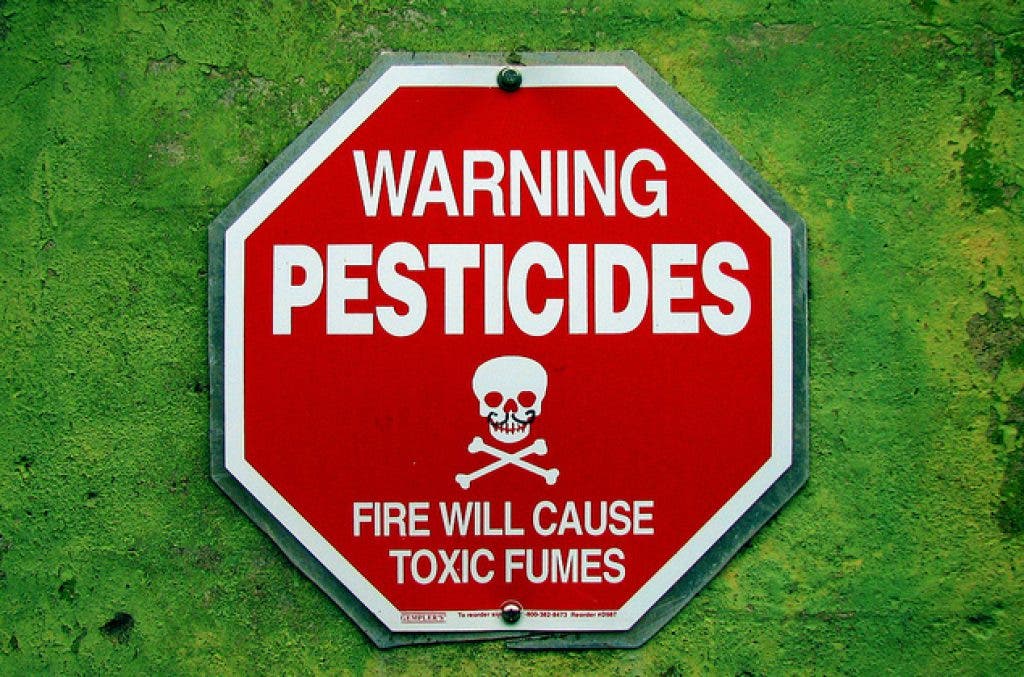
All legal pesticides in this country have a label, with one of three signal words. “Caution” is the lowest toxicity rating. “Warning” tells the consumer this pesticide has a moderate toxicity rating. “Danger,” when used alone, means this product poses a dangerous health hazard and must be stored, transported, mixed and applied with utmost care.
The words “Danger” and “Poison” together with a skull and crossbones is the flashing red light of toxicity, not to be messed around with.
Danger and Poison with their friends Skull and Crossbones equals highly toxic, during today’s application, maybe next week in Santa Monica Bay, and possibly at next year’s mammogram. There’s no telling.
Read the label, early and often. Read the label before you buy the product to make absolutely certain this is what you need. Read the label before you mix the product. And while you’re at it, follow all directions, even if you are a rebel. Never use more than the manufacturer recommends. Psst, rebel! Feel free to use less.
Why? Because less is more. Really. Anecdotal evidence from Dodger Stadium indicates that reduced application rates of insecticides gets the job done. Which saves money and causes fewer unintended consequences, like polluting ground water, killing non-target pests or giving a skin rash to the applicator.
Proper Usage
Not to sound like your bossy big sister, but allow me to continue my rant. As a general rule, don’t spray a liquid or fine powder on a windy day. It is bad to hit non-target plants, people and pets with a shower of unnecessary chemicals. Don’t overspray onto sidewalk or curb. The first rain or broken sprinkler will carry that overspray into the sewer, which is linked to our water supply.
Keep it Legal
If and when you climb the EPA ladder to pesticide use, keep a few crucial notions in mind. Select legal pesticides only. In the Golden State, illegal pesticides are available and are highly dangerous to people, pets and other living organisms.
Legal pesticides, such as mothballs, must be used according to the manufacturers direction. Mothballs volatilize, that is, slowly change from solid to gas when exposed to air. Their scent is the active pesticide ingredient, naphthalene or paradichlorobenzene, and must be used only within a closed container or garment bag, according to label instructions.
Those of us who equate the smell of mothballs with happy times playing in Granny’s attic need to go out and get some fresh air. Inhaling large amounts of mothball gas can lead to headaches, nausea, diarrhea, vomiting, eye or nose irritation or coughing.
Be cautious of insecticidal chalk, “Miraculous Chalk” or “Chinese Chalk.” Imported from our friends in China, the active ingredient is deltamethrin, considered safe in the correct applications, when used with personal protective equipment such as goggles, non-permeable gloves, long sleeves, and a respirator. This chalk resembles household or school chalk, and can easily be mistaken as a toy, especially by children. Dermal absorption is possible, as is touching and ingesting food after playing with this chalk. Residue on clothing can result in sustained inhalation or skin contact.
As with all pesticide exposure, clothing should be washed separately from everyday garments. An additional rinse cycle will dilute residue expunged into sewer or gray water.
Good news! According to the Pesticide Information Project of Cooperative Extension Offices of Cornell University, Michigan State University, Oregon State University, and University of California at Davis deltamethrin breaks down in the soil within two weeks.
Avoid “Tres Pasitos,” a powerful rodenticide which is illegal for general sale and use in the U.S., but imported from Mexico and Latin American countries. Its active ingredient is aldicarb, highly toxic when ingested. In the U.S. aldicarb is available only to qualified applicators, such as pest control experts, who are certified by the state. It should be applied in controlled amounts for specific rodent control.
While youngsters everywhere raid mommy’s closet for Justin Beiber or Michele Bachman costumes, I am in my dungarees, almost as glamorous as the spinster in American Gothic. I’ve secured my pesticides (rodenticide, ant baits) and fertilizer (fish emulsion) in their original packaging, inside of child-and-pet-proof containers. Pesticide tricks? No thanks. My treat will parade through any day now.