Community Corner
Walking While Black in South Pas—Is That a Problem?
One mom's reflections on race and tolerance in South Pasadena.

Every , my son would get really worked up, “But why? Why did that man kill him?”
His “Aunty Nana” came up with the best answer, “It was fear. He killed him out of hatred created by fear.”
In my elementary school, which was mostly African-American and Asian-American and about 1/3 white and other, I mostly hung with my three best friends—a little United Nations. Me, “Sammy Boy”—who was a Jewish "tomboy”—and three boys: African-American, Japanese and German descent.
Find out what's happening in South Pasadenafor free with the latest updates from Patch.
The day Martin Luther King Jr. was assassinated, I remember sitting with my mom and a neighbor while they cried watching the scenes over and over again on television. That same year, I wrote to the state of Louisiana to ask if it was true that it was illegal for me to marry my black boyfriend, being officially “Caucasian,” though never viewed as such by most white folks. They mailed me back a copy of the actual law forbidding blacks and whites to marry.
What Would MLK Do?
Find out what's happening in South Pasadenafor free with the latest updates from Patch.
When my son, Gabe, was around 7, I picked him up at a friend’s home. The mom and my friend greeted me with “something happened.” Her nephew, about 10 years old (who—like her and her son—was of Armenian descent) had told Gabriel that he didn’t like the "n--gers" touching him when Gabe’s hand had brushed against his.
Furious and devastated for my son, I asked, “What did you say to him? Did you tell him your mom would kick his a--?"
“No” Gabe replied.
“That’s not what Martin Luther King would do. He’d fight back with words and talk and talk.”
When my son was around 10, we attended a weekend for multiracial Jewish families called Camp Tawonga in the Bay Area. One family made of two moms (Jewish and white) told a story.
They live in Albany, a small town next to Berkeley, but predominantly white at the time. When their son turned around 10, they introduced their family to the local police department and explained, “This is our son, we live here in the community,” as they’d heard of kids being pulled over for “walking while black.”
It was chilling to think that my son could someday be seen as a potential perpetrator. Michelle Alexander’s new book, The New Jim Crow, Mass Incarceration in the Age of Colorblindness, among others document the mass incarceration of black men.
I wouldn’t have chosen to place my son in a high school and community where he was a racial minority, but he ended his middle school in Altadena with an experience of being with classmates from a variety of racial and ethnic groups and had grown to feel comfortable enough to sign his texts “Afro-Jew Without a Fro.”
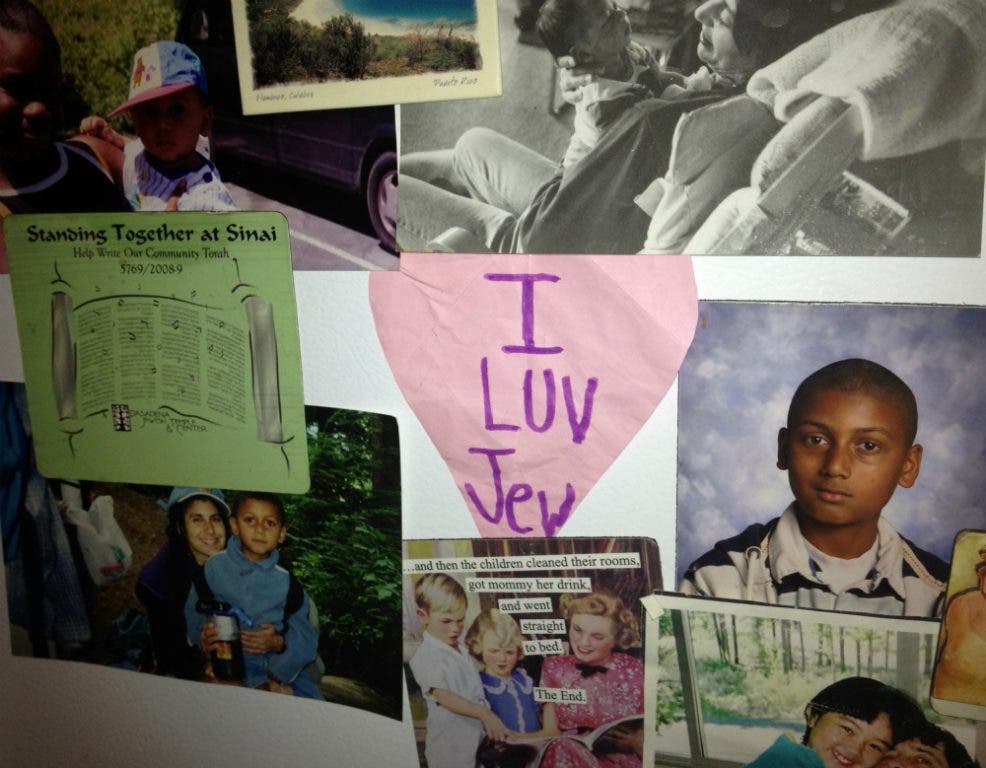
In his eighth grade class, his Arabic classmate gave him and the other Jewish kid in the class a Valentine that said “I love Jew” on a heart.
Race and South Pasadena High School
Recently Gabe told me a disturbing story he had heard, involving black students in South Pasadena High School and asked me to write about it. I contacted an African-American friend with a daughter there, and she told me that she also had heard the story about how “walking around together while black” had caused some kind of uproar resulting in the students being called into the vice principal’s office. She was very upset and wanted to know more.
On the eve of MLK day, I was finally able to interview an African-American student who asked to remain anonymous because of fear of reprisal—we’ll call her “L.”
“It started at a pep rally,” she told me.
“A couple of the black kids were walking around, and because it was unusual for the majority of the African-American kids to walk around together, they decided that it would be fun to do that.”
Then because it became more of a thing of guys hanging out, L walked away with her girlfriends. Much of the rest of the story below is what she told me that she gathered from speaking with other students involved as well as subsequent emails and postings.
Alarmed at seeing the group of “black youth” walking together at SPHS, another student went to talk to the office. It’s possible, L told me, the African-American kids may have uttered some words like “black power,” but they were just walking around. A lot of kids began to look around and ask, “What's going on, is there going to be a problem?”
Is there a Problem?
When I asked L if this is a problem for any group of male students walking around, she replied, “If white kids are walking together, it’s perfectly normal. If it’s black kids, for some reason, it’s a crime.”
The “walking black youth” were taken into Vice Principal Terrance Dunn’s office (who also happens to be black) and questioned as to what they were trying to do. Were they trying to gain some kind of recognition? According to L, he then told them he “would let it go this time, but don’t let happen again because kids are worried that you might beat up on someone.”
Later L told me the African-American students were upset and felt that it was wrong that they were questioned. A couple days later when several of the black male students discovered they were all wearing purple—an unplanned coincidence—they decided to walk around together again.
According to L, it was a smaller group and not even “buff” guys. Hardly intimidating. L says that one of the younger school counselors (who happens to be white) came out and asked them why they were all wearing purple. Was there some reason, perhaps a gang?
And so, regrettably, as we celebrate Martin Luther King Jr.’s birthday, I have to ask the question “Walking together while black in South Pasadena”— is that a problem?
And much like Gabe’s “Aunty Nana’ told him many years ago, it might be. Is it because of that same fear and ignorance that resulted in Dr. King’s assassination almost 45 years ago?
Tell us about how you teach your children about race, injustice and discrimination of any kind? How do your children see race? What has been your family experience? Do you believe racial profiling or prejudice exists in South Pas?
This article is one of a two-part series reflecting on race and tolerance. Click HERE to read Part 1, published Monday.
