Politics & Government
Interfaith Families Deal With December Dilemma [VIDEO]
Pathways class at Temple Beth Hillel helps families find a balance in their winter holiday observance
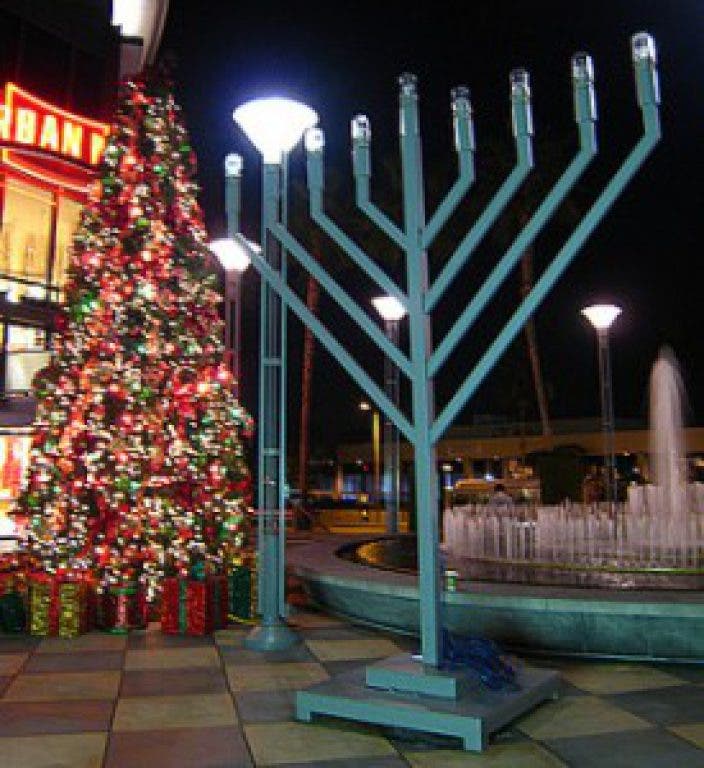


Hanukkah bush or Christmas tree? Deck the halls or host a * party? These are some of the questions faced by Jewish/Christian couples who find the December holidays one of the most challenging times for blending their disparate family traditions, respecting their in-laws and making their children feel okay.
I was invited to observe the December Dilemma class at . It’s one of 13 sessions in the two-year long Pathways course for families who are trying to find their way in interfaith relationships.
The usually well-attended, and sometimes contentious, class suffered from the torrential rains of mid-November. Only three couples arrived, ensconcing their kids safely at daycare provided by the temple before joining the group in the synagogue’s The participants asked me not to film the class, and no one but was comfortable speaking to me on camera. But I’d interviewed some of the participants by phone in the days leading up to the class and I joined them for the entire two-hour session.
Find out what's happening in Studio Cityfor free with the latest updates from Patch.
Anna and Andy Henry were special guests that day. Having completed the entire Pathways journey, they were there to share the life-changing discussions and decisions they had engaged in while enrolled in the course.
“People come into class not knowing what they want to do,” said Anna Henry, “and the class is the journey about figuring it out so that at the end you can know what you want.”
Find out what's happening in Studio Cityfor free with the latest updates from Patch.
Anna was born Jewish in communist Hungary at a time when Jewish identity had to be hidden to avoid persecution. Although all of her grandparents were Holocaust survivors, she was raised, in the 1960s and '70s, essentially Catholic–baptized, educated at Catholic school, celebrating Christmas at home and at church. She didn’t find out she was Jewish until well after immigrating with her family to America at age 13. Standard amongst Hungarian Jewry, she said, “for your own protection.”
Anna’s husband Andy was brought up “mostly sort of Christian” in “beautiful Montana.” “My mother was Christian Scientist but not the very kooky kind,” he joked. He said he didn’t know until two years ago that his father was “miscellaneous Protestant but almost Catholic” who “didn’t believe in going to a church.” Their family celebrated a huge but not “Jesus-heavy” Christmas.
The Henrys continued to celebrate Christmas together for the first few years of their marriage. One of Andy’s mom’s first gifts to Anna was a handmade Christmas stocking.
“Many people [in the class] have the goal of having a balanced interfaith household. That was our goal initially,” Anna told me. But while going through the two-year course they both decided they want to be a Jewish family. “I want to go back to who I am. I want to be authentic to myself,” Anna said. And Andy, through his own studies, is also drawn to Judaism. He thinks he might convert someday.
Only, now they and their two little boys are faced with being different from Andy’s family and even from Anna’s now divorced parents. Her mom still celebrates Christmas and her dad is an Orthodox Jew.
I was amazed at the number of issues around the holidays that can create confusion and conflict in blended families. They range from the huge – do we get a tree? – to the seemingly mundane – what do we do about grandparents sending Christmas-paper-wrapped gifts to our Jewish children? And of course the kids want to know why they aren’t getting presents from Santa.
Rabbi Hronsky explains the dilemma in the video and describes a couple of creative solutions some families have come up with to resolve the dilemmas posed by conflicting holiday traditions.
Jews have been having our own December Dilemma since our forebears arrived on the shores of the New World, where celebrating Christmas is as American as apple pie. While Hanukkah is a minor Jewish holiday, it’s proximity to Christmas and the drive to assimilate led to a kind of Christmas-Hanukkah conflation. Thus was born the Hanukkah bush and the practice of Hanukkah gift giving. And nowadays, the big publically displayed menorahs.
“It was about being a part of American tradition and culture,” said Hronsky, “so Jews were fitting in and if you rejected it, it was almost as though you were un-American.”
To help wend their way through the confusion the Pathways course is open to anyone and everyone. The rest of the classes cover the other Jewish holidays, life cycle events, attending each other’s house of worship and the values and philosophies of Judaism and other religions among other topics.
There have been couples in the course where both partners are Jewish but one is Orthodox and the other is not. Attendees have been Christian, Sikh, atheist and members of eastern religions. The goal is definitely not conversion. Anna Henry told me one participant who finished the course had settled on being a Pagan.
“Member, non-member, it doesn’t matter,” Hronsky said. “We’ve had folks that are in interfaith marriages; somebody who’s converted. We’ve had grandparents in the program who are trying to adjust to how their grandchildren are being raised…We’ve had folks in here who have raised their kids all the way into college and they came to this class and said ‘Ok, we did what we needed to do [for our kids] and now what do we need as a couple?’”
“Every story's different,” Anna Henry said. “There's all kinds of people in the class, but the common thread is ‘I don't know what direction is right for me.’ You’re all trying to figure out your path. So Pathways is the perfect name for the class.”
As the days grow shorter, we can keep in mind what all the December holidays have in common: bringing light into the darkness of winter and into the dark places in our lives. To “increase the light and increase the joy,” Rabbi Hronsky agreed.
So, Seasons Greetings and Happy Winter Holidays, everyone!
*Latkes are fried potato pancakes, traditionally served on Hanukkah.