Neighbor News
The Faults Beneath Our Feet:
Why Solano County Homebuyers Can't Afford to Ignore Earthquake Risk

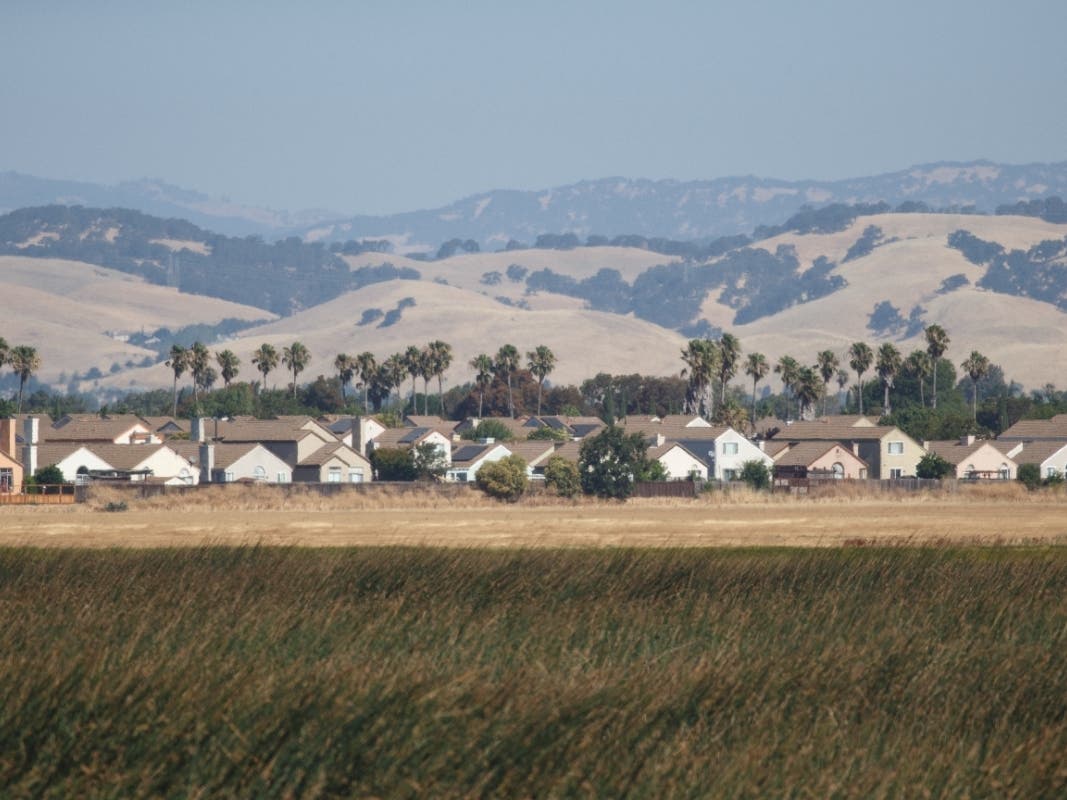
When a 7.0 earthquake strikes a fault in Solano County, residents will face not only the immediate physical devastation of collapsing buildings and ruptured infrastructure but also a secondary crisis: dangerously delayed rescue operations. The reasons for these delays are deeply rooted in California's emergency response system and Solano County's own preparedness shortcomings.
The August 24, 2014, magnitude 6.0 South Napa earthquake on the West Napa Fault provided a stark preview. While the epicenter was in Napa County, Solano County—particularly Vallejo—bore significant damage, including 16 confirmed water main breaks, structural damage to residential and commercial buildings, and road closures. Yet activity by emergency responders in Solano County "consisted mainly of assessing the damage at the local level and providing support to emergency responders in neighboring Napa County. The Solano County Office of Emergency Services (OES) activated its Emergency Operations Center (EOC), but incident commanders sent initial response assets to the cities of Napa and Vallejo as reports of damage were minimal in the county's unincorporated jurisdiction.
That was a 6.0. A 7.0 earthquake releases 32 times more energy. The demands on Solano County's resources would be overwhelming. When disaster strikes, California relies on a mutual aid system where resources are shared across jurisdictions. But in a major earthquake, this system creates a brutal triage: aid goes to where the most people are affected.
Find out what's happening in Suisun Cityfor free with the latest updates from Patch.
During a large earthquake, Solano County faces the risk that its own rescue crews could be diverted. In the 2014 quake, Sonoma County sent two fire strike teams, four water tenders, and two ambulances to Napa County under mutual aid. In a larger event, resources would be pulled toward the densely populated urban centers of San Francisco, Oakland, and Sacramento. These metropolitan areas command national attention and media coverage, and their sheer population density demands an overwhelming share of available rescue personnel. Solano County, with its smaller cities and rural areas, becomes a lower priority in the state's resource allocation calculus. As one emergency planning document bluntly states: "Competing requests for regional aid resources" are expected, and "community needs would quickly exceed the response capability of the Solano County Office Emergency Management, requiring mutual assistance from state, federal, volunteer, and private agencies."
This isn't just a matter of resources being stretched thin—it's a matter of resources potentially being stripped away and sent elsewhere.
Find out what's happening in Suisun Cityfor free with the latest updates from Patch.
Mass Graves and the Crisis of Overwhelmed Systems
The user references a disturbing scenario: reports of mass graves during a quake. While this is an extreme outcome, it points to a genuine fear among emergency planners. In a catastrophic 7.0 event, the number of fatalities could overwhelm local mortuary services, coroner's offices, and hospitals. When the death toll exceeds the capacity for dignified individual processing, mass fatality management plans are activated. These plans are grim, but they are real. The rapid decomposition of bodies in warm weather, the lack of refrigeration, and the sheer volume of casualties can force authorities to consider mass burials or temporary storage solutions.
The threat of mass graves is a symptom of a deeper problem: Solano County may not have the resources to handle the dead because those resources—along with the living—have been diverted elsewhere.
Systemic Failures: A County Unprepared
The 2022 Solano County Civil Grand Jury released a damning report titled "Solano County Is Not Prepared For Future Emergencies." The report found that the county lacks a centralized base to coordinate emergency response. Instead of a unified command structure, Solano County operates a "patchwork of special districts, county departments, and individual property-owner initiatives." This fragmentation would be catastrophic during an earthquake, where disasters "often impact properties across legal boundaries."
The Grand Jury identified specific weaknesses: incompatible evacuation zones and routes, a lack of radio interoperability among agencies, and no countywide communications plan. Without a centralized Department of Emergency Management, coordination between cities like Fairfield, Vacaville, Vallejo, and the unincorporated areas would be chaotic. As one official put it, "We need to do something different, something more."
The county's own THIRA (Threat and Hazard Identification and Risk Assessment) strategy acknowledges that establishing interoperable communications would be difficult because "systems, cell towers, and Internet service will be down throughout a majority of the County." The county would rely on non-traditional forms of communication such as radios—yet even that capability is strained. The assessment notes that "over the past year, the County lost Operational Communications capability as some resources in the County's cache are depleting."
The First 72 Hours: On Your Own
During the first 72 hours following a major earthquake—often called the "golden window" when trapped survivors have the best chance of being rescued—Solano County residents may find themselves entirely on their own. Emergency drills have long stressed this reality. In a 2012 Solano County CERT (Community Emergency Response Team) drill simulating a 7.0 earthquake, volunteers practiced rescuing victims pinned beneath bleachers and trapped in dugouts. The message was clear: "The county's resources are overwhelmed." As one Red Cross coordinator explained, with likely communication failures and road blockages, "people will need to rely on each other for their immediate and life-saving needs."
When a 7.0 earthquake strikes a Solano County fault, the famous faults of California will dominate the headlines. The media will focus on San Francisco, Oakland, and Sacramento. The rescue crews will be sent to where the cameras are, where the population density is highest, where the political pressure is greatest. Solano County will be left to fend for itself, with a fragmented emergency response system and resources that have been diverted elsewhere.
This is not a hypothetical scenario. It is the logical conclusion of California's mutual aid system, Solano County's documented preparedness failures, and the brutal mathematics of disaster response. The residents of Solano County need to understand this reality—not to panic, but to prepare. Because when the next big one hits, help may not be coming. At least, not in time.
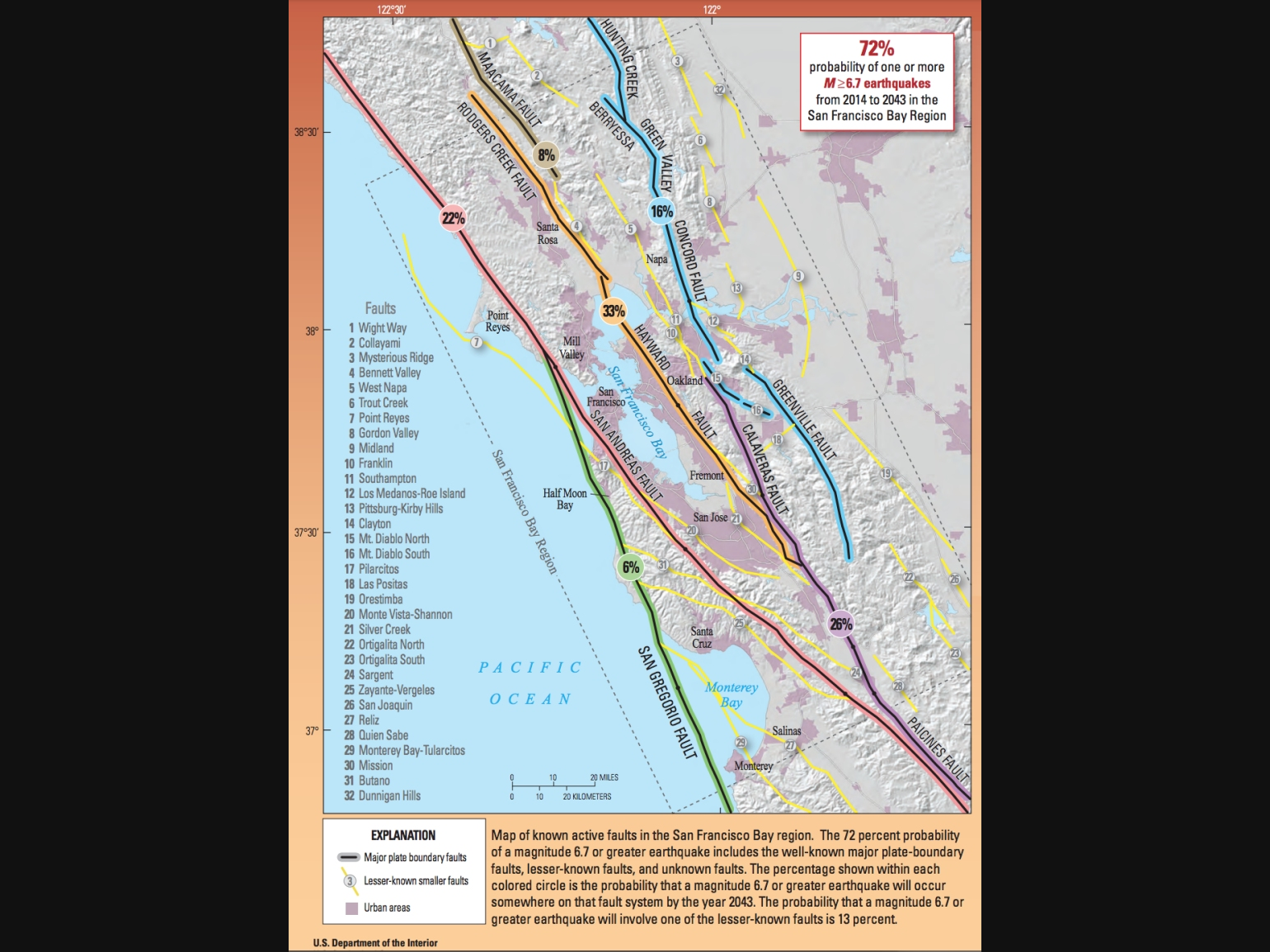
When most Californians think about earthquake danger, their minds go straight to the San Andreas Fault or the Hayward Fault. These are the famous ones—the geological celebrities that dominate disaster movies, emergency preparedness campaigns, and the collective anxiety of the state. But for anyone buying a home in Solano County, fixating on these famous faults is a dangerous distraction. The real threat lies much closer to home, running through the very ground beneath our feet.
Solano County sits atop a complex web of active faults that most prospective homebuyers have never heard of. The West Napa Fault, Green Valley Fault, Southampton Fault, and Vacaville-Winters Fault crisscross the region, each capable of producing earthquakes that could devastate communities from Fairfield to Vacaville. These faults may lack the name recognition of their more famous neighbors, but they pose risks that are every bit as real—and in some cases, more immediate.
The Quiet Threat of Solano County's Faults
The West Napa Fault gained sudden notoriety on August 24, 2014, when a magnitude 6.0 earthquake struck at 3:20 a.m., lasting twenty seconds and causing $326 million in property damage while generating more than $1 billion in overall economic impact. Before that morning, the fault hadn't been considered a major threat compared to the San Andreas. That assumption was wrong.
Recent research from the U.S. Geological Survey has revealed that the West Napa Fault extends more than nine miles farther north than previously thought, reaching beyond St. Helena to Calistoga, and possibly even farther south beyond Vallejo. This additional length means the fault could now produce a magnitude 7.0 earthquake—roughly 32 times more powerful than the 2014 temblor. As USGS research geologist Belle Philibosian explained, "Every increase of one magnitude is actually 32 times as much energy". A magnitude 7.0 earthquake on the West Napa Fault would not merely rattle windows; it would reshape communities.
The Green Valley Fault, which runs north-south through Solano County between Fairfield and Napa, may pose an even greater danger. Geologists have concluded that this fault is "primed" for a magnitude 7.1 earthquake. The fault is believed to have last ruptured sometime in the 1600s, meaning it is long overdue. Trench excavations across the fault near Fairfield have revealed evidence of four surface-rupturing earthquakes in the past thousand years. The Green Valley Fault's location near key dams and aqueducts that supply water to the San Francisco Bay Area, Southern California, and the Central Valley makes its potential rupture particularly alarming.
The Vacaville-Winters Fault has already demonstrated its destructive potential. In April 1892, a doublet of earthquakes—magnitude 6.4 and 6.2—struck the region, producing significant damage in Winters, Dixon, Allendale, and Vacaville, with a maximum Mercalli intensity of IX (Violent). One person was killed. The Gordon Valley segment, which likely produced the 1892 main shock, extends between Winters and Vacaville. Given the region's low relief and the presence of major water conveyance infrastructure, future earthquakes on this fault could have significant hazard implications.
The Southampton Fault, while less studied, is another active structure that cuts through Solano County. Together with the Green Valley Fault, it represents a network of seismic hazards that are woven into the county's geological fabric.
Overshadowed but Not Less Dangerous
Why do these faults receive so little attention? The answer lies partly in proximity and partly in perception. The San Andreas and Hayward faults run through densely populated areas with massive infrastructure and media attention. They are the faults that scientists have studied for generations, the ones that appear on every seismic hazard map.
But being overshadowed does not make a fault less dangerous. In fact, the lack of public awareness about Solano County's faults may make them more perilous. Homebuyers who believe they are safe because they aren't living atop the San Andreas are making a tragic miscalculation. The Green Valley Fault alone has stored enough energy to produce a magnitude 7.1 earthquake. The West Napa Fault's maximum potential has been upgraded to magnitude 7.0. These are not minor tremors; these are major earthquakes capable of causing widespread destruction.
The Insurance Reality: Standard Policies Won't Save You
Here is the uncomfortable truth that every Solano County homebuyer must confront: your standard homeowners insurance policy does not cover earthquake damage. In California, a separate earthquake insurance policy is required to protect your home investment. Without it, you are entirely on your own if the ground starts shaking.
The California Earthquake Authority (CEA) provides the majority of residential earthquake insurance in the state. CEA policies are catastrophe insurance designed to cover the most important things you own. Coverage options include protection for your house and attached structures, with deductibles available at 5%, 10%, 15%, 20%, or 25%. Personal property coverage protects furniture, appliances, clothing, and electronics. Loss of Use coverage pays for the additional cost of living elsewhere while your home is being rebuilt.
Critically, CEA earthquake insurance must be purchased through a participating insurer that also provides your standard homeowners policy. Your homeowners insurance company is required by law to offer earthquake insurance. But here is the sobering statistic: only about 10% of California homeowners actually purchase earthquake coverage. The vast majority are gambling with their most valuable asset.
What Homebuyers Need to Know
For anyone purchasing a home in Solano County, earthquake risk assessment should be as fundamental as inspecting the roof or reviewing the title report. The Alquist-Priolo Earthquake Fault Zoning Act requires that active fault zones be mapped, and these maps affect where new residential construction can be built. Prospective buyers should check whether a property lies within an earthquake fault zone and understand the implications.
Homeowners can also take proactive steps to reduce risk and insurance costs. The CEA offers premium discounts of up to 25% for older homes that have been properly seismically retrofitted in accordance with California standards. Programs like the California Earthquake Brace and Bolt Program provide grants of up to $3,000 toward qualifying retrofits. These measures not only reduce insurance premiums but also make homes more resilient when the shaking starts.
Conclusion
Solano County is a wonderful place to live, with vibrant communities, affordable housing compared to much of the Bay Area, and a quality of life that draws families and businesses alike. But the beauty of the region does not erase the geological reality beneath it. The West Napa Fault, Green Valley Fault, Southampton Fault, and Vacaville-Winters Fault are not abstract scientific curiosities. They are active, dangerous, and overdue.
The famous faults of California have captured our imagination, but it is the lesser-known faults that may ultimately determine our fate. When you buy a home in Solano County, you are buying into a seismic landscape that demands respect and preparation. Earthquake insurance through the CEA is not an optional add-on; it is a necessity. Your homeowners policy won't cover you. Your mortgage won't protect you. Only a dedicated earthquake policy can help you rebuild when—not if—the next big one arrives.
The ground beneath Solano County is not stable. It never has been. The only question is whether you will be prepared when it moves.