August 2026. If you're looking for a single headline to capture the state of Northern California's housing market, you won't find one. That's because the region has fractured into two distinct realities. In one, centered on San Francisco and the core Bay Area, we are witnessing a seller's market of historic proportions, fueled by AI wealth and a crippling lack of supply. In the other, stretching from Sacramento to the inland valleys, a more balanced, if not slightly tepid, market is taking shape, offering buyers a glimmer of hope after years of being on the back foot.
The narrative that the Northern California housing market is a monolith is not just inaccurate—it's dangerous for anyone trying to buy or sell a home today. Understanding this great divergence is the only way to navigate the current landscape.
The Bay Area Inferno: A Crisis of Supply
Find out what's happening in Suisun Cityfor free with the latest updates from Patch.
Let's start with the epicenter of the frenzy: San Francisco. To call it a "seller's market" is an understatement; it's a market in the grip of an acute supply shock. As of July 2026, the city had just 135 single-family homes for sale. This represents a staggering 59% decline in inventory compared to the previous year. To put that in perspective, there were 330 single-family homes available in June 2025—meaning the market has lost nearly two-thirds of its inventory in just 12 months. With barely 500 total homes (including condos) available citywide, buyers are facing the most limited selection in recent memory.
The result is predictable yet breathtaking. The median sale price for a San Francisco single-family home has surged more than 26% year-over-year, hitting $2.15 million. Competition is so fierce that the average home is selling for more than 26% over the asking price. Homes are flying off the market in an average of just 12 days. The months of supply inventory (MSI)—a key metric of market balance—stands at a microscopic 0.7 months. For context, a balanced market is typically around three to four months of supply.
Find out what's happening in Suisun Cityfor free with the latest updates from Patch.
This is not just a San Francisco phenomenon. Silicon Valley and the broader Bay Area are experiencing similar, if slightly less extreme, conditions. Zillow’s analysis of the nation’s 50 largest metro areas identifies the Bay Area as a concentrated cluster of seller’s markets where "inventory is low, homes sell quickly, price cuts are rare and a large share of sales close above the asking price".
So, what is driving this inferno? The answer is twofold: the "lock-in effect" and the AI boom. An estimated 77% of California homeowners are currently sitting on mortgage rates below 5%. The prospect of selling and buying a new home at today's rates, hovering around 6.5%, is financially ruinous for many. This "lock-in effect" has choked the supply of existing homes for three straight years. Simultaneously, the AI boom has created a massive glut of wealth in the region. Well-compensated tech workers and investors are competing for a rapidly shrinking pool of luxury listings, driving prices to dizzying heights. In one small Northern California town, the median home price has surged 20% to nearly $10 million, making it the most expensive ZIP code in the nation.
The Inland Reality: A Buyer's Respite?
Drive an hour or two inland, and the story changes dramatically. The Sacramento region, often seen as a bellwether for the state's affordability, presents a very different picture. Here, buyers are beginning to feel like the market has finally tilted in their favor.
As of mid-2026, the greater Sacramento area, including Placer, Sacramento, and El Dorado counties, had about 4,138 active listings and a more robust 2.4 months of housing inventory. While still technically a seller's market (as less than four months of supply favors sellers), it is far more balanced than the Bay Area. More inventory means more choices and more negotiating power for buyers. In this market, negotiation over price reductions, seller credits, and interest rate buydowns is becoming common.
This divergence is reflected in price trends. In June, home values in Sacramento dipped slightly. Statewide, while the median price hit a record $930,260 in May, the growth is uneven. The record is being buoyed by a sharp skew toward high-end luxury sales in coastal markets. In fact, sales of homes priced between $500,000 and $1 million—the core of the middle-income market—actually fell. This suggests that while the wealthy are competing for a shrinking pool of luxury homes in the Bay Area, the market for more attainable housing in the inland regions is struggling to find buyers. As a C.A.R. economist noted, "headwinds" are expected for some local markets in the second half of 2026. The narrative of a singular, booming California market is a myth sustained by the eye-watering numbers coming out of its most exclusive coastal cities.
2026: The Great Divide
In many ways, the housing market of August 2026 is the culmination of a long-term trend. The pandemic-era "race for space" has given way to a more sober, fragmented reality. The California Association of Realtors forecasts a modest 2% increase in sales for 2026 and a 3.6% price growth to a record $905,000. But these broad strokes hide the intense local pressures that are creating vastly different experiences for buyers and sellers.
For a buyer in Sacramento or the Central Valley, the market may feel like it has finally cooled, offering more leverage and breathing room. For a buyer in San Francisco or Silicon Valley, it's a brutal, high-stakes competition where a six-figure offer over asking is the price of entry.
Looking Ahead: No End in Sight
What does the future hold? The fundamentals suggest this split will persist. While mortgage rates are expected to ease slightly to around 6.0% by the end of the year, this will not be enough to unlock the tens of thousands of homeowners who are "locked in" at sub-5% rates. The supply of existing homes will remain constrained. Meanwhile, the AI industry shows no signs of slowing its demand for prime Bay Area real estate.
The much-touted increase in new construction is also insufficient. Statewide, estimates of the housing shortage still exceed one million units. In Sacramento, new apartment deliveries are projected to plummet by 72% in 2026. We are simply not building enough homes to meet demand, especially in the job-rich coastal areas.
In conclusion, the Northern California housing market in August 2026 is a story of two markets. One is a raging fire, fueled by AI wealth and constrained by a generation of homeowners unwilling to move. The other is a smoldering ember, offering hope and opportunity for those priced out of the coast but still struggling against the headwinds of high interest rates and a slow economy. To treat them as the same is to misunderstand the very nature of the crisis. The challenge for policymakers, buyers, and sellers alike is to recognize that the solution for San Francisco is not the same as the solution for Sacramento, and that a one-size-fits-all approach to California's housing woes is destined to fail.
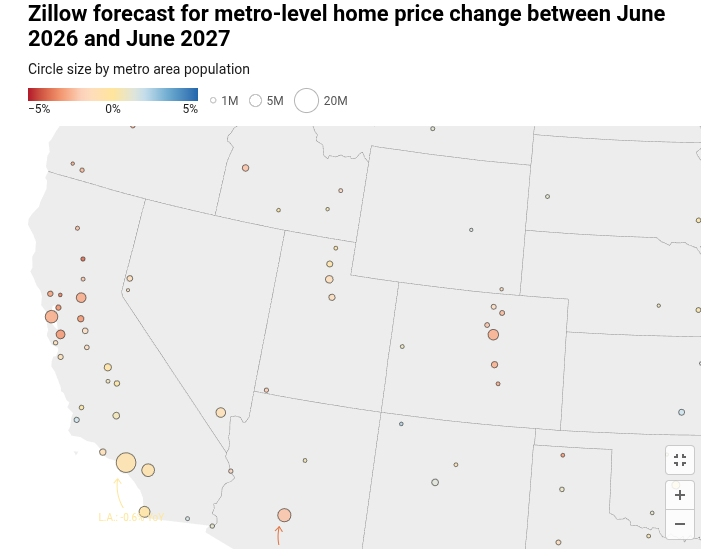
Among the 300 largest U.S. metro area housing markets, Zillow forecast the biggest home price decline between June 2026 and June 2027 to occur in these 15 metros:
- Austin, TX → -6.4%
- Houma, LA → -6.4%
- Lake Charles, LA → -5.2%
- New Orleans, LA → -4.9%
- Punta Gorda, FL → -4.0%
- Chico, CA → -3.9%
- Lafayette, LA → -3.4%
- Texarkana, TX → -3.4%
- Vallejo, CA → -3.2%
- San Antonio, TX → -3.1%
- San Jose, CA → -3.1%
- Stockton, CA → -3.1%
- Cape Coral, FL → -3.1%
- Alexandria, LA → -3.1%
- Beaumont, TX → -3.0%