Neighbor News
The Earthquake You Should Really Fear Is the One We Haven’t Mapped Yet
Yes its true the Hayward and San Andreas get the headlines for faults that pose a risk but theres others that pose the same threats.

Every few years, the same ominous warnings resurface: the San Andreas Fault is locked and loaded, the Hayward Fault is overdue, and the “Big One” is a matter of when, not if. These headlines are terrifying, and they’re not wrong. But if we fixate only on the famous faults whose names we know by heart, we risk missing a much more unsettling truth. We need to prepare for the next major earthquake not just because a handful of celebrity faults are past due, but because some of the most devastating recent quakes have come from faults we didn’t even know existed — or that we wrongly dismissed as harmless.
The 1994 Northridge earthquake was a brutal wake-up call. The magnitude 6.7 blind thrust fault that ruptured beneath the San Fernando Valley killed 57 people, collapsed freeways, and caused billions of dollars in damage. It did not occur on the San Andreas or any other fault that had been mapped and modeled. It came from a previously unknown buried fault, hidden deep beneath the surface, with no surface expression for geologists to have studied beforehand. We didn’t see it coming because we literally couldn’t see it. The fault wasn’t considered a threat because our data were incomplete, not because the danger wasn’t there.
Two decades later, the 2014 South Napa earthquake delivered a similar lesson with a slight twist. The West Napa Fault was known on paper, but it was considered a minor player, not a major seismic source. Then it ruptured in a magnitude 6.0 event that injured more than 200 people, damaged historic downtown Napa, and caused roughly $1 billion in losses. Once again, a fault that had been underestimated — one that lacked the alarming data history of its famous cousins — reminded us that our seismic maps are works in progress, not finished portraits of the dangers under our feet.
Find out what's happening in Vallejofor free with the latest updates from Patch.
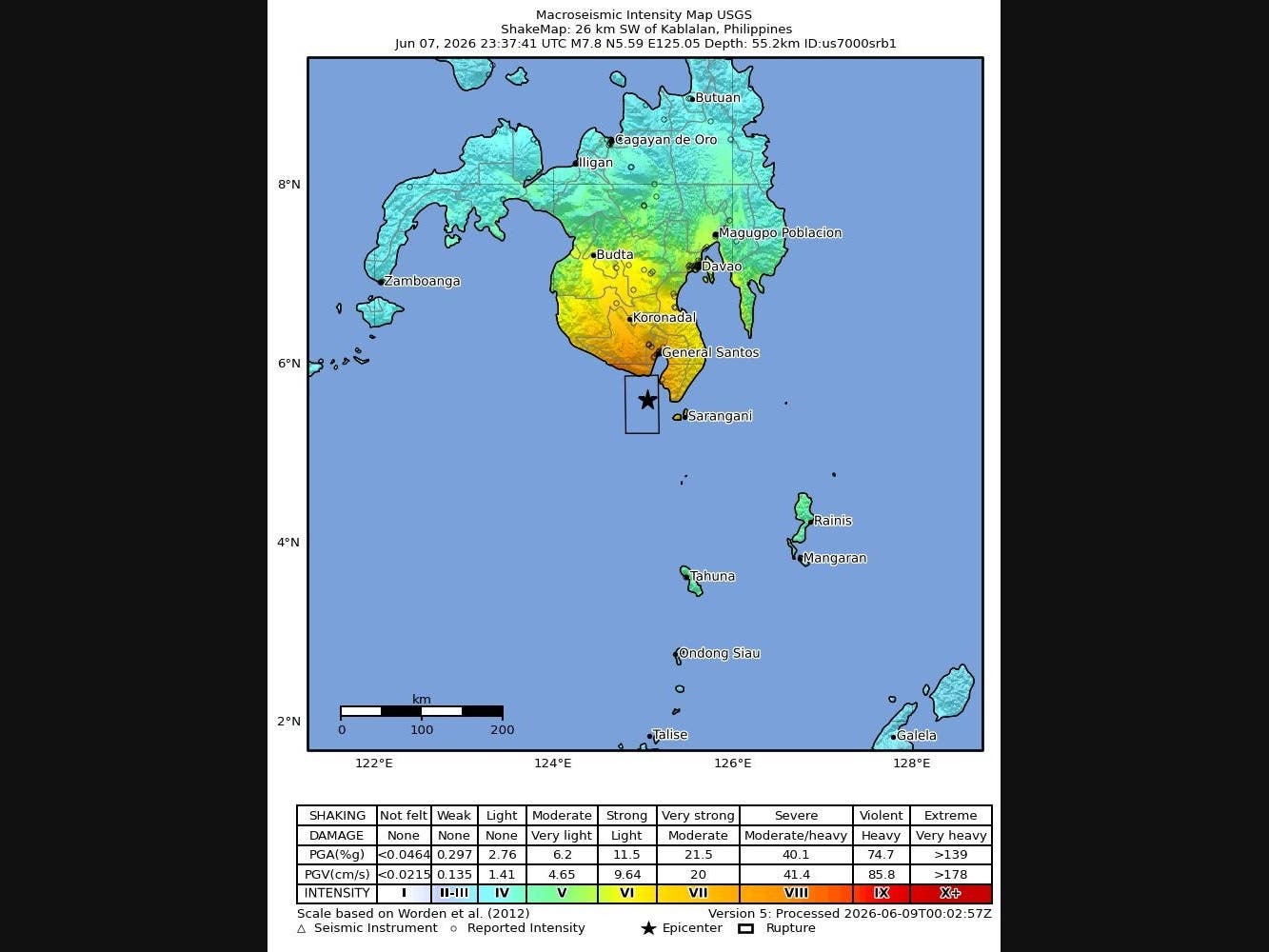
This pattern isn’t confined to California. In the Philippines, a trio of powerful earthquakes between 2025 and 2026 hammered home the same brutal lesson, this time with terrifying force. In 2025, a magnitude 6.9 or greater quake struck Cebu. Later that year, a similar-size jolt hit Davao Oriental. And in 2026, General Santos City was rocked by yet another major earthquake — all exceeding magnitude 6.9, and all rupturing on fault lines that the Philippine Institute of Volcanology and Seismology (PHIVOLCS) had not previously recognized as active threats. These were not hidden faults that scientists had quietly catalogued and ignored; they were unknown, missing from hazard maps, their potential unappreciated until the ground began to heave. The country had long known it was dangerously exposed to tsunamis in the event of a large offshore earthquake, but when the shaking began on faults no one had drawn on a map, the question of when catastrophe might strike was answered — and the question of how prepared the nation truly was became urgently, painfully clear.
These are not isolated incidents, nor are they limited by geography. From Southern California’s basin-and-range landscape, threaded with blind thrust faults, to the Philippine archipelago — a tectonic jigsaw of microplates and subduction zones — unmapped and underestimated faults are the rule, not the exception. In Los Angeles, Manila, Cebu, and countless other populated corridors, similar buried faults likely remain invisible to science. Each new earthquake retrospective offers the same humbling postscript: the fault responsible was either completely unknown or misunderstood. Our catalog of faults grows not because the earth is suddenly more dangerous, but because our knowledge is playing catch-up with a planet that keeps its secrets well hidden.
Find out what's happening in Vallejofor free with the latest updates from Patch.
This is why a singular focus on the “overdue” San Andreas, Hayward, or even the Philippine Fault can create a dangerously false sense of security. People look at fault maps in California or hazard maps in the Philippines, note that they live miles from the nearest red line, and conclude they are safe. But Northridge taught us that you don’t need to live on top of a named fault to be directly above a rupture. The Philippine quakes showed that entire cities can be surprised by ground motion from faults no agency had marked as dangerous. The ground beneath your home — whether in Davao or downtown Los Angeles — doesn’t care whether it appears on a USGS or PHIVOLCS map.
Preparing for earthquakes is too often framed as a choice driven by well-known risks: the Big One will strike, so fasten your bookshelves. That argument remains valid, but it is insufficient. The more complete, honest case is this: We must prepare because we cannot reliably predict where the next destructive quake will originate. Unknown faults don’t provide a countdown clock or a headline-friendly name. They provide surprise. The only rational response to that uncertainty is universal preparedness — not just for those living near the San Andreas, but for everyone in seismically active regions, whether in California or the Philippines.
What does that preparedness look like? It means mandatory seismic retrofits for vulnerable building types regardless of their distance from mapped faults. It means funding the continued search for hidden faults with advanced geophysical surveys, and treating areas of uncertainty with the same respect we give well-known rupture zones. In tsunami-prone nations like the Philippines, it also means robust coastal evacuation planning and well-rehearsed vertical evacuation drills, because the next unknown fault could rupture offshore with minutes of warning. It means every household maintaining an emergency kit and a plan, not because a specific fault is overdue, but because the next damaging quake could just as easily come from one we haven’t named yet. And it means fully supporting earthquake early warning systems — ShakeAlert in the United States, and kindred systems abroad — that can give vital seconds of notice regardless of which fault is slipping.
The overdue San Andreas narrative has value: it grabs attention and motivates action. But it also narrows the imagination, implying that if we just watch the right faults, we can see the danger coming. The Northridge and Napa earthquakes proved otherwise in California. The 2025 and 2026 quakes in the Philippines proved it again, thousands of miles away. The most dangerous fault is the one we haven’t mapped yet, whether it’s buried under a California suburb, a Cebu neighborhood, or the seafloor off General Santos City. Preparing for it isn’t paranoia — it’s acknowledging the geological reality that we will almost certainly be surprised again. The question isn’t which fault will rupture next. It’s whether we’ll be ready when the ground moves beneath a fault whose name we’ve never heard.