Neighbor News
Philippine Vice President Sara Duterte Who Doesn't Trust the State She Serves
The Duterte family has taken on Trial of the century status in the Philippines

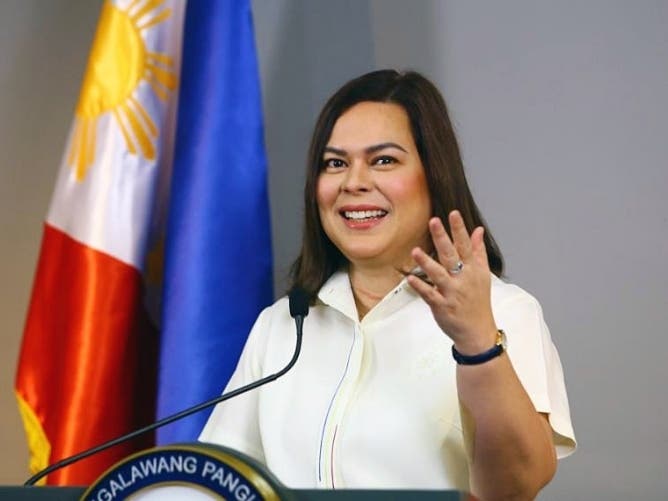
On the morning of September 5, 2026, Sara Duterte walked into the Quezon City Hall of Justice to post bail on three counts of grave threats — charges stemming from a televised press conference in November 2024 in which she said she had arranged for someone to kill President Ferdinand Marcos Jr., First Lady Liza Araneta-Marcos, and then-House Speaker Martin Romualdez if she herself were harmed. Outside, a scrum of police, court personnel, and camera crews pressed in around her. She looked up at the stairs, thought of Ninoy Aquino, and told reporters she did not feel safe. "Pakiramdam ko papatayin nila ako," she said — I feel like they will kill me.
It was a remarkable sentence for a sitting Vice President of the Philippines to say about the government she is second-in-command of. It was also, whatever one makes of its sincerity, entirely consistent with a posture Duterte has held for months: that the state's security apparatus cannot be trusted, that the police and the courts answer to her political enemies, and that her own safety depends not on the Republic's institutions but on a personal protective network that answers, in the end, to her. That network — the Vice Presidential Security and Protection Group, numbering by various official accounts somewhere between roughly 320 and over 400 personnel — is worth pausing on, not because the exact head-count settles anything, but because of what the argument over it reveals. A vice president who has spent a career benefiting from state power is now telling the public that state power is the thing she fears most. That is either a serious indictment of Philippine law enforcement, or a remarkably convenient story for someone facing a criminal warrant and an impeachment trial. It may, uncomfortably, be some of both.
An op-ed's job is not to pretend the discomfort away. A security force built to distrust its own government Some numbers here are not seriously disputed. Interior officials have put her security complement at roughly 400 in recent statements; after the PNPwithdrew 75 officers from her detail this year, the Department of Justice's own count still had roughly 320 personnel remaining. Commission on Audit figures reportedly showed the number peaking above 400 in 2022 and settling somewhat lower since. However you slice it, Duterte's protective detail has for years been unusually large relative to the office she holds — by some officials' accounting, larger than the detail assigned to the President himself. There is an ordinary explanation available for this, and Duterte's camp has offered versions of it: high office invites real threats, and a former president's daughter — who was herself, until recently, part of the government's own leadership — has a legitimate security profile that outlasts any single political dispute. That is a fair point, and it would be dishonest to wave it away. Vice presidents and their families arenot hypothetical targets in a country with the Philippines' history of political violence.
Find out what's happening in Vallejofor free with the latest updates from Patch.
But the more interesting claim, and the one Duterte herself has now made explicitly and publicly, is not that she needs protection from criminals or insurgents. It's that she needs protection from the state's own security forces — that the police assigned to guard her are, in her words, ultimately controlled by "the current administration," and that she trusts a small, personally loyal subset of her guards — many with roots in her years as Davao City mayor — more than she trusts the uniformed institutions of the Republic. That is not a security posture. That is a vote of no confidence in the rule of law, delivered from inside the government that rule of law is supposed to bind.
The charge that started it It's worth being precise about what Duterte is actually accused of, because the underlying facts are serious enough without embellishment. In August 2026, prosecutors filed three counts of grave threats against her, tied to her online press conference in November 2024 in which she said she had spoken to someone about killing the President, the First Lady, and the then-Speaker if she were assassinated first.
Find out what's happening in Vallejofor free with the latest updates from Patch.
The Quezon City Regional Trial Court found probable cause on September 4 and issued a warrant; she posted bail of ₱360,000 the next day. Her lawyers have argued, so far unsuccessfully at the trial-court level, that as an impeachable official she should not be subject to ordinary criminal process while a Senate impeachment trial covering overlapping conduct is underway.
Whatever one thinks of the legal merits of that jurisdictional argument — and reasonable lawyers disagree about it — the underlying conduct is not some ambiguous slip of the tongue. Duterte said, on the record, that she had arranged a contingency plan to have the country's top three officials killed. She has not seriously disputed saying it; her defense has been about jurisdiction and intent, not denial. That alone should be enough to make the "victim" framing she reached for on the courthouse steps a hard sell. You do not get to threaten the President's life and then claim martyrdom when the legal system responds.
The Ninoy comparison, and why it doesn't hold Duterte's own defenders invoked history for her when, standing on the courthouse steps, she referenced Ninoy Aquino's assassination and said there were "so many firearms" around her. The Liberal Party's rebuttal was blunt: Aquino came home to confront a dictatorship and hold it accountable; Duterte was appearing in court to answer for threats she herself made. The comparison inverts the moral structure of the original story. Aquino was an unarmed opposition figure returning to a system stacked against him. Duterte is a sitting constitutional officer, backed by hundreds of armed personnel, invoking sovereign immunity arguments to try to keep a criminal case out of ordinary court.
That doesn't make her fear performative — political figures across ideological lines in the Philippines have genuine reasons to worry about their physical safety, and dismissing all of it as theater would be its own kind of dishonesty. But there is a difference between fearing for one's safety and using that fear to reframe accountability as persecution. The latter is a well-
worn move in Philippine politics, employed by figures across the spectrum, and it deserves the same skepticism regardless of who is making it.
Where the security detail actually comes from matters The more substantive question — more substantive than headcounts or staircase metaphors — is where the loyalty inside that 400-person detail comes from, because it is not generic. Reporting has tied a meaningful share of her closest security personnel to networks that trace back to her years as Davao City mayor, including officers who have been embedded with her since 2007. Separately, and more gravely, human rights investigators, whistleblower testimony, and an active International Criminal Court case have for years examined allegations that Davao-based police networks under the elder Duterte's mayoralty and later presidency were connected to extrajudicial killings carried out under the so-called Davao Death Squad — allegations the Duterte family has denied, and which remain the subject of ongoing legal proceedings rather than settled fact. I want to be careful here, because it would be easy — and unfair — to treat contested, unproven historical allegations as if they were established truth simply because they are dramatic. They are not proven in any Philippine or international court as they pertain to Sara Duterte personally, and she has not been charged over them. What is fair to say is narrower and still significant: the personal, non-institutional loyalty networks that reportedly form the trusted core of her security detail did not arise in a vacuum. They are, by multiple journalistic accounts, threaded through decades of Davao-based policing relationships that predate her national political career and that are themselves the subject of serious, ongoing scrutiny. A politician's choice to lean on that specific network for personal protection — rather than on the institutional chain of command she nominally sits atop — is itselfa political statement, whatever one concludes about
the underlying historical allegations.
The optics problem no press release
can fix
Duterte's team understands, better than most, how
crowds read on camera. When she surrendered on
September 5, the footage that circulated made it look,
briefly, like she was enveloped by a wave of civilian
support. Closer accounts of the scene suggest the crowd was overwhelmingly composed of police, court
personnel, and media — with her own plainclothes
security filling the remaining gaps around her body.
That is not a moral failing; it is simply what a
courthouse perp-walk looks like when organic public
mobilization hasn't caught up with the news cycle. But
it does undercut the narrative her camp wanted that
day, which is part of why supporters were mobilized
more deliberately — with an announced 300-person
camp-out — ahead of her formal arraignment.
Separately, and more troublingly, some of the loudest
"global" support for the Duterte family circulating
online in recent months has been outright fabricated:
independent fact-checkers traced a viral video
claiming to show tens of thousands rallying for the
Dutertes in the Netherlands to unrelated anti-
corruption protest footage from Serbia, with the audio
swapped. Other viral clips repurposed World Cup
crowd footage from Mexico. Real, much smaller pro-
Duterte gatherings have taken place near the ICC in
The Hague, where the elder Duterte is being held; they
simply do not resemble the sweeping international
movement the doctored footage implied.
None of that proves the Vice President's office
ordered the fabrication — there's no public evidence
that it did — but it does say something about the
information environment surrounding this family's
politics, one where manufactured crowds and manufactured victimhood are recurring features
rather than one-off mistakes. A politician doesn't
control what supporters post online. But a politician
does control whether she leans into a false narrative
once it's been debunked, and that's a fair thing to
watch for going forward.
The institutional stakes are bigger
than one politician
Step back from Duterte herself, and the more durable
story here is about what happens to a democracy
when its second-highest official publicly declares that
she cannot rely on the state's own security and
judicial institutions — and builds a personal
alternative instead. That posture, regardless of
whether Duterte's specific fears are justified, sets a
precedent that should worry people who don't
particularly care about her fate one way or the other.
If a Vice President can maintain a protective force
sized like a small army, staffed disproportionately by
personally loyal officers rather than the ordinary
institutional rotation, and justify it by declaring public
distrust of the police and courts, then the logic is
available to any sufficiently powerful official who finds
themselves under investigation. Today it's grave-
threat charges against Duterte. Tomorrow it could be
a governor, a senator, or a different administration entirely. The pattern — cultivate a security network
built on personal loyalty rather than institutional
accountability, then invoke persecution when
investigators come calling — is not unique to the
Dutertes, but their family has arguably perfected it,
first in Davao and now nationally.
The Senate impeachment court, for its part, is now
wrestling with an uncomfortably related question:
how many votes it actually takes to convict her, given
that four senator-judges are currently unavailable to
sit — two in detention, one abroad on medical leave,
one reportedly in hiding. That the Constitution's clean
two-thirds rule has become a live procedural fight,
with oral arguments scheduled for September 23, is
itself a symptom of the same underlying problem:
institutions built for an orderly system are straining
under a moment that isn't orderly at all.
What deserves skepticism, and what
doesn't
It would be a mistake to treat Sara Duterte as a
cartoon villain, or to assume every viral claim about
her family's history is proven simply because it
circulates widely and fits a preferred narrative. The
Laud Quarry investigations, the Davao Death Squad
allegations, the ICC proceedings against her father —
these are real, serious, and still working their way through legal processes that haven't concluded.
Duterte herself has not been criminally charged over
any of that history, and fairness requires saying so
plainly.
But it would be an equally serious mistake to let the
noise of contested historical allegations obscure the
plain facts sitting in front of a Quezon City courtroom
right now: a sitting Vice President said, on camera,
that she had arranged to have the President killed if
she died first; a court found probable cause; she
posted bail; and rather than simply litigating the
jurisdictional question through ordinary channels, she
has spent the following days telling the public that the
police protecting her cannot be trusted, while relying on a several-hundred-person personal guard built substantially from her own political network.
Those two things can both be true: that Duterte may face real threats, and that her response to accountability has been to reach for the same move used by powerful people throughout history when the law catches up to them — reframe the reckoning as persecution, and make sure you have enough armed people around you that no one can easily test the claim. The public doesn't need to resolve every historical allegation about the Duterte family to see that pattern clearly. It's happening in real time, on the courthouse steps, this month.