Health & Fitness
Contentious Issue: The “250-Degree” Takeoff
Should any "instrument flight rules" (IFR) aircraft departing to the west from Santa Monica Airport fly over Santa Monica?
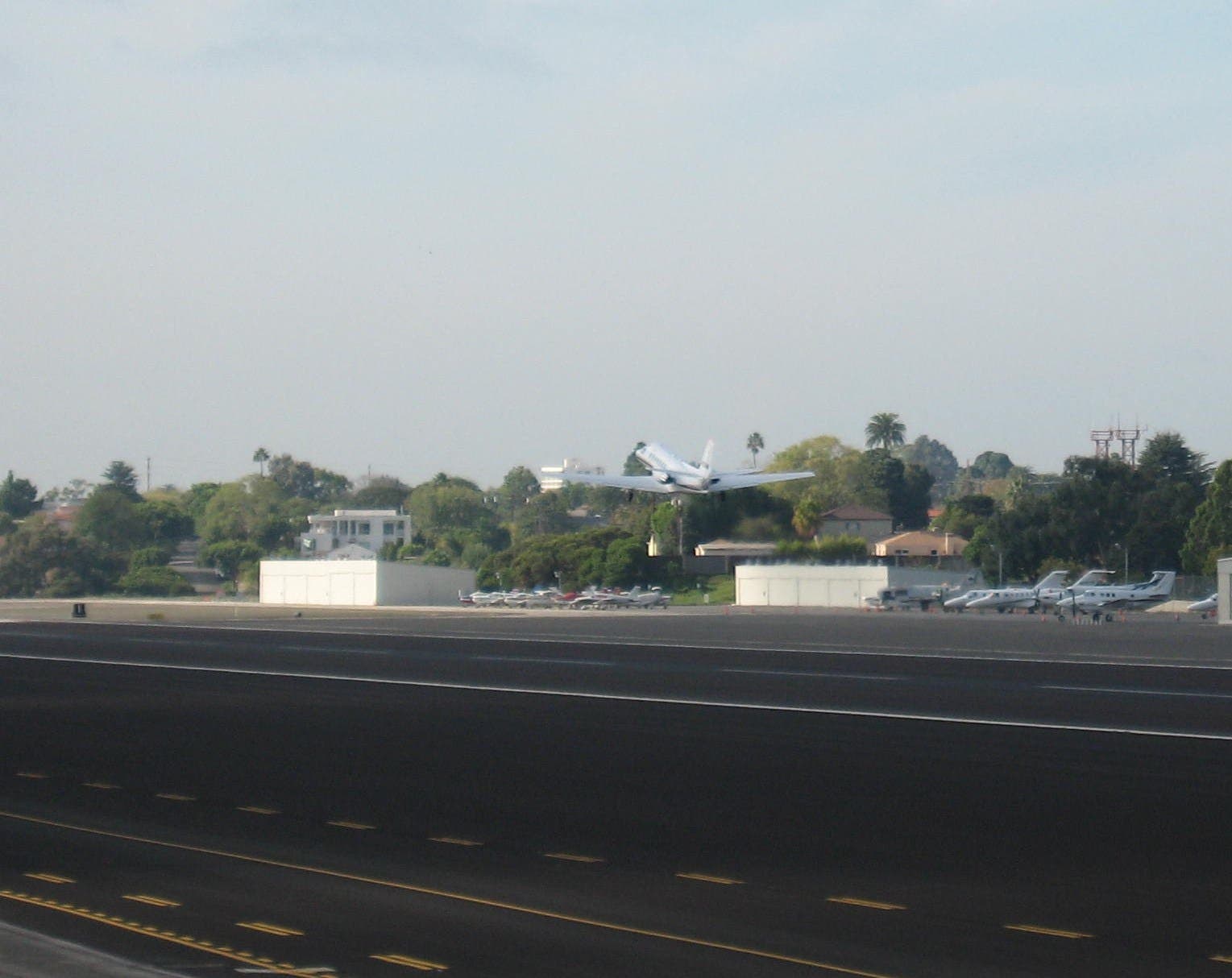
A relatively new contentious issue has neighbors on all sides of Santa Monica Airport (SMO) stirred up.
Should any “instrument flight rules” (IFR) aircraft departing to the west from Santa Monica Airport fly over Santa Monica?
Understanding the two types of ways aircraft operate; either IFR or VFR
Find out what's happening in Venice-Mar Vistafor free with the latest updates from Patch.
IFR Aircraft - An aircraft conducting flight in accordance with instrument flight rules. This includes all jets and a few propeller aircraft. All non-IFR flights operate in accordance with “visual flight rules” (VFR). VFR aircraft are not subject to IFR procedures. The vast majority of SMO operations are of the VFR category.
An old expression says, “It all comes out in the wash.” Well then, let’s load up the machine with all we know and turn it on. I hope it all comes out clean and clearer.
Find out what's happening in Venice-Mar Vistafor free with the latest updates from Patch.
Some of you may already be aware of the contention between Santa Monica and Los Angeles neighborhoods that surfaced regarding a planned altering of SMO departure routes. The FAA devised a test procedure for SMO that would require propeller driven IFR departures to turn over Santa Monica at a “250-degree” heading immediately after takeoff instead of continuing straight-out to the ocean and flying over Venice. This came as a result of the Federal Aviation Administration’s (FAA) June, 2008 change to the criteria used to evaluate obstructions and terrain, and the FAA’s March, 2009 clarified rules pertaining to Minimum Vectoring Altitudes to provide for safer clearance for aircraft operations. For more information, read the: FAA Interim Review.
Over the years I have become aware of (uncovered) certain specifics regarding Santa Monica Airport that I believe to be significant to the complete understanding of many aspects regarding the airport, an airport that historically served the nation during wartime, but now caters to the private-jets that are responsible for 90% of the officially-recorded noise violations, as well as the enormous air pollution to those who are located downwind of SMO.
Take this issue regarding the “250-degree” departure. To fully understand what this is about, we need to understand the history of the “250-degree” departure dating back to before the year 1990. I became aware that prior to 1990, the IFR departure procedure was to take the 250 degree turn immediately after departure. That is a fact that no one argues; not the City of Santa Monica; not the FAA. What is questionable though is the reason for the 1990 change and who initiated it.
I have been told on good authority that in court proceedings, the former Santa Monica Airport Director, Jeff Mathieu, testified that the City of Santa Monica requested the change to mitigate noise over Santa Monica. However, SMO’s website Airport History page states that, “In 1990 the FAA proposed an amendment to SMO’s IFR departure procedures changing the 250 degree turn “immediately after departure” to “at reaching the LAX 310 degree radial”. This change was instituted as a result of the Cerritos air crash.”
I am still eagerly waiting for the facts from the FAA and the City of Santa Monica.
In 1983, just prior to the signing of the 1984 “Santa Monica Airport Agreement” by the FAA and the City of Santa Monica, there was an average of between 1 and 2 jet takeoffs a day from SMO. The intent of 1984 Agreement was to lessen the impact of aircraft operations for all homes / neighborhoods around the airport. After the signing of the agreement SMO’s transformation was underway.
Preparations for the influx of private jets commenced. The jet center, Super Marine’s long-term lease was approved around1986.
The calm before the storm: According to Virginia Ernst, a Los Angeles resident living a mere 300 feet from the east end of SMO’s runway, In the early 1990’s millions of dollars were spent to resurface the runway to make it suitable to accommodate jets. Pilots of jets were complaining it was too bumpy when landing. The week or two when SMO was closed to work on the runway was sheer heaven Virginia told me.
Getting back to the year 1990 and the change in the departure procedure for all IFR (mostly jet) aircraft; logic has me inclined to believe that Santa Monica indeed made the request so that Santa Monica residents would be less impacted by noise, and not that it came about by an FAA amendment in response to the Cerritos crash. If the 250-degree was deemed dangerous then by the FAA, why is it now being brought back? I remain open to be corrected.
Nevertheless the 1990 change was approved and all IFR (mostly jet) aircraft were directed to fly straight out to the ocean over Venice. However, there were side effects that resulted that need to be considered. The new route caused the primary departure flight tracks from LAX and SMO to converge and conflict just west of the airports requiring all IFR (mostly jet) aircraft be held at SMO until they received permission from the LAX tower for clearance. When you couple the new hold times for jet aircraft with the coming surge in jet traffic at SMO, you produce an enormous toxic soup of jet emissions that alter the air in the downwind residential Los Angeles neighborhoods.
Los Angeles borders Santa Monica Airport to the east and to the south. However, Los Angeles has no official voice on the Santa Monica Airport Commission. In fact Santa Monica officials do not even invite Los Angeles elected officials to participate in discussions with the FAA regarding SMO operations.
How I got involved: In 1997, while doing what I love in my garden, I became aware of an awful smell. It took me awhile to realize that the odor was always accompanied by a high shrill sound, and that it was the idling jets that were the source of the sound and the stink. These awful smelling toxic fumes coming out of the rear ends of the jets were exacerbated by the 1990 change from the “250-degree” departure procedure as jets then began to sit idling on the runway waiting for clearance from the LAX control tower. As jet operations increased, frequently jets would line up in cue waiting for clearance to depart.
Before I cover how jet operations grew at SMO, there is another significant 1990 document to consider: Two pages of a Department Of Transportation (DOT) / Federal Aviation Administration (FAA) document dated 5/26/89; “SUBJ: SITING CRITERIA FOR INSTRUMENT LANDING SYSTEMS” -The top of page 2 on "Critical Jet Blast Areas" states, “...Since prolonged exposure to jet fumes is dangerous to the health of personnel working on the systems, it is also necessary to minimize this deleterious effect. Therefore, no jet aircraft shall be permitted to park or hold within 300 feet of the ILS equipment shelters, the localizer antenna array, or the glide slope antennas…”. Did the DOT/FAA and the City of Santa Monica bother to consider that Los Angeles resident Virginia Ernst lives 300 feet from the blast of every jet that takes off to the west from SMO, and that allowing thousands of private jets into SMO might be a hazard to the health of those living close by?
Ok, that’s a pretty good background on the groundwork that was done to accommodate the arrival of private jets, corporate jets, and fractional-ownership jets at SMO. Let’s look at the numbers. It is easy math. We already covered 1983 when there was an average of between 1 and 2 jet takeoffs a day. In 1990 there was an increase to between 2 and 3 jet takeoffs a day, on average [Graph of Jet growth at SMO 1983 through 2008]. That was probably enough to have residents of Santa Monica complaining to their City officials, and their City responding by asking for the flight path change discussed earlier in this article. With no figures available for the years 1991 and 1992, I imagine that it was within this time frame when millions of dollars of runway improvements took place and the airport administrators were too distracted to tally jet operations. When the tally resumed in 1993 there were almost 6 jet takeoffs a day on average. In 1997 there were between 8 and 9 jet takeoffs a day, on average and it was then that jet operations began to grow very rapidly. Coincidently, that is when I became aware that we had a problem with air pollution. Jet operations peaked in the year 2007 with 18,575 total annual jet operations. That’s on average, between 25 and 26 jet takeoffs a day. Some days there were more than 50, other days less than 20.
So from 1983 to 2007 there was an increase of 1,800%, that’s 100% times 18. Think about that in terms of interest on your financial investment. Every dollar would turn into $1,800.00. In a future article I will go into the scientific studies that surround Santa Monica Airport, but for now I want to make the point that by changing the IFR departure procedure in 1990 from the 250 degree turn immediately after departure to the 210 degree straight out to the ocean and coordinating with LAX traffic, not only were thousands of Venice residents subjected to the noise that Santa Monica residents would have had to live with, but also thousands of West Los Angeles and Mar Vista residents had their air quality converted into a toxic soup. [Click to see Home Video of Santa Monica Airport Jet Fumes]
No matter where you live in relation to SMO, residents have voiced their disturbance by the arrival and the growth of private jets. With both ends of the runway less than 300 feet from homes, there is really no way to mitigate the jet impacts. The question I feel now needs to be answered is how the City of Santa Monica will involve the City of Los Angeles to address all the complex SMO issues.