
When we look at a representational piece of artwork, we tend to look at the image as a whole first. We do that mainly because from the first glance, it makes sense to us that way. We can see what it is. This satisfies us and makes us comfortable. On closer examination, we may discover surprising details about the work that are unexpected, which then give us an additional spurt of pleasure.
But in addition to the techniques that might be used, the artist also composes the elements of the work in such a way as to keep our eyes wandering over the whole. So, our normal approach to a painting will be to look at the whole and take that in, and then start letting our eyes wander over the composition. The way the artist arranges the elements does affect how we look at the parts of the piece.
For instance, consider this famous Andrew Wyeth painting: “Christina’s World” (below)
Find out what's happening in Venice-Mar Vistafor free with the latest updates from Patch.
When we first look at this painting, we see the whole of it: the young woman in the foreground leaning forward as she looks across the meadow space at the distant house and barn. But once we have taken that in, we come back to looking at the figure and the lines of her body, the forward leaning shapes that point up the canvas at the house. Our eyes then move upward to the larger bulk of the house, and then almost immediately to the gap between the buildings. The composition makes us look into an “empty” space without our noticing – we look beyond the boundaries of “Christina’s World.” And we feel something about it without thinking.
That is what art of any sort wants to do: to make us feel before thinking.
Find out what's happening in Venice-Mar Vistafor free with the latest updates from Patch.
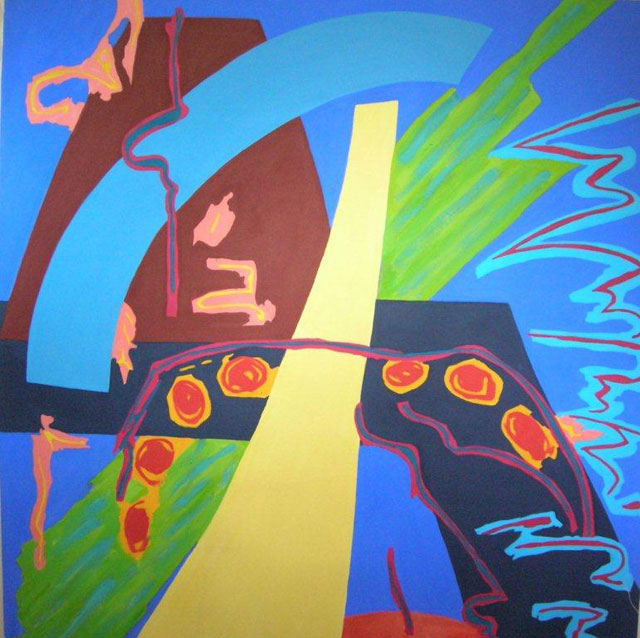
Our tendency to try and see the whole first gets confused when we first encounter abstract art. We want to make sense of the whole before we consider the elements. But much abstract art defies that impulse. It doesn’t seem to make sense as a whole. So we have to learn to let the elements speak to us, to first let our eyes roam where the composition takes us. Only after we do that can we step back and see the whole and go “Oh! Now I get it.”
Take a look at this Abstract Art piece by Diana Hobson, titled “All the Stops.” (see below)
She takes your eyes somewhere.
As an aside, the phrase “all the stops” or “pulling out all the stops” comes from music, specifically pipe organs. In the pipe organ, the control that lets the air blow through a specific type of pipe is called a “stop.” When the stop is pushed in, no air will go through any of the pipes of that particular sort. There are thin metal pipes that sound like flutes, and squared wooden pipes that have reeds at their ends that can sound like oboes. There are many varieties of pipes. So, when the organist pulls out a stop, all the pipes of that type will sound their notes when the appropriate key is played. To “pull out all the stops” means that the organist is going to make a Very Big Noise that will rock the listeners to their bones.
Notes:
“Christina’s World”, by Andrew Wyeth, 1948 is from the collection of the Museum of Modern Art in New York City. Its reproduction here is under Fair Use practices for the purpose of commentary and instruction.
“All the Stops” by Diana Hobson is copyright by Diana Hobson. Reproduced by permission.
@@
TAGS: Andrew Wyeth, Diana Hobson, Christina’s World, All the Stops, composition