

MEETING ABSTRACT ART
For many people the words “abstract art” automatically trigger a “back-away” reaction. People feel uncertain about how to look at and understand abstract art. Nobody has ever taken the time to explain how to really look at works that are different from traditional representational art. So, hold onto your hats, we going to give it a whirl here.
First off, consider the word “abstract.” It means to pulls something out of something else. When you do this in art, you are pulling out elements of what you see in order to consider them separately, as something in and of themselves. Traditional representational art likes to look at things as a whole, giving the viewer the artist’s personal perception of something they see; a face, a landscape, or a still life arrangement. But abstract art doesn’t do that. Instead, the artist is considering in a visual way a particular element of experience, isolating it from the “whole picture” in order to consider it as a think in itself.
Find out what's happening in Venice-Mar Vistafor free with the latest updates from Patch.
Sometimes, an artist will create an image that deals with a specific aspect of what they see. They might even entitle the piece with something that does not even seem to connect with what the viewer sees in the work. But some artists do not title their works randomly, so the viewer does need to consider what the artist is suggesting with the title.
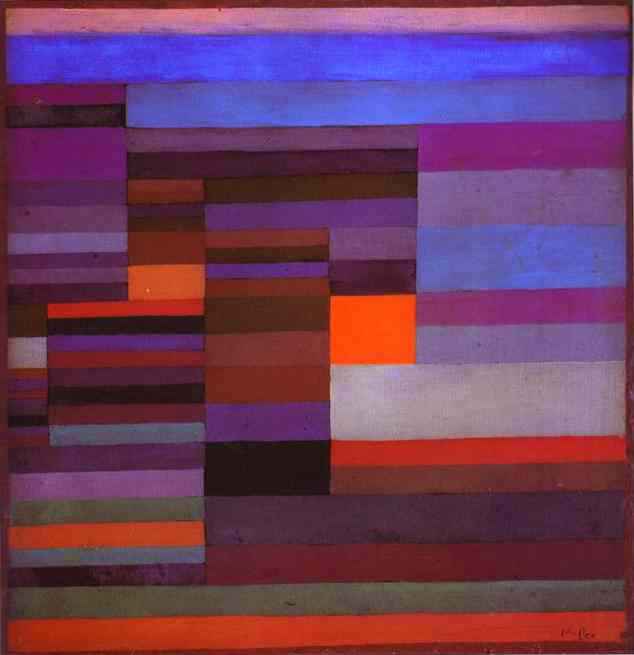
For instance, one of Paul Klee’s abstract works is titled “Fire in the Evening” (or in the original French, “Le Feu le Soir”).
Find out what's happening in Venice-Mar Vistafor free with the latest updates from Patch.
See above photo by Klee - Fire in the Evening
Your first reaction might be to ask “How are all these blocks supposed to be “fire in the evening”? But consider the painting in conjunction of a photo of a wildfire taken apparently around dusk.
See above photo of wildfire by Waldbrand
The colors of evening now stand out in Klee’s painting, as well as the hot spots of the fire. He has abstracted the colors of the thing he was contemplated (fire in the evening) and arranged them as blocks. That is how you look at abstract art.
Diana Hobson has been creating abstract works for over four decades. She brings a lot of personal energy to her works, with vivid movement in the elements and bold colors in her presentation. Take a look at this piece, titled “Dark Wind”.
See above photo of Dark Wind by Diana Hobson
Abstract art can change your perception of non-visual aspects of the world around you. The next time you are out on a breezy evening, think about this image that Diana has captured. Perhaps you will be able to feel it around you. In the meantime, enjoy the painting!
Notes:
Image of Paul Klee’s “Fire in the Evening” (“Le Feu le Soir”) from Wikimedia Commons. The painting is owned by the Museum of Modern Art.
Photo of the wildfire: “Waldbrand.jpg” from Wikimedia Commons, photo taken by Todd Heitkamp, from the NOAA website.
Diana Hobson’s “Dark Wind”, copyright D. Hobson, 2011. Oil on canvas