Community Corner
Parents Eat School Lunch
Parents went to school to try out LAUSD's new menu to mixed reviews.
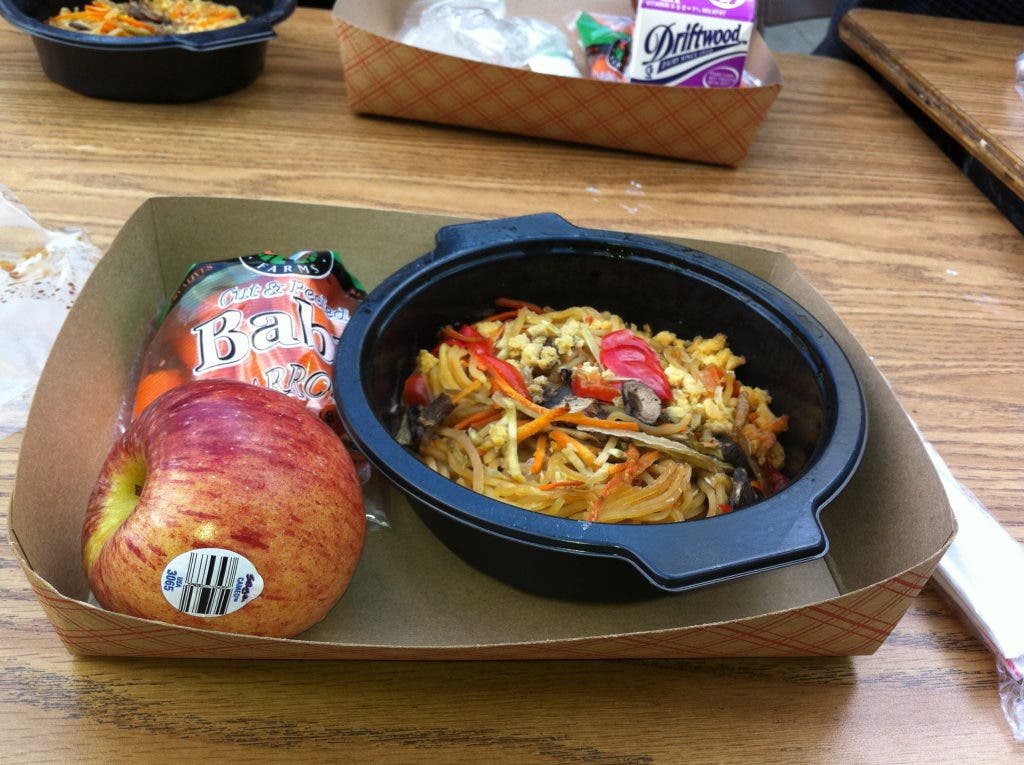


Recently about a dozen parents at did something rather unusual. They ate lunch in the school cafeteria to sample LAUSD’s new healthier menu. The school district is making a major effort to revamp its menu to respond to rising rates of childhood obesity and declining fitness among students.
Chocolate milk is gone. Now the choices are low fat or lactose-free milk. Deep fried foods have been banished as well Cheese and potatoes are allowed only in limited quantity. The emphasis is on adding more vegetables, whole grains and un-processed food. In creating the new menu, the district is also seeking to broaden the variety of foods it serves and pique children’s tastes with spices and dishes from different parts of the world.
This all sounds great, but many parents at Walgrove (where my kids are students) have been hearing nothing but complaints from their children about the new menu. Many of the kids miss pizza, grilled cheese, curly fries and chicken nuggets. Their parents wanted to find out for themselves how the new dishes tasted.
Find out what's happening in Venice-Mar Vistafor free with the latest updates from Patch.
Chandra Epps, the school cafeteria manager gamely made arrangements to order extra food for parents (who paid for their meals) to come to school and give the menu a try. She also provided us with forms to give feedback to the district on the menu and met with us afterward to answer questions.
On the day we went the cafeteria was serving “seasoned chicken” or “vegetable chow mein” with a choice of whole fruit, a slice of whole wheat bread and a package of cut carrots with ranch dressing.
Find out what's happening in Venice-Mar Vistafor free with the latest updates from Patch.
The reviews from parents were mixed. Stacy Boggeri said the seasoned chicken was better than she expected it to be. But parent Joe Falzarano thought it lacked flavor. Glenn Bell said he liked “that you can see that it's chicken” and he appreciates that on the new menu he can “recognize every ingredient.” Mother, Akuwa Owusu-Ansah said she thought it was “mediocre” and “not very appetizing.” And yet another mother, Ruth Handel pointed out that it’s difficult to eat a whole piece of chicken on the bone with nothing but a plastic spork.
I had the chow mein, which didn’t win a lot of enthusiasm either. I thought it mostly tasted like soy sauce and it was much more noodles than vegetables. One of my kids tried it and said he liked it. He ate most of mine.
The parents all agreed that the apples and carrots were the best part of the meal but those who took the pears were sorry. They were hard and flavorless because they were under-ripe.
Epps explained that she too is struggling with the new menus. She says waste has increased and that she isn’t always sure how much of each item to order because she can’t base her orders on past experience. As a result, popular items are sometimes gone by the time later lunch periods roll around and the food that is there goes uneaten.
Parents agreed that it’s good that the district is trying to improve the quality and healthfulness of the food they serve, but the obstacles are significant. At $1 a meal, it’s tough to get great ingredients. Food that is cooked in a central kitchen and reheated in its individual packaging on campus is not going to be beautiful or necessarily the right temperature. And while some kids may love spices or unfamiliar ethnic dishes, others are committed to eating bland American kid-fare and will refuse to try anything with an exotic name.
Still, the parents hope that the district will read and respond to their feedback. They also hope their kids will remember seeing them at school trying the cafeteria lunch and will perhaps feel inspired to try something different from the menu themselves.