Schools
Murwood School Celebrates Diverse Abilities
Hands-on activities get young minds thinking about peers with visual impairment, attention deficit, speech impairment and other challenges.




Students feasted on a smorgasbord of hands-on exercises that stimulated diverse ability awareness Wednesday at Murwood Elementary School.
Murwood's second annual Diverse Ability Day had parent volunteers and educators leading groups of students through a series of stations in the cafeteria-auditorium with tasks to simulate:
- visual impairment;
- sensory overload;
- physical disability;
- speech impairment;
- auditory process;
- fine motor challenges; and
- dyslexia.
"It's all about embracing the differences," said Kym Frietzsche, parent of an autistic Murwood third-grader, Drew, and an organizer of Wednesday's event.
Parent Elizabeth Boegel led groups in exploring sensory overload. After kindergartners lined up, Boegel had the line pinch in close to one student to promote awareness of how someone might feel uncomfortable.
"She's going to get grumpy," Boegel told the group. The compressed student who was told she was going to get grumpy grinned. (And so it goes.)
At another station, students were enlightened about the dizziness of dyslexia by trying to trace over a geometric diagram using a mirror box — seeing only the mirror image of their hands tracing the lines.
The next station was visual impairment, where giggling students donned taped-over eyeglasses and tried to read letters on a poster. They also got to feel the bumps of the letters on a Braille card.
Principal Lisa Cheney, in her Wednesday message on the Murwood website, asked parents to ask their children what they learned in the awareness exercises: "Now that you understand better, do you feel more comfortable with children who act differently? What can you do if you see someone being teased or sitting by themselves?"
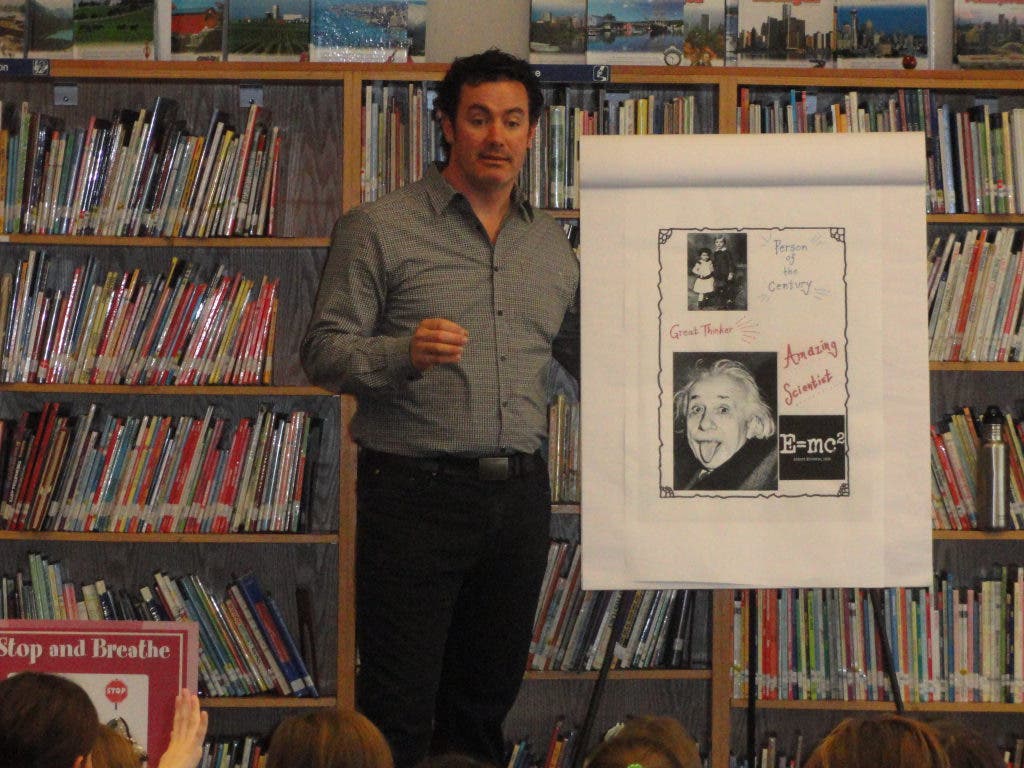
Daniel Bruno, facilitator of the school's character education program, the Soul Shoppe, guided discussions for large groups in the library about famous people with learning disabilities who were teased when they were schoolchildren — physicist Albert Einstein; baseball player Andres Torres, diagnosed with Attention Deficity Hyperactivity Disorder, who was an integral part of the San Francisco Giants' world championship in 2010; and children's book author Patricia Polacco, who copes with dyslexia.
Polacco, said Bruno, "didn't learn to read until she was 14 … She got bullied and picked on a lot." Now she writes (and illustrates) for a living.
Bruno gave the young minds plenty to think about. "What if too many people had told Albert Einstein he was dumb?" he said. "Maybe he wouldn't have had the confidence to do what he did."
After their awareness sessions, students were awarded with "I can wait" buttons. They are designed to provoke questions that promote awareness — if you're with someone who needs more time to accomplish a given task, you can wait.
Get more local news delivered straight to your inbox. Sign up for free Patch newsletters and alerts.